
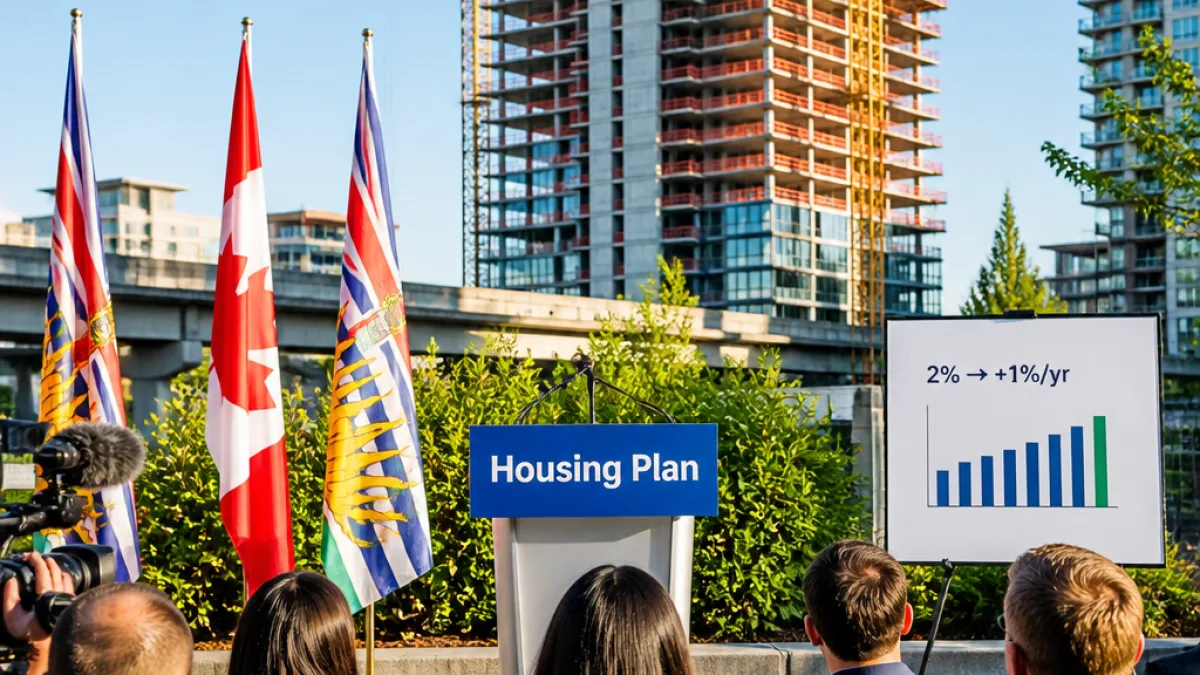
At a campaign stop in Burnaby on Friday, B.C. Premier David Eby proposed a new levy on completed condominium units that remain empty for more than a year, part of a broader push by the NDP to address housing affordability ahead of the Oct. 24 provincial election.
Tax designed to push developers to sell
Eby said the tax would begin at 2 per cent of the assessed value for a finished unit left unsold for one year and would rise by 1 percentage point for each additional year it remained empty. The leader argued the measure would prompt developers to sell or lower prices rather than wait for market conditions to improve.
Speaking with a condo complex under construction behind him, Eby cited an industry analysis by Real Property Data that he said found “thousands of unsold units worth $4.4 billion” sitting empty across Metro Vancouver. The premier said his government’s proposal could unlock roughly 5,000 condos for occupancy.
“We will intervene. We will stand up for British Columbians, just like we stand up to (U.S. President Donald) Trump, stand up to developers. We will stand up for the families, who are struggling with affordability.”
The proposed tax would apply only to completed units, not to developments still under construction, and would target inventory that is physically ready for people to move into but has remained vacant.
Context and competing plans
The announcement comes as governments at both the provincial and federal level consider other approaches to bring vacant units into the long-term housing stock. Eby’s remarks follow ongoing discussion about a joint federal-provincial proposal to buy more than 2,220 vacant condominiums in B.C. and convert them into affordable homes.
Housing affordability remains a flashpoint in the province, particularly in the Lower Mainland, where high prices and low rental availability have placed pressure on renters and prospective buyers. The premier framed the tax as a direct intervention intended to stop developers from “sitting on” completed units while families continue to face high costs.
How the levy would work
Details about implementation, exemptions and whether the tax would apply provincewide or be focused on specific regions were not provided in full on Friday. Eby said the levy would be introduced by an NDP government if his party is re-elected.
- Starting rate: 2% on assessed value after one year of vacancy
- Escalation: +1 percentage point for each additional year empty
- Estimated impact: Eby said the policy could free about 5,000 units valued at roughly $4.4 billion
| Years vacant | Annual tax rate (on assessed value) |
|---|---|
| 1 year | 2% |
| 2 years | 3% |
| 3 years | 4% |
Reaction and unanswered questions
On the campaign trail, Eby framed the proposal as a way to protect families and address the supply of move-in-ready units. He argued that developers with deep pockets can delay sales until prices rise, while households cannot afford to wait.
Several details remain unresolved: how assessed values will be determined for the tax, whether smaller projects or certain types of units would be exempt, what appeal mechanisms would exist for developers, and how revenue from the tax would be used.
Thursday’s announcement also raises questions about the wider market effect. Economists and developers have in other contexts warned that punitive levies can deter future construction or be passed on in other costs, but Eby’s office framed the proposal as a targeted intervention to unlock existing supply rather than a demand-side measure.
What this means for buyers, renters and builders
For prospective buyers and renters, the tax is intended to increase the number of units available immediately on the market, potentially easing short-term pressure on prices and vacancy rates. For developers, it would introduce a cost for completed units that remain unsold beyond a year, altering the calculus of holding inventory.
With the province now in a snap campaign, the proposal is likely to become a focal point in debates over housing policy, development incentives and government intervention in real estate markets. Voters and industry stakeholders will be watching for more specifics and for responses from other parties as the Oct. 24 election approaches.
















