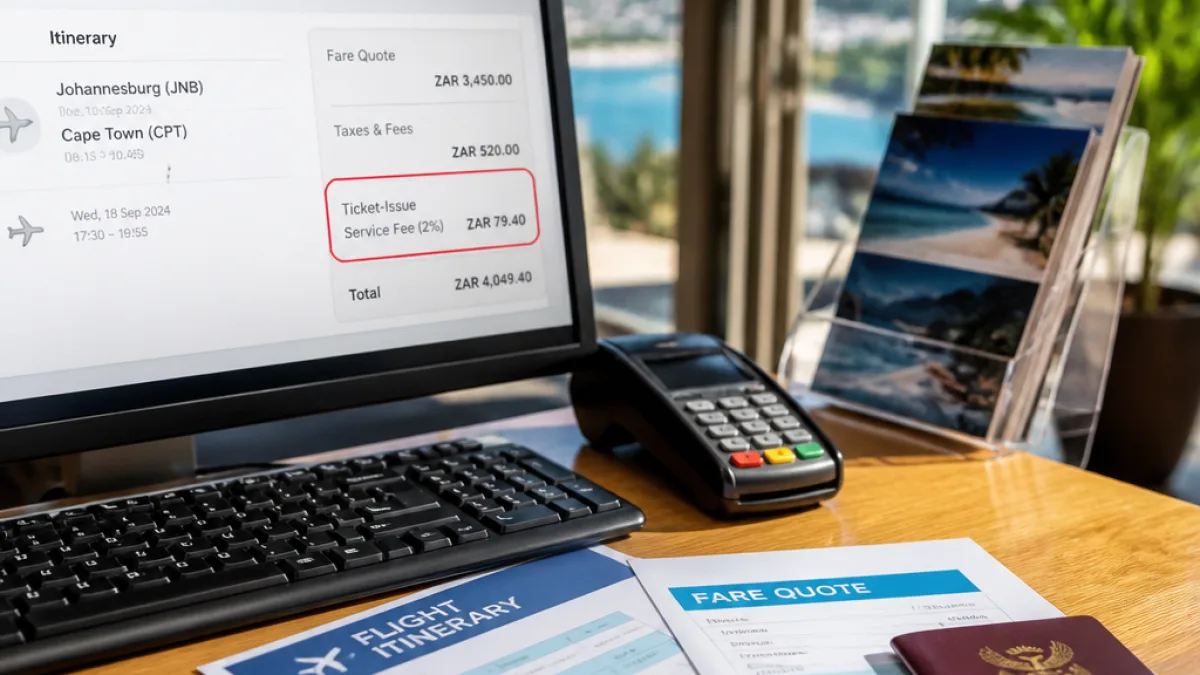
South African travel agencies are facing closer scrutiny of the costs attached to booking platforms, ticketing systems and travel content, after FlightsiteAgent changed how it applies a 2% charge. The adjustment has prompted wider discussion about whether these expenses reduce agencies’ margins, how the value of booking technology is measured and how the costs may eventually be reflected in the price paid by travellers.
The fee was initially linked to credit-card payments. It has since been redesigned as a service charge applied when a ticket is issued, irrespective of the payment method used. The change places the focus on the work and infrastructure involved in completing a booking, rather than only on the method used to settle the transaction.
What has changed?
Andy Hedley, chief executive of the TravelLab Group, which includes FlightsiteAgent, said the charge supports a wider package of services. These include the administration required for ticketing, the infrastructure behind the booking platform, software improvements, negotiations with suppliers and the operational work involved in issuing and managing tickets.
“The current structure applies a standard service fee at ticket issuance, across all forms of payment, reflecting the platform, commercial benefits and support services available, regardless of how a booking is paid for.”
For travellers, the practical lesson is that the amount paid for a ticket may not represent the full cost of arranging the journey. Depending on the agency and its commercial model, expenses can be recovered through the selling price, commissions or separate service fees. Customers comparing quotes may therefore need to check whether a booking includes an agency service charge, rather than looking only at the advertised fare.
| Previous approach | Current approach |
|---|---|
| Charge linked to credit-card payments | Standard 2% service fee at ticket issuance |
| Payment method was central to the charge | Fee applies across payment methods |
The cost of the tools behind a booking
Riaan van Schoor, chief executive of Agentivity, said booking platforms require substantial investment and that agencies should be prepared to pay for the technology they use. He argued that the established financial relationship between airlines, global distribution systems and agencies needs to change, giving agencies more control over the tools on which they depend.
His view also highlights the labour that can sit behind a seemingly simple flight booking. An agent may help a client compare options, manage ticketing, communicate with suppliers and deal with changes or administration. Van Schoor said agencies should charge for that work, noting that some still impose only a ticketing fee despite providing a broader service.
A more complicated distribution chain
Travel agencies do not rely on a single route to obtain travel content. The available channels include traditional global distribution systems, global distribution system-connected New Distribution Capability services, NDC aggregators, direct airline links, hotel aggregators and car-rental platforms. Each channel can have its own commercial terms and costs.
- Booking platforms provide the digital infrastructure used to search, reserve and manage travel.
- Distribution channels connect agencies with airlines, accommodation providers and other suppliers.
- Service fees can help cover administration and advice that are not fully reflected in a ticket commission.
- Clear pricing allows travellers to understand what they are paying for before confirming a booking.
The debate is consequently bigger than one company’s fee structure. It concerns how travel businesses pay for the systems that make bookings possible and how agencies remain viable while offering support to clients. For customers, transparent explanations of charges can make it easier to compare an agency’s service with a direct booking and to decide whether the assistance provided is worth the additional cost.
As travel businesses weigh the efficiency and support offered by different platforms, agencies will have to balance technology expenses with competitive pricing. Travellers, meanwhile, can protect their budgets by asking for an itemised quote that separates the fare, taxes and any agency or platform-related service charge before payment is made.