
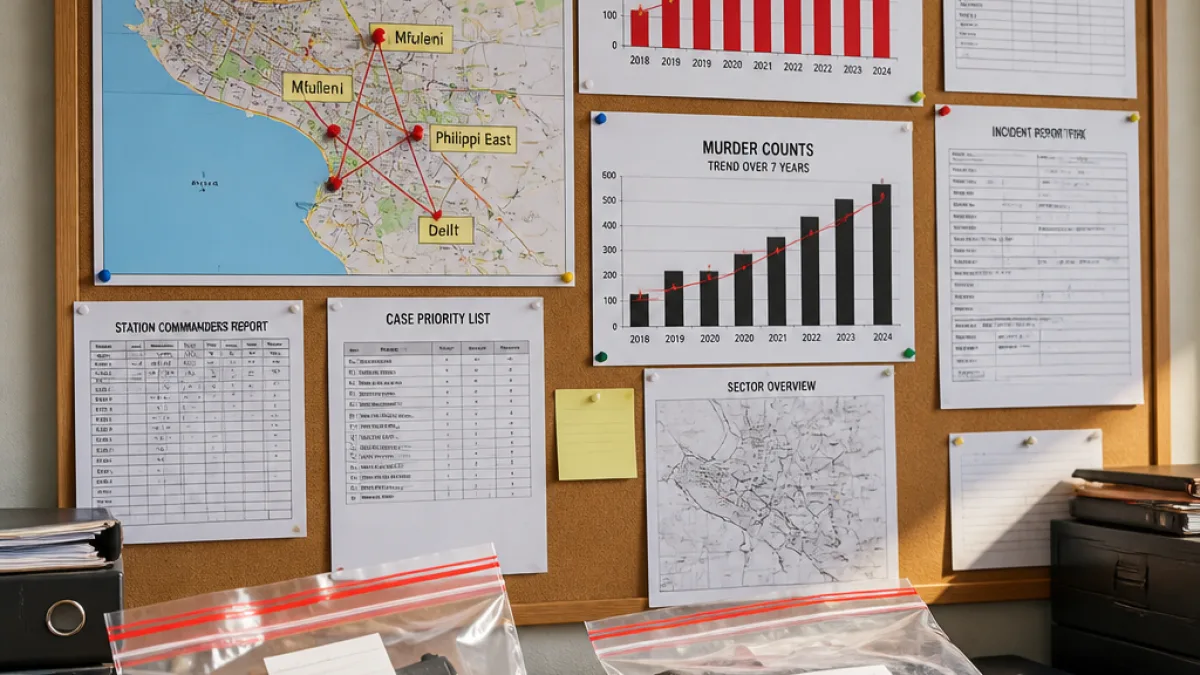
The Western Cape recorded a disproportionate burden of violent crime in the first quarter of the 2026/27 financial year, with police stations across the province featuring prominently in national rankings for murder and other serious offences, according to published crime data for April to June 2026.
Sharp concentration of killings in metro areas
During the three-month reporting period, the province recorded 1,071 murders, of which 869 occurred in the City of Cape Town district. Several Cape Town stations rank among the highest nationally for murders and for a broader category of 17 community-reported serious crimes.
Nationally prominent Western Cape stations in the murder rankings include:
- Mfuleni — 73 murders (ranked 1 nationally)
- Nyanga — 56 murders (ranked 3)
- Philippi East — 53 murders (ranked 4)
- Delft — 53 murders (ranked 5)
- Harare — 49 murders (ranked 6)
- Khayelitsha — 44 murders (ranked 10)
- Kraaifontein — 43 murders (ranked 11)
- Gugulethu — 37 murders (ranked 16)
- Mitchell’s Plain — 30 murders (ranked 27)
| Station | Murders (Apr–Jun 2026) | National rank |
|---|---|---|
| Mfuleni | 73 | 1 |
| Nyanga | 56 | 3 |
| Philippi East | 53 | 4 |
| Delft | 53 | 5 |
| Harare | 49 | 6 |
Serious-crime burden and policing focus
The statistics also placed several Western Cape stations high in the aggregated category of 17 community-reported serious crimes. Cape Town Central led the national list with 2,559 cases, followed by Mitchell’s Plain (1,619), Mfuleni (1,584), Delft (1,541), Kraaifontein (1,491) and Worcester (1,228).
Western Cape Provincial Commissioner Lieutenant-General Sizakhele Dyantyi pointed to firearms as central to the province’s violence, and set out policing priorities in response. As he told reporters,
“In this Province the weapon of choice remains firearms in the commission of violent crimes. Our job is to rid communities of illegal firearms and ammunition through targeted operations.”
Police figures released alongside the crime report show that 610 firearms were confiscated in the Western Cape between April and June, while 792 cases of illegal possession of firearms and ammunition were recorded in the quarter, down slightly from 821 in the same period last year.
What the numbers mean for communities
The concentration of murders and serious crimes in particular precincts underlines deep, localised security challenges. Community leaders and civil-society groups have long argued that hotspots reflect a mix of entrenched poverty, gang activity, drug markets and the availability of illegal weapons. The official statistics make clear that violent deaths are not evenly distributed but are clustered in townships and poorer suburbs of the metro.
Policing responses described by the provincial commissioner include a combination of overt operations, covert intelligence-led interventions and targeted firearms seizures. These actions aim to disrupt criminal networks and remove weapons from circulation, but they require sustained intelligence, prosecution and community cooperation to translate into longer-term reductions in killings.
Where policy and policing must connect
Reducing murder and serious crime will also demand coordinated support from other arms of government: social services to address drivers of violence, education and youth employment programmes to offer alternatives to gang recruitment, and investment in community policing resources. The statistics released for April–June provide a snapshot that should prompt closer local planning by precinct commanders and municipal partners.
For residents, the immediate practical measures are familiar: remain vigilant, report illegal firearms and suspicious activity to the local police, and engage with community structures such as neighbourhood watches and CPF forums. Where trust in policing is weak, civil society and municipal leaders should press for clearer plans and measurable outcomes from law-enforcement operations.
The figures for the first quarter of 2026/27 serve as a reminder that while Cape Town’s beauty remains visible in many parts of the city, parts of the metro continue to bear a heavy cost from violence. How effectively the provincial and national policing apparatus, together with municipal and community actors, turn those numbers around will be a test of public safety policy in the year ahead.













