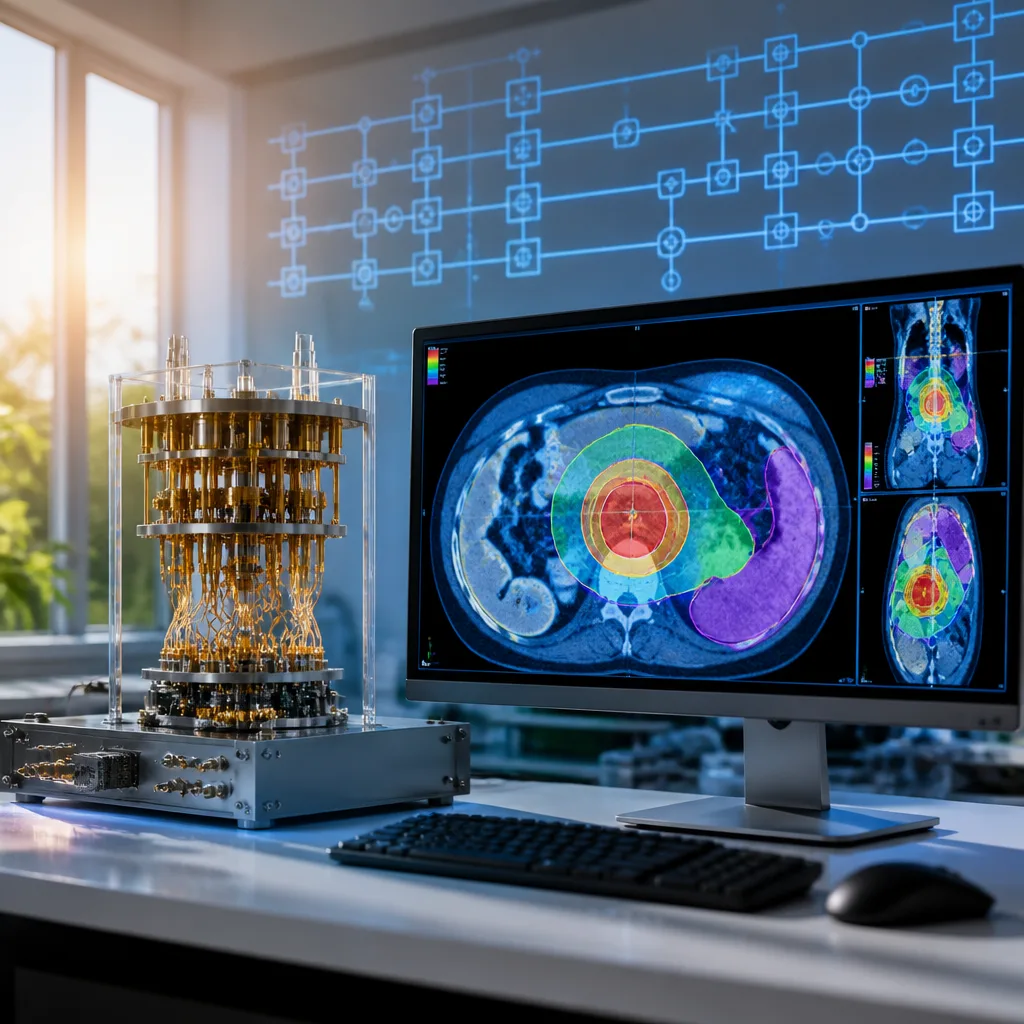
Researchers at the University of Southern California are investigating how quantum computing combined with artificial intelligence could improve the accuracy of medical imaging used to diagnose and plan treatment for cancer.
What the team is doing
The work, led by Amir Kalev, a lead quantum scientist at USC Viterbi’s Information Sciences Institute and an adjunct research professor in USC’s Department of Physics and Astronomy, tests whether a hybrid quantum‑classical approach can help AI systems perform one of medical imaging’s most exacting tasks: image segmentation. Image segmentation is the pixel‑level tracing of structures — in this case tumours — that separates diseased tissue from surrounding healthy tissue.
The researchers argue that, because many clinical decisions depend on very precise boundaries, improved segmentation could enable surgeons and radiation oncologists to target tumours more accurately, spare nearby organs and better measure whether treatments are working. Kalev told the team they concentrated on healthcare because, he said, “medical imaging is an area where precise predictions are essential.”
Why segmentation matters
Image segmentation does more than identify a lesion: it defines where it starts and stops. That matters for:
- radiation planning, where beam placement depends on tumour contours;
- surgical planning, where the extent of resection balances removing disease with preserving function;
- response assessment, where small changes in measured tumour volume indicate whether therapy is effective.
Better segmentation therefore has the potential to improve outcomes and quality of life by reducing unnecessary damage to healthy tissue.
Quantum computing’s proposed role
Quantum computing leverages quantum‑mechanical phenomena to process certain types of information differently from classical computers. In this project the team is not claiming quantum supremacy or that quantum devices will replace existing computers. Instead, they are exploring whether quantum processors, used together with classical AI, can enhance particular computations involved in analysing images.
The research is early stage. The team has developed methods that combine quantum and classical algorithms to tackle image analysis problems, with the hope that this hybrid model will improve the precision of segmentation produced by AI systems. At present the work lays groundwork rather than delivering a clinical product.
Potential benefits and caveats
If the hybrid approach yields consistent improvements, clinicians could gain a clearer map of tumour boundaries, which may:
- allow tighter radiation fields and less collateral tissue damage;
- help surgeons plan more conservative operations when appropriate;
- improve objective measures of treatment response.
But the team and others caution that this is preliminary research. Translating algorithmic gains into clinical benefit requires rigorous validation on large, representative datasets, regulatory review and careful testing across different scanning machines and patient populations. The promise of quantum computing in healthcare is substantial, but must be appraised against safety, reliability and reproducibility — the very questions that guide adoption of any new medical technology.
Context and next steps
Medical imaging already uses a range of modalities that clinicians combine when assessing disease. Common imaging types include:
| Modality | Typical use in cancer |
|---|---|
| MRI | Soft‑tissue contrast, brain, liver, prostate imaging |
| CT | Bone and chest imaging, staging, radiotherapy planning |
| Ultrasound | Real‑time imaging for biopsies and some organ assessments |
The USC group’s research focuses on how AI can better interpret scans from these modalities, with quantum computing augmenting particular computational steps. The investigators characterise the work as an early but promising pathway: developing algorithms, testing them on imaging tasks and assessing whether quantum components enhance performance compared with classical approaches alone.
For South African clinicians and policymakers, the development is worth watching. Advances that improve segmentation and imaging interpretation could eventually be adopted in hospitals here, but only after robust evidence demonstrates consistent clinical benefit and the tools meet regulatory standards. In the short term, the work illustrates a broader trend: researchers are exploring hybrid methods that pair emerging quantum hardware with mature AI techniques to address tightly defined, high‑value problems in medicine.
“We chose to focus on healthcare because medical imaging is an area where precise predictions are essential,”
That precision‑focused aim is the measurement by which this line of inquiry will be judged: does the quantum‑AI combination make predictions measurably more accurate and reliable in real clinical contexts? The answer will determine whether it moves from laboratory promise to a practical tool for clinicians.