
Klapmuts operation highlights role of canine unit in local drug enforcement
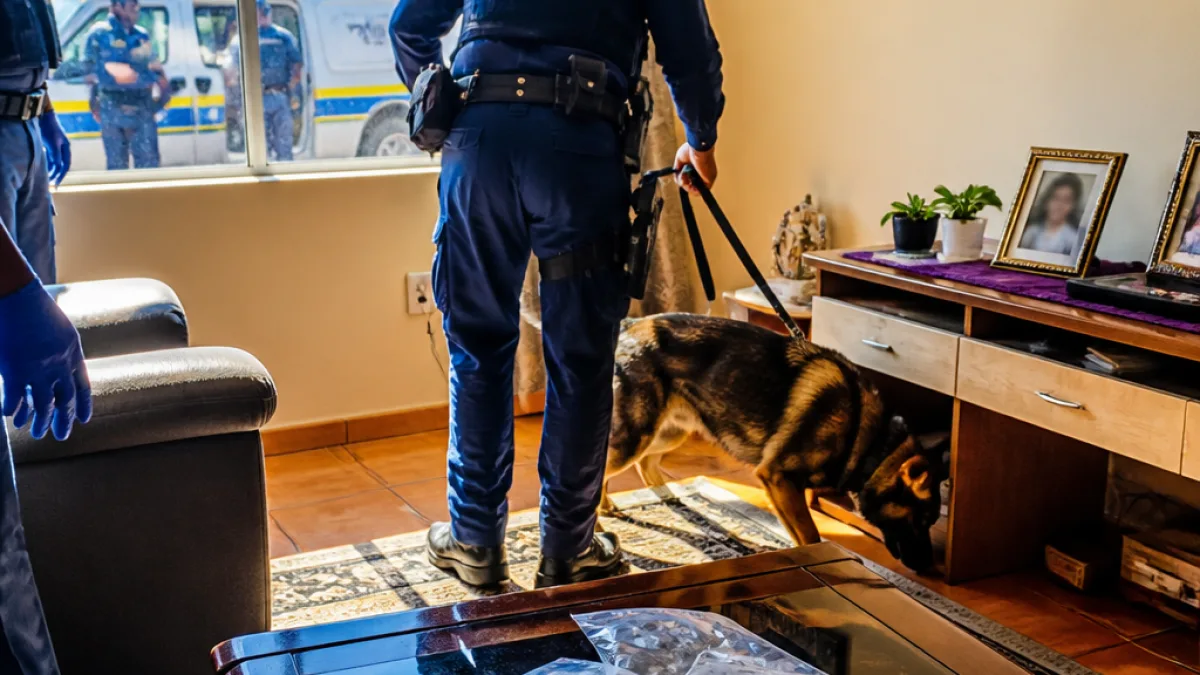
An operation in Klapmuts this past weekend that brought together Klapmuts police and Stellenbosch municipal law-enforcement officers recovered a small but significant quantity of illegal drugs after a specially trained police dog, K9 Juno, detected narcotics concealed beneath a cupboard.
Stellenbosch Municipality said the search yielded 36 half Mandrax tablets, 8 quarter tablets, one full Mandrax tablet and 38 bankies of tik, with the total value estimated at about R2 800. An adult male was arrested and is expected to face charges relating to the possession of illegal substances.
"The search resulted in the seizure of 36 half Mandrax tablets, eight quarter tablets, one full Mandrax tablet and 38 bankies of tik, with the total value estimated at about R2 800," the municipality said.
The operation followed information received about suspected drug activity in the area. According to the municipality, K9 Juno located the drugs and the arrest was made during the search. The municipality noted that Juno had recently assisted in another drug bust in Cloetesville.
- Partners involved: Klapmuts police and Stellenbosch municipal law enforcement.
- Canine unit: K9 Juno located the concealed drugs.
- Seizure: various formulations of mandrax and tik; an arrest was effected.
- Value: approximately R2 800.
Municipal officials said the K9 programme has not yet been officially launched but will be rolled out to additional areas to strengthen local enforcement efforts. The introduction of canine units forms part of broader attempts by the municipality to support policing operations and combat the local drug trade.
For Stellenbosch residents, the deployment points to two immediate consequences. First, small-scale dealers operating in neighbourhoods such as Klapmuts and Cloetesville can expect heightened enforcement as the K9 unit is expanded. Second, municipal involvement in search operations signals closer coordination between local government law-enforcement teams and SAPS formations at station level.
Law-enforcement sources routinely say coordinated operations can disrupt local supply chains even when seizures are modest by street-value standards. A combined approach — intelligence-driven raids, visible patrols and targeted policing — is intended to raise the operational cost for those trafficking in controlled substances and, ideally, to reduce harm in communities where drug use and trading are visible.
| Item | Quantity |
|---|---|
| Half Mandrax tablets | 36 |
| Quarter Mandrax tablets | 8 |
| Full Mandrax tablets | 1 |
| Bankies of tik | 38 |
| Estimated value | R2 800 |
Civic leaders and community safety structures in Stellenbosch have in recent years called for more visible policing and better resourcing of local law-enforcement. The municipality’s statement that the canine capability will be deployed more widely responds to that demand, but it also raises practical questions about training, oversight and sustainability.
Canine units require ongoing investment: handlers must be trained; dogs need veterinary care and maintenance; and operations must be planned to avoid civil-rights concerns. Municipalities that add such capabilities typically note that the dogs are force multipliers — they can search quickly, reduce risk to officers and provide clear cause for searches — but they are most effective when paired with sustained community engagement, social services and addiction support where needed.
For now, Klapmuts residents will see an immediate operational outcome: a suspect in custody and a small cache of drugs removed from circulation. The broader test for Stellenbosch’s K9 initiative will be whether the programme is expanded with appropriate resourcing and community-facing measures so that enforcement forms part of a comprehensive approach to reducing drug-related harms.
Stellenbosch Municipality and Klapmuts police provided the information contained in this report.













