
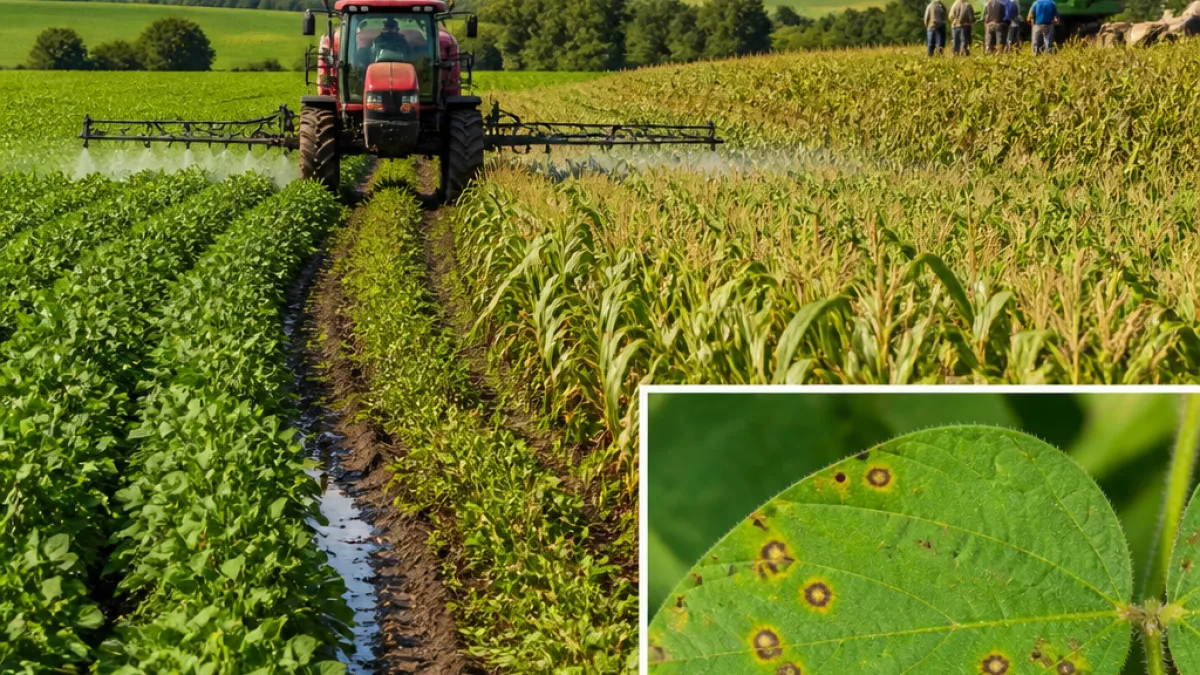
Uneven planting and wetter conditions have left a northwest Ohio farm managing a wide mix of crop stages and increased disease pressure, the grower said, underscoring the challenges facing producers as they move into late summer crop care.
Planting spread complicates disease management
Justin Gravatt, a farmer in Union County, told Brownfield Ag News he has been applying fungicide to manage emerging leaf diseases on soybeans after a season of staggered plantings. He said fields range from beans planted in the last week of April through to double‑cropped beans planted in July.
“I’ve got beans that we planted the last week of April, the second week of May, the first week of June, plus the double crops in July. There is a little bit of frog eye leaf spot starting in the beans, so it could be rough cutting them this fall.”
Gravatt said he recently completed a second fungicide application. The mixed maturity across fields makes timing spray applications and scouting more complicated, because younger and older stands require different management and have different risk windows for disease development.
Crop progress — where the USDA stands
The latest USDA crop progress and condition figures referenced by Gravatt show much of Ohio’s corn and soybean crops are advanced, but not uniformly mature. Below are the headline numbers from the USDA update cited by the farmer:
- Corn: 95% silking, 56% in dough, 7% dented.
- Soybeans: 95% blooming, 71% setting pods.
- Crop condition ratings: Corn 62% rated good to excellent; soybeans 59% rated good to excellent.
- Oats: 83% harvested and rated 84% good to excellent.
| Crop | Key stage | Good–Excellent rating |
|---|---|---|
| Corn | 95% silking; 56% dough; 7% dented | 62% |
| Soybeans | 95% blooming; 71% setting pods | 59% |
| Oats | 83% harvested | 84% |
While the statewide numbers suggest a generally healthy crop, Gravatt noted local variation within his own acres. Some corn fields were replanted late and are now only just starting to tassel and set ears. Those later fields have also experienced wetter conditions than the earlier planted corn, he said.
Implications for harvest and quality
The combination of staggered planting dates and emerging diseases such as frog eye leaf spot in soybeans can increase costs and complicate harvest logistics. Multiple fungicide passes add expense and labour requirements, and mixed maturity means harvest will be spread over a longer period, potentially exposing crop to variable weather and quality risks.
For farmers managing widely differing crop ages, scouting each block frequently is vital to target inputs where they will be most effective. Applying fungicide too early on later‑maturing beans can leave them vulnerable later in the season, while older stands may already be past critical infection windows.
Practical points for producers
- Prioritise scouting by field age and disease susceptibility rather than treating entire farms uniformly.
- Consider fungicide timing carefully — apply when disease risk and crop stage align, not solely to follow a calendar schedule.
- Plan harvest logistics to handle a stretched window, including contractor availability and drying capacity for corn at different maturities.
Gravatt farms corn, soybeans and wheat in Union County. His experience — a mix of early, mid and late plantings — illustrates the operational strain that uneven crop development places on labour, machinery and chemical programmes during a crucial period for yield and quality preservation.
Producers in regions with similar planting spreads should be aware that reported state‑level progress figures can mask substantial within‑farm variability. Targeted scouting, flexible spray programmes and harvest planning are practical steps to limit yield loss and protect grain quality as crops move towards maturity.














