
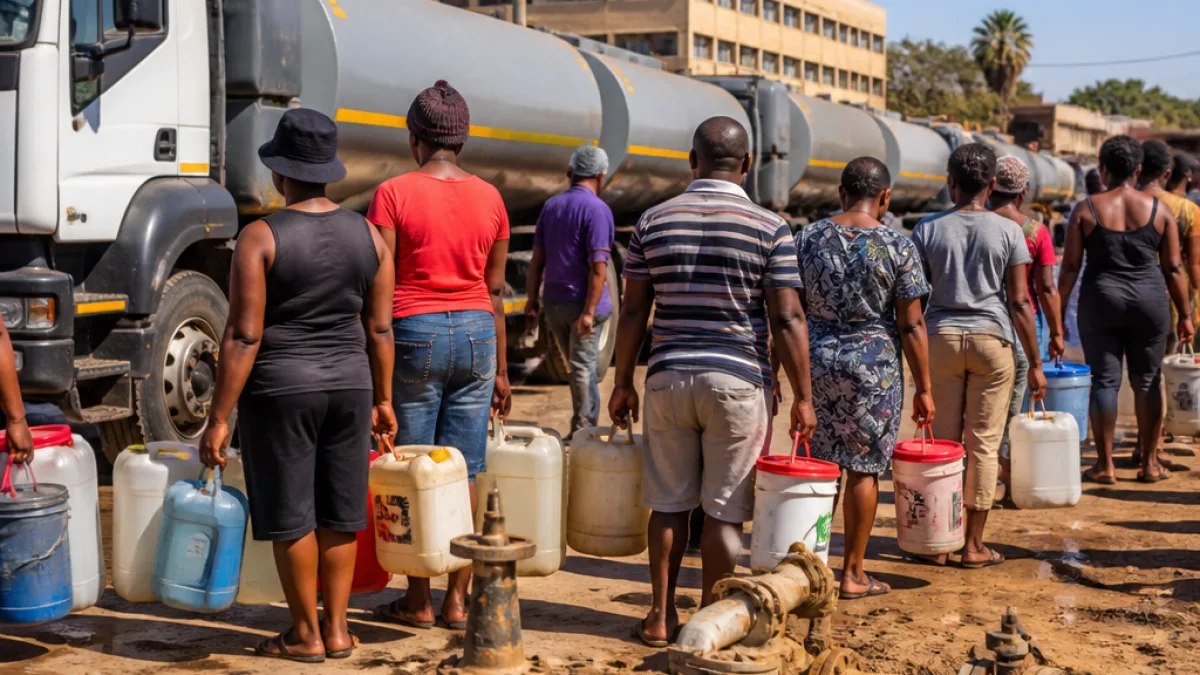
Communities across Nkangala District continue to rely on water tankers intended as temporary emergency relief, as drought, failing sources and ageing pipe networks prevent consistent piped supply. Municipal records and field reporting show the short-term measure has become a long-term, costly substitute for functioning bulk and reticulation systems in Emalahleni and Thembisile Hani local municipalities.
Money spent, certainty nowhere
Public expenditure on emergency water provision has been substantial. Emalahleni Local Municipality recorded spending of about R46-million on tanker services in a single year. Over four financial years, neighbouring Thembisile Hani spent more than R21-million on similar services. Yet residents report persistent uncertainty about when deliveries will arrive, whether water will be free and how the millions paid for tanker services translate into reliable access.
Municipal documents obtained in the investigation indicate repeated procurement of private water-delivery contractors. In practice, many communities face irregular delivery schedules, empty JoJo tanks and prolonged periods without running water, leaving households to ration water, skip hygiene routines or travel long distances to buy or collect water.
How an emergency response became permanent
The shift from emergency relief to an entrenched service model is driven by several interacting pressures: prolonged dry conditions, declining performance of ageing infrastructure and an apparent absence of timely capital investment to restore bulk-supply capacity. The resulting gap has been filled by tanker fleets, some operated by private firms contracted by municipalities.
- Residents described years of unreliable tanker deliveries, which affect domestic work, sanitation and small-scale businesses.
- Private providers sometimes demand cash payment from households, raising concerns about loss of municipal revenue and inconsistent pricing.
- Records suggest some contracted companies are connected to relatives of politically connected individuals, creating the risk of conflicts of interest where oversight is weak.
Local impact: daily life, health and the economy
Households dependent on tanker delivery face practical and economic consequences. Interruptions to water supply influence domestic chores, school attendance, informal trading and farming. Water insecurity also increases public-health risks where insufficient water impedes hygiene practices in households and communal facilities.
Small enterprises that rely on regular water — such as eateries, car washes and smallholder growers — report reduced income when tanker deliveries fail or are delayed. For poorer households, purchasing water from independent vendors can be an additional and sometimes unaffordable cost.
Accountability and procurement concerns
The investigation highlights gaps in transparency and accountability. Where municipal contracts are let for emergency supplies, oversight appears limited and monitoring of delivery performance and financial reconciliation is inconsistent. The practice of drivers collecting cash payments directly from recipients makes it difficult to track municipal revenue and whether payments reflect approved contract terms.
Allegations that some suppliers have connections to local political figures point to potential conflicts that require scrutiny. Public procurement regulations and municipal financial-management rules aim to prevent such conflicts, but enforcing these requires active oversight by council structures, municipal supply-chain units and, where necessary, auditors and regulators.
| Municipality | Emergency tanker spend (reported) | Period |
|---|---|---|
| Emalahleni | R46-million | One financial year |
| Thembisile Hani | R21-million+ | Four financial years |
What residents and officials need to consider
Long-term reliance on tankers is more expensive and less reliable than restoring and maintaining bulk and reticulation infrastructure. Municipalities and provincial authorities face policy choices and funding decisions:
- Prioritise capital investment and maintenance to restore bulk-water sources, treatment works and pipelines where feasible.
- Improve transparency in emergency procurement contracts and establish clear delivery-performance metrics.
- Ensure independent monitoring of contracted suppliers and remove direct cash-collection practices that undermine accountability.
For households coping with irregular deliveries, practical steps include maintaining well-secured and covered storage tanks, joining community water committees where they exist, and reporting non-delivery or suspected irregularities to municipal hotlines and ward councillors so incidents are logged and tracked.
The situation in Nkangala underlines a wider challenge across parts of the province where climate stress, deferred maintenance and governance weaknesses intersect. Aligning short-term emergency relief with a clear, funded plan to rehabilitate infrastructure will be essential if municipal water services are to return to the reliable, affordable baseline that residents expect and deserve.
Reporting from Emalahleni.















