MBOMBELA — The provincial government of Mpumalanga has inaugurated a new AgriBEE structure intended to move agricultural transformation beyond compliance and towards substantive ownership, skills transfer and sustainable market access for black farmers.
Framework aims to turn indicators into real economic outcomes
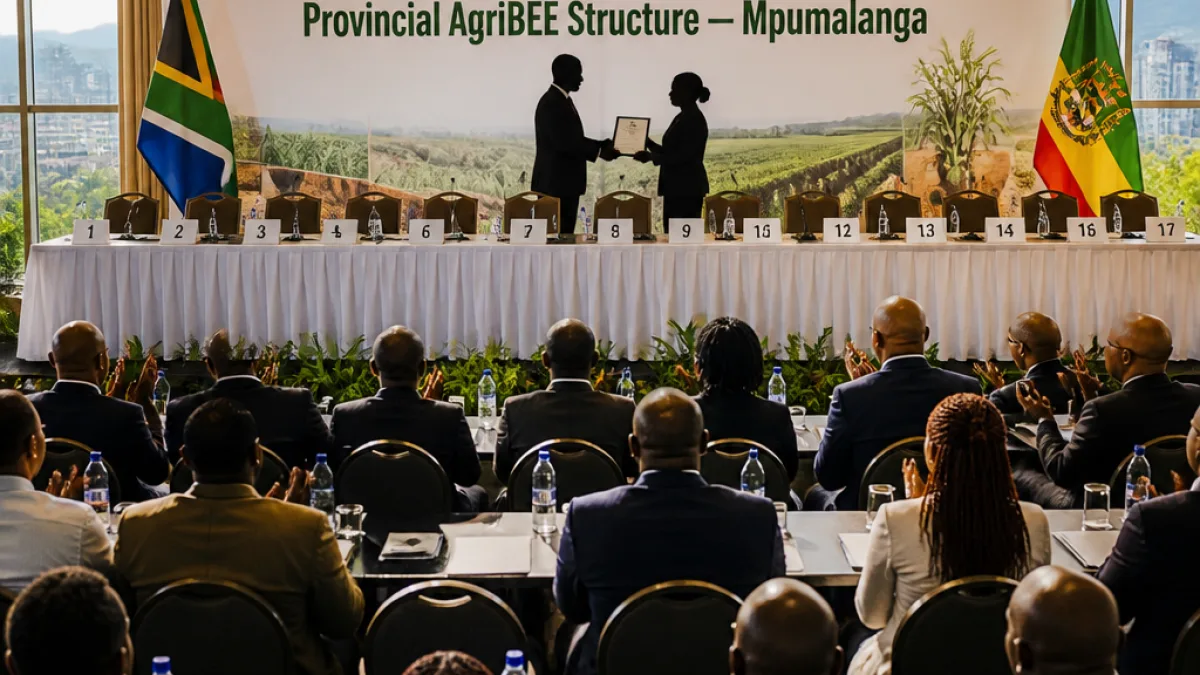
The structure was formally launched at The Capital Hotel in Mbombela on 14 August, when 17 stakeholders accepted appointments to serve a three-year term from 2026 to 2029. The inaugural event was attended by the provincial MEC for agriculture, rural development, land and environmental affairs, Khethiwe Moeketsi, the chairperson of the AgriBEE Charter Council, Ndivhuho Navillee Phungo, and the director-general for B-BBEE charters compliance, Dr Madime Mokoena.
Moeketsi said the framework centres on five core pillars: ownership, management control, skills development, enterprise and supplier development, and socio-economic development. She emphasised that these should not remain abstract scorecard items but must produce measurable livelihoods, enterprises and skills.
“Ownership must translate into black farmers and entrepreneurs owning productive assets and enterprises. Skills development must translate into capable farmers, artisans, technicians, agricultural professionals and entrepreneurs,”
She added that enterprise and supplier development should result in businesses receiving real contracts and sustainable market opportunities, while socio-economic development must strengthen rural economies and communities.
Who will drive the structure
Twenty stakeholders were nominated to the provincial structure, and 17 accepted their appointments. The cohort draws from government and public entities, farmer and commodity organisations, research and academia, transformation and social development organisations, as well as other strategic stakeholders, Moeketsi explained.
The AgriBEE Charter Council, represented by Phungo at the inauguration, provides oversight to ensure the provincial structure aligns with the national AgriBEE objectives while responding to Mpumalanga’s specific agricultural profile and rural development needs.
- Membership: 17 confirmed stakeholders on a three-year term (2026–2029).
- Key focus areas: ownership, management control, skills development, enterprise & supplier development, socio-economic development.
- Presence: the launch included both provincial officials and national B-BBEE charter representatives.
Practical implications for farmers and rural communities
The provincial initiative aims to convert policy commitments into concrete outcomes such as transfer of productive assets, technical training for farmers and agricultural workers, and access to contracts and markets that can sustain rural enterprises. For Mpumalanga — a province with a mix of commercial farming, emerging black farmers and rural dependence on agriculture — these interventions are central to building resilient local economies.
By emphasising skills and enterprise development alongside ownership, the structure recognises that access to land or assets alone may be insufficient without training, mentorship and market linkages that allow new or expanded enterprises to survive and grow.
Structure's priorities visualised
| Core Pillar | Intended Outcome |
|---|---|
| Ownership | Black farmers owning productive assets and enterprises |
| Management control | Increased decision-making by transformed leadership |
| Skills development | Capable farmers, artisans, technicians and agricultural professionals |
| Enterprise & supplier development | Contracts and sustainable market opportunities |
| Socio-economic development | Stronger rural economies and communities |
Officials say the provincial structure will be expected to monitor progress and report on measurable economic outcomes, not just compliance with a scorecard. The presence of national charter officials at the launch underlines the intention to link provincial implementation to national B-BBEE policy and oversight.
Next steps and expectations
The newly formed group will be responsible for translating the AgriBEE pillars into programmes and interventions that can be implemented across Mpumalanga’s farming sectors. This will involve cooperation between government departments, research institutions, commodity bodies and private-sector partners to create viable market pathways and training opportunities.
For rural households and emerging farmers, the success of the structure will be measured in asset transfers that enable production, the availability of technical assistance and access to contracts that offer stable income beyond seasonal fluctuations. Observers will watch whether the provincial body can move rapidly from planning to delivering visible outcomes in communities that rely on agriculture for their livelihood.
The inauguration marks the start of a three-year term for the stakeholders; their early work and the pace at which they can pilot interventions will set expectations for how AgriBEE contributes to transformation in Mpumalanga’s agricultural economy.