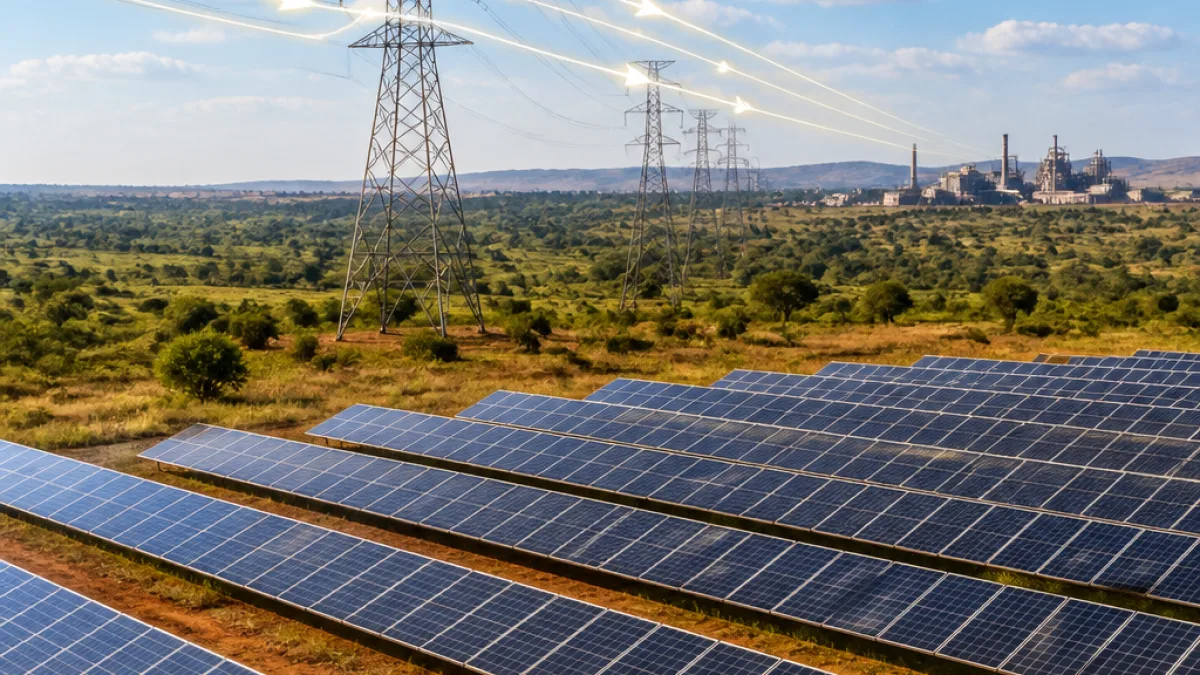
A Voltalia solar farm near Tzaneen in Limpopo is now supplying electricity to a Rio Tinto mineral sands smelter in Richards Bay under a 20‑year corporate power purchase agreement (PPA), the developer said.
How the power moves: wheeling via Eskom
The 148MW plant injects its output into Eskom’s grid in Limpopo, and Eskom records what is delivered at the generator connection point and what the Richards Bay Minerals (RBM) smelter draws from the grid at the other end. The two sides are financially reconciled against a schedule of standard prices, Voltalia reported — an arrangement commonly known as wheeling.
This model lets a large industrial user buy renewable power from a private generator without the generator building a dedicated transmission line to the customer. According to Voltalia, the project supplies roughly 300GWh a year to a single industrial buyer, showing the wheeling model can operate at industrial scale.
Emissions and the energy transition
Voltalia estimates the plant lowers RBM’s annual greenhouse gas output by at least 237 000 tonnes of CO2e. The developer says this represents at least a 10% reduction in RBM’s combined scope 1 and 2 emissions — implying the smelter’s total scope 1 and 2 emissions run at around 2.4 million tonnes a year.
Voltalia’s figures also imply a displaced emissions intensity of about 790kg CO2e/MWh. By comparison, the company noted Eskom’s grid factor is nearer 1 tonne CO2e/MWh, making the project’s estimate conservative rather than generous.
Local job creation and ownership
During construction Voltalia said the project created roughly 800 jobs, with more than half filled by young local people. Now that the plant is operational, the developer reports about 50 permanent roles.
The project company is also structured with local ownership: Voltalia states it is 35% black women‑owned, split between Renewable Solutions at 21% and Growth Arm at 14%, and both shareholders have board representation.
Timeline and context
RBM began the procurement process in 2021 and signed the PPA with Voltalia in October 2022. The plant reached full commissioning in April this year after an original schedule that targeted completion in 2024, illustrating the multi‑year nature of such deals.
Wheeling has been discussed in South Africa for several years as a way for large users to access private generation without building new transmission infrastructure. Voltalia’s Bolobedu project is one of the larger operating examples, demonstrating that wheeling arrangements can serve substantial industrial loads.
- Capacity: 148MW
- Estimated annual generation supplied to RBM: ~300GWh
- Estimated annual emissions reduction: ≥237 000 tonnes CO2e
- Construction jobs: ~800
- Permanent jobs: ~50
- Local ownership: 35% black women‑owned
| Metric | Figure |
|---|---|
| Plant capacity | 148MW |
| Annual energy to RBM | ~300GWh |
| Annual emissions reduction | ≥237 000 tCO2e |
| Construction jobs | ~800 |
| Permanent jobs | ~50 |
What this means for Limpopo and industry
For Limpopo, the project delivered construction employment and a permanent presence in a region that seeks greater economic activity. For the smelter in Richards Bay, wheeling provides a route to long‑term renewable supply without the need for a direct private transmission line.
More broadly, the arrangement is a practical example of how corporates and independent renewable generators can collaborate within South Africa’s existing grid framework to reduce emissions and secure energy at scale. It also highlights the role of Eskom as the national network operator — the ‘wire’ that enables such commercial arrangements even when Eskom is not the seller of the power.
Voltalia has linked the project to international partners and to corporate sustainability goals, while RBM’s PPA reflects industrial demand for predictable, lower‑carbon power supplies. The project’s duration from initial procurement to commissioning underscores that these deals require years of planning, consenting and construction.
As wheeling gains traction among large electricity users, questions remain about how quickly the model can be scaled, how it will affect grid planning and tariffs, and what it means for broader access to private generation for other sectors and smaller customers.
Reporting for this article relied on statements and figures provided by Voltalia and details of the PPA between the developer and RBM.