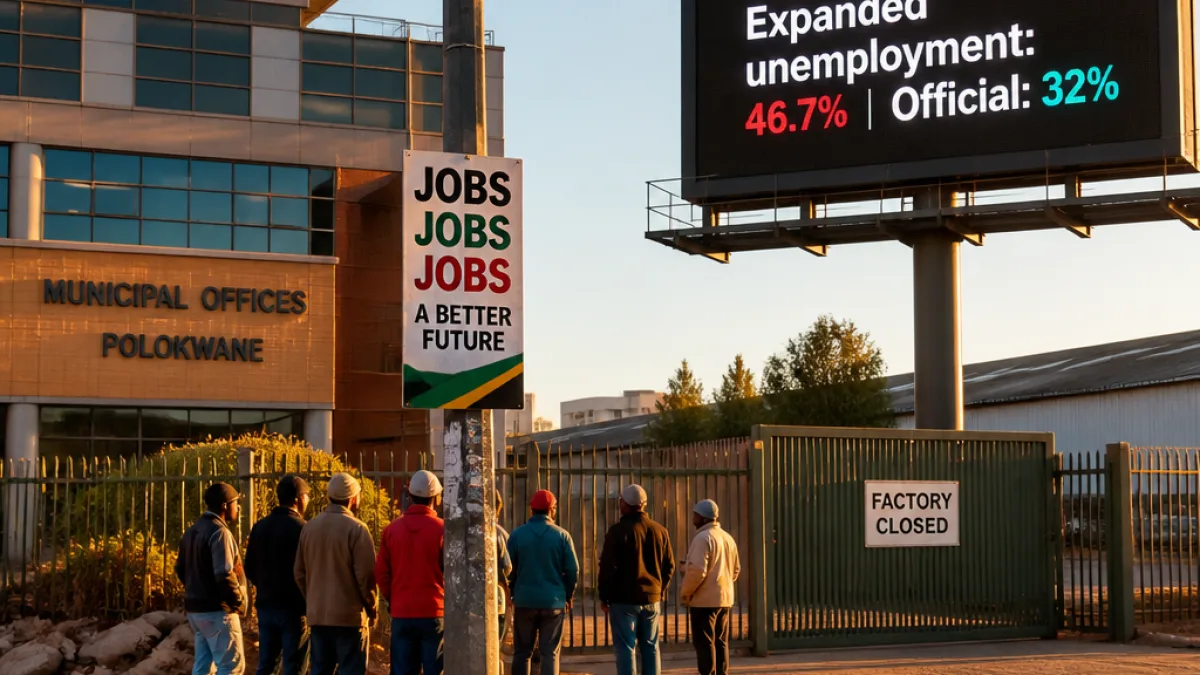
Limpopo’s labour market is under severe strain, with Statistics South Africa’s Quarterly Labour Force Survey showing the province’s expanded unemployment at 46.7% and the official unemployment rate rising to 32% in the second quarter of 2026.
What the numbers show
Stats SA data indicate an increase in the province’s official unemployment rate from 31.7% in the first quarter of 2026 to 32% in the second quarter. When the broader measure of unemployment is taken into account — which includes discouraged jobseekers and those who have stopped looking for work — nearly one in two people in Limpopo’s extended labour force are not working.
Political response: DA proposes municipal-driven growth
The Democratic Alliance in Limpopo has responded to the figures by arguing that poor service delivery and weak municipal governance are key constraints on investment and job creation. DA member of the Limpopo provincial legislature Lindy Wilson told reporters the province is "blessed with agricultural potential, mineral wealth, tourism assets and a strategic position as South Africa’s gateway to the north," but that residents are leaving because they cannot find opportunities at home.
“This should not be the reality of a province blessed with agricultural potential, mineral wealth, tourism assets and a strategic position as South Africa’s gateway to the north,”
Wilson urged a shift towards what she called professional municipalities — local governments that provide reliable services, maintain infrastructure, practise sound financial management and reduce unnecessary bureaucracy to enable investment.
Why the gap between official and expanded rates matters
Stats SA has highlighted that in Limpopo the gap between the official unemployment rate and the expanded rate exceeds 14 percentage points. That gap reflects people who are not captured by the narrow official definition — those who have become discouraged or who want work but are not actively searching for reasons such as lack of transport, household responsibilities, or loss of hope.
- Official unemployment (broadly active jobseekers): 32% (Q2 2026)
- Expanded unemployment (includes discouraged workers): 46.7% (Q2 2026)
- Change from Q4 2025: official rate up from 28.2% to 32% across the periods reported
DA’s local government focus
The DA’s plan, as outlined by Wilson, places emphasis on the role of municipalities in either enabling or blocking local economic development. She argued that while municipalities cannot create every job, they can provide the conditions that make it viable for businesses to invest and expand.
Wilson singled out unreliable water and electricity supplies, deteriorating roads and mismanaged municipal finances as barriers to investment. Her prescription centres on limiting red tape and improving capacity at municipal level so that local government becomes an active partner in creating an environment conducive to job growth.
Context and local impact
High unemployment has immediate effects for households across rural and urban Limpopo. Loss of income places pressure on food security, transport affordability and access to services. The extended unemployment measure suggests many people have disengaged from the formal job search, which has long-term consequences for skills retention and labour-market attachment.
| Measure | Q4 2025 | Q1 2026 | Q2 2026 |
|---|---|---|---|
| Official unemployment | 28.2% | 31.7% | 32% |
| Expanded unemployment | — | — | 46.7% |
While the DA links municipal performance to jobs, the figures also point to deeper structural challenges in the provincial economy, including the need to convert agricultural potential, mineral resources and tourism into sustainable, quality employment opportunities.
What residents should know
For people seeking work in Limpopo, the widening gap between official and expanded unemployment suggests many potential jobseekers are not currently reachable through standard job-matching systems. Those offering training, community employment programmes or targeted local economic initiatives may need to adapt outreach to discouraged and inactive members of the labour force.
Political parties are positioning themselves ahead of the November elections by offering different approaches to economic management. The DA’s focus on municipal competence and reduced bureaucracy sets out a local-government-led route to growth; whether that will alter the province’s unemployment trajectory will depend on implementation and whether provincial and national policies support local investment and job creation.
Stats SA’s survey remains the most recent official snapshot of labour-market trends in Limpopo. Further detail and breakdowns by age, gender and district will be important for policymakers and civil society groups planning interventions to reduce joblessness and support livelihoods across the province.