WATERLOO, Iowa — Farmers across four Iowa counties are being offered free, multi-year nitrogen soil testing to measure residual nitrogen and help shape fertiliser decisions. The programme, run by the Iowa Nutrient Research & Education Council (INREC) together with the Iowa Department of Agriculture & Land Stewardship (IDALS), aims to collect three years of soil data from 250 fields in targeted watersheds.
How the Iowa scheme works
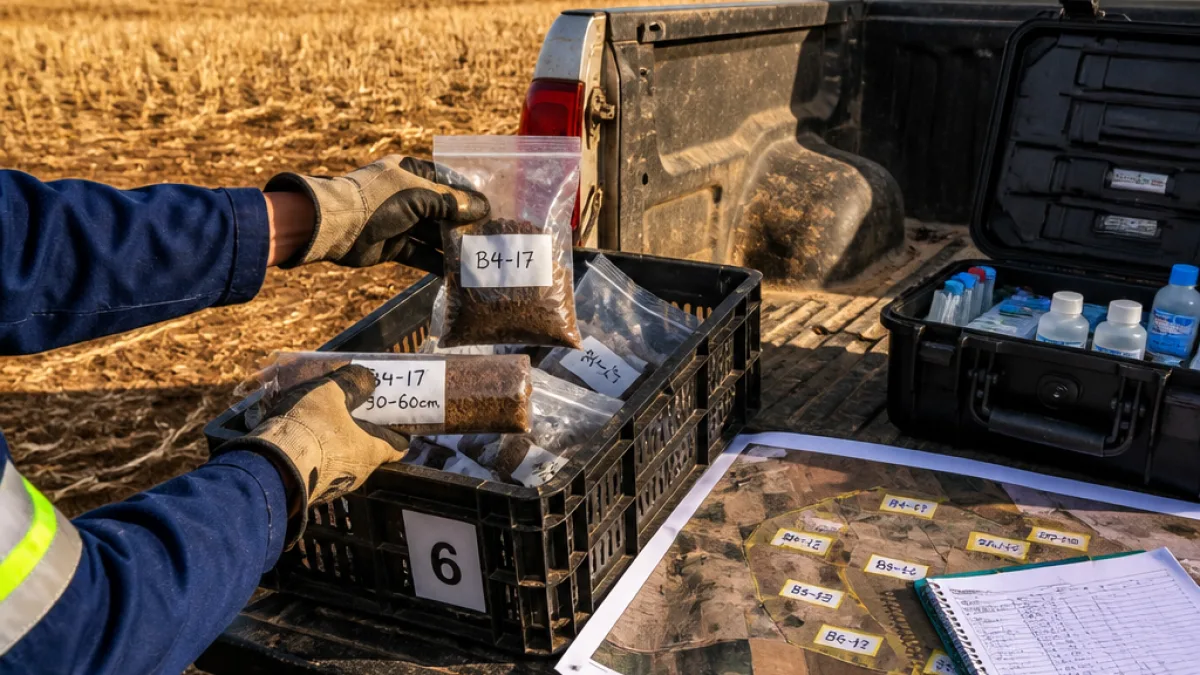
The Nitrogen Soil Sampling Project began earlier this year in the Greater Des Moines watershed and has now expanded into the Middle Cedar watershed, covering Black Hawk, Grundy, Tama and Benton counties. Farmers who sign up provide pre‑season management information and submit post‑harvest surveys, and soil samples are taken in the fall — a window the organisers describe as critical for assessing residual nitrogen.
“One soil sample represents a snapshot in time, and this multi-year Nitrogen Soil Sampling Project is designed to help farmers track patterns and better understand how weather and growing season variability affects the residual nitrogen levels in their soils,”
— Iowa Secretary of Agriculture Mike Naig, in a press release cited by local media.
Data use and expected benefits
Survey and soil data are shared anonymously with Iowa State University researchers to improve the N‑FACT (Nitrogen Fertiliser and Crop Tool) modelling used by the Iowa Nitrogen Initiative. Project organisers say the information will help farmers tailor fertiliser applications to actual soil nitrogen availability, which may reduce input costs on farms and lessen nitrogen runoff that can harm water quality.
- Participants complete a survey on nitrogen management, crop rotation, cover crops and manure application.
- Soil sampling occurs in the fall to capture post‑harvest residual nitrogen.
- Entries and lab results are anonymised and provided to university researchers to refine decision tools.
Key facts at a glance
| Aspect | Detail |
|---|---|
| Organisers | INREC and IDALS |
| Target fields | 250 fields over three years |
| Primary aim | Assess residual soil nitrogen and inform fertiliser decisions |
| Research partner | Iowa State University (data to refine N‑FACT) |
| Sign‑up | Through iowanrec.org |
Lessons for Free State farmers and policymakers
While the project is an Iowa initiative and does not involve South African agencies, its approach points to several practical lessons that are relevant in the Free State, where maize and other field crops dominate large tracts of farmland:
- Routine, standardised soil testing over several seasons helps distinguish one‑off weather effects from persistent nutrient trends.
- Anonymised sharing of management data with researchers can improve local decision tools and calibrate models to regional conditions.
- Targeting sampling in the post‑harvest period provides a clearer picture of residual nitrogen that would otherwise be available to the next crop or vulnerable to runoff.
For producers and extension services here, the Iowa model underscores the value of combining farmer participation, laboratory analysis and university research to produce actionable guidance on fertiliser rates. That guidance may reduce unnecessary fertiliser expenditure and contribute to better water management where nutrient runoff is a concern.
What farmers should consider
Producers thinking about introducing a similar approach locally should weigh logistical and budgetary considerations such as sample collection capacity, laboratory turnaround times, funding for multi‑year monitoring and the existence (or need) of local decision‑support tools that can interpret the data for farm‑level management.
In Iowa, organisers emphasise that a single sample is merely a snapshot — the value comes from repeated, consistent sampling and linking results to farm management records. Free State role‑players — including the provincial Department of Agriculture, agricultural colleges and research institutes — could consider pilot schemes that borrow elements of this structure while adapting them to South African soils, climates and cropping systems.
The Iowa project is open for sign‑ups via the INREC website. Farmers and officials here who wish to explore comparable programmes should seek out local research partners and consider trials that explicitly include cover crop and manure management data to reflect prevalent practices on Free State farms.
Contact for sign‑up (Iowa project): iowanrec.org (project run by INREC in partnership with IDALS; data shared with Iowa State University).