
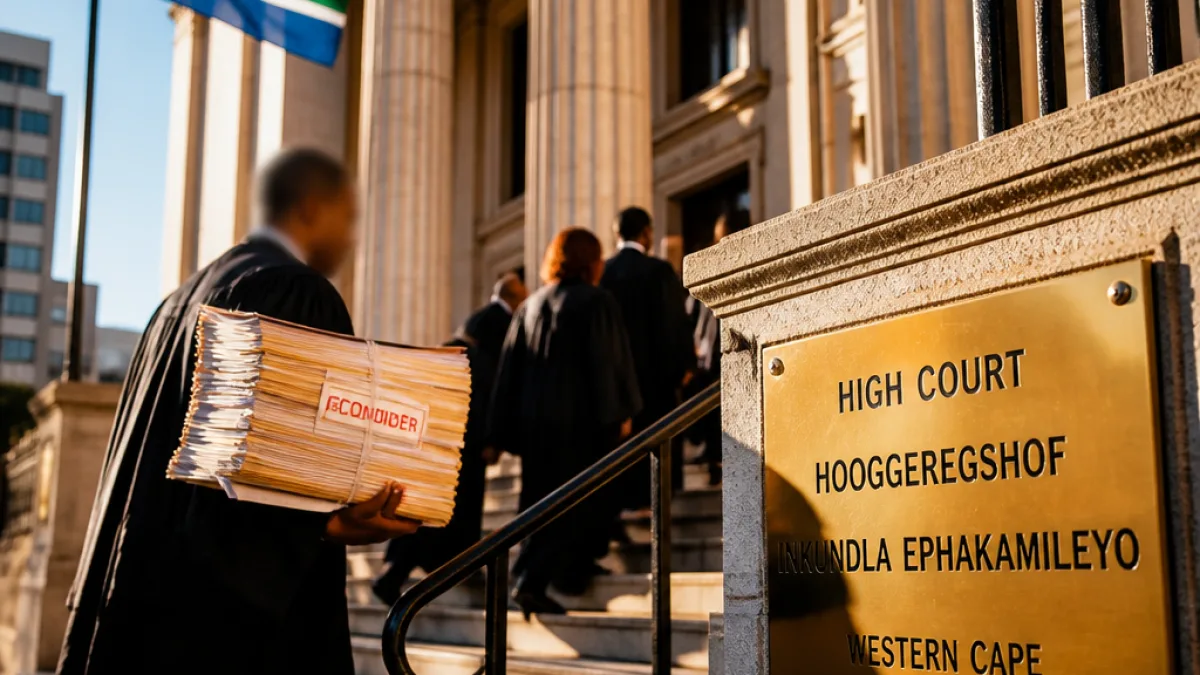
The Western Cape High Court in Cape Town has set aside the Standing Committee for Refugee Affairs’ decision to withdraw the refugee status of a Congolese national, finding the committee’s December 2023 ruling unlawful, unreasonable and procedurally unfair. Acting Judge Siviwe Yake delivered the judgment on 17 September 2026 and ordered the committee to reconsider the man’s status within 60 days of the order.
Judge finds multiple defects in committee decision
The court case concerns a man identified in the papers as Ilunga, born in 1982 in Pweto in Haut‑Katanga province of the Democratic Republic of the Congo. Court records state that Ilunga has lived in South Africa since 2003 and was recognised as a refugee after his arrival.
The Standing Committee first withdrew his refugee status in 2016. That decision was set aside by Judge Erasmus on 9 May 2023, with an order for reconsideration. The committee again withdrew his status on 29 December 2023, stating that his circumstances no longer justified recognition under the Refugees Act.
Acting Judge Yake found that the later decision was flawed on multiple grounds. The judgment cites both the Constitution — section 33, which protects the right to just administrative action — and the Promotion of Administrative Justice Act (PAJA). The judge concluded that defects in the committee’s process and reasoning rendered the decision unsustainable.
“The cumulative effect of the defects is that the impugned decision cannot withstand scrutiny under PAJA. Each of these defects, whether considered individually or cumulatively, renders the decision unlawful, unreasonable, and procedurally unfair within the meaning of section 33 of the Constitution and section 6 of PAJA,”
Grounds cited by the committee and rebuttal
In its letter to Ilunga’s attorney, the committee relied on section 5(1)(e) of the Refugees Act as amended, saying that “the circumstances under which the applicant was recognised as a refugee no longer exist.” The committee also said Ilunga had not demonstrated “compelling reasons” under section 5(2) of the Act.
Ilunga’s counsel, Q Maxongo, argued that the committee adopted an unduly narrow approach to the evidence and failed to properly apply its mind — a line of argument that referred to precedent in the Northwest Townships case and commentary by Judge Colman.
What the order requires
As a result of the court’s ruling, the Standing Committee must:
- Reconsider Ilunga’s refugee status within 60 days of the order.
- Address the procedural and substantive defects identified by the court, taking care to apply the correct legal tests under the Refugees Act and PAJA.
Context and implications
The case underscores tensions in the administration of refugee status in South Africa. Decisions by the Standing Committee can have life‑changing consequences for applicants, including access to work, healthcare and protection from deportation. Orders from the High Court that set aside committee decisions are significant because they test whether administrative bodies are applying the law and procedure correctly.
The judgment is likely to be read closely by refugee lawyers and advocacy organisations because it reiterates the requirement that administrative decisions comply with PAJA and the Constitution. It also demonstrates that repeated withdrawals and reconsiderations of status — as happened here in 2016 and again in 2023 — will attract rigorous judicial scrutiny where procedural fairness or reasoned decision‑making is lacking.
Practical note for affected people
For recognised refugees and people with pending asylum claims, the case is a reminder of the legal protections available under the Refugees Act, the Constitution and PAJA. Those who believe a decision by the Standing Committee was unfair or irrational may seek review in the High Court, often with the assistance of specialist legal aid or non‑governmental organisations that work on migration and asylum law.
| Key dates | Action |
|---|---|
| 2003 | Ilunga reportedly arrived in South Africa |
| 2016 | First withdrawal of refugee status by the committee |
| 9 May 2023 | Judge Erasmus set aside the 2016 withdrawal and ordered reconsideration |
| 29 Dec 2023 | Committee again withdrew refugee status |
| 17 Sept 2026 | Acting Judge Siviwe Yake set aside the 2023 decision and ordered reconsideration within 60 days |
The court record available to the public provides the framework of the dispute but does not include every evidentiary detail heard by the committee or the High Court. The order requires the Standing Committee to revisit the matter and to produce a decision that can withstand judicial review.
The ruling will be watched by legal practitioners and civil society groups working on asylum and migration in the Western Cape. For now, Ilunga remains protected by the court order while the committee carries out the mandated reconsideration.













