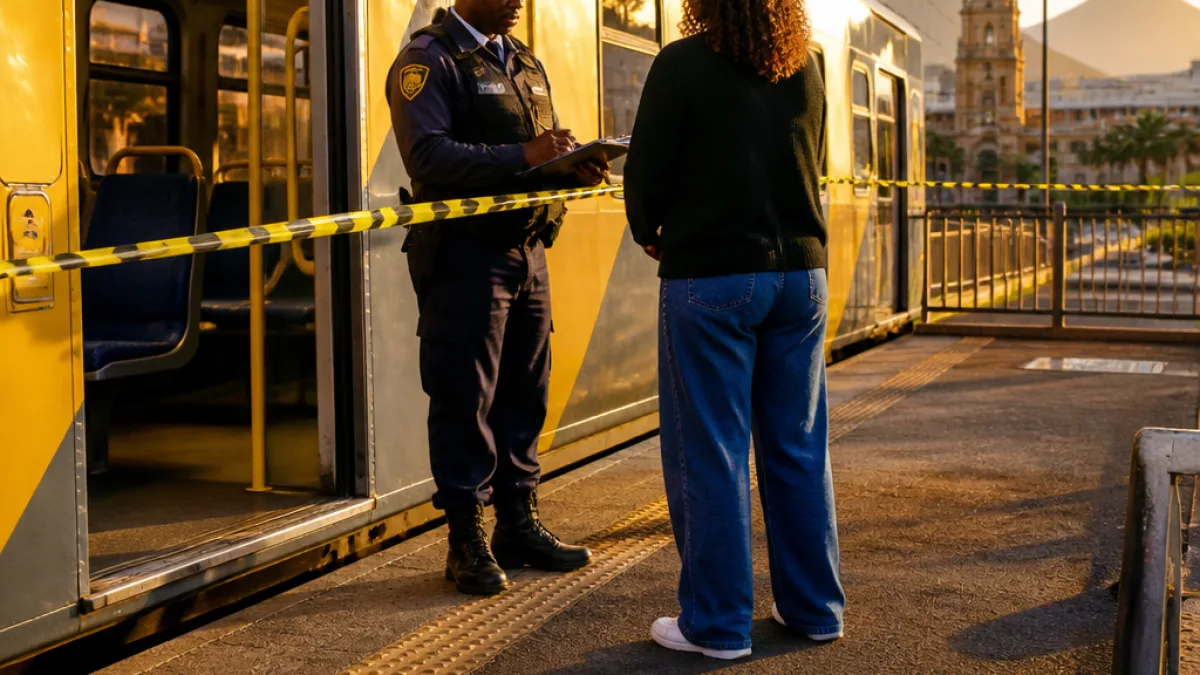
The Western Cape High Court has found the Passenger Rail Agency of South Africa (Prasa) fully liable for the injuries suffered by Aisha Barnabas, who was allegedly pushed from a moving train during a robbery near Nyanga on 9 May 2011.
Judge says public carrier owes duty of care
In a judgment delivered last week, Acting Judge Siviwe Yake found that Prasa — as a public carrier entrusted with transporting commuters — owes a legal duty to ensure reasonable security measures are in place to protect passengers from foreseeable harm. The judge accepted that Barnabas was a lawful train user, holding a monthly ticket, and that the duty arose from the nature of Prasa’s operations rather than from any contractual entitlement.
“I find that the plaintiff held a valid monthly ticket and was a lawful train user. In the result, the court is satisfied that the plaintiff has discharged the onus of proving lawful presence on the train.”
The court accepted that there was no security personnel in the carriage to ensure doors were closed while the train was in motion. That absence was central to the finding of negligence against Prasa.
Injuries, consequences and disputed facts
Court papers say Barnabas sustained a severe laceration to her leg and head, and suffered a dislocated shoulder. She was admitted to hospital, underwent medical treatment, has been left disabled, and is expected to suffer loss of income and a diminution in the amenities of life. The precise amount of damages has not yet been determined by the court.
Prasa denied negligence in its pleadings. It argued that Barnabas was solely responsible for her injuries or that her own conduct contributed to them. The court, however, found that Prasa bore responsibility because it failed to ensure doors were not open while the train was moving and did not provide carriage security personnel.
What the ruling means for passengers and the operator
The judgment emphasises the obligations of public carriers to provide reasonable security for passengers. For commuters who rely on suburban rail services in Cape Town — particularly routes that pass through high-risk nodes such as Nyanga — the decision reinforces the principle that operators can be held accountable where security measures are demonstrably absent.
Operational and financial consequences for Prasa will depend on the quantum of damages that the court will determine in follow-up procedures. The judgement may also inform other pending or future claims by commuters assaulted or robbed on trains where similar security failures are alleged.
- Date of incident: 9 May 2011
- Plaintiff: Aisha Barnabas
- Judge: Acting Judge Siviwe Yake
- Finding: Prasa 100% liable for proven damages
- Compensation: Amount to be determined
| Item | Detail |
|---|---|
| Alleged injuries | Severe laceration to leg and head; dislocated shoulder; hospital admission; disability |
| Prasa’s defence | Denied negligence; alleged plaintiff’s own conduct contributed or was sole cause |
Context and wider implications
Suburban rail safety has long been a flashpoint in Cape Town. Incidents of theft and assaults on trains have prompted public outcry and calls for better policing and security provision. While this judgment does not create new law, it applies established principles of delictual liability to public transport and underlines the expectation that operators take reasonable steps to prevent foreseeable harm.
For commuters, the ruling may offer a route to redress where negligence by operators can be shown. For Prasa, it raises questions about carriage security protocols, staff deployment and risk management on routes serving the Cape Flats and other vulnerable areas.
The matter will return to court when the quantum of damages is determined. Until then, the finding that Prasa was 100% liable for proven damages stands as a significant judgment in a case dating back 15 years.
Legal teams for both parties were recorded in court papers; no further comment from Prasa was included in the judgment summary available to the press.
Reporting from Cape Town.