
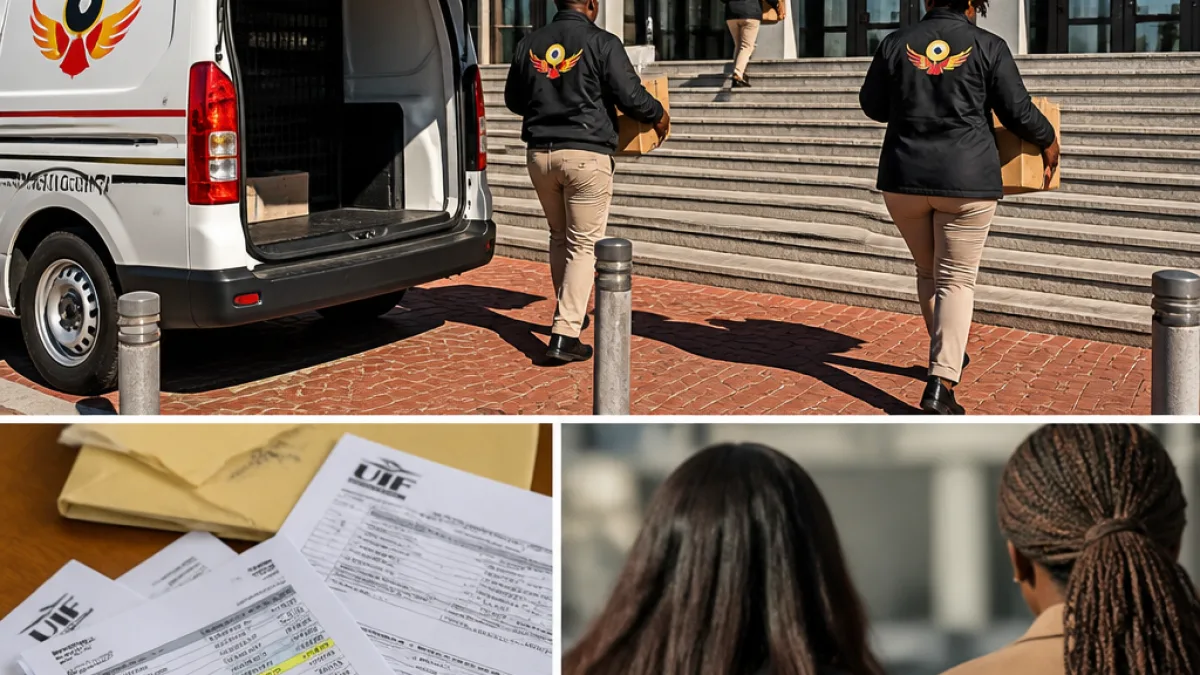
Two Eastern Cape women appeared in the Gqeberha Specialised Commercial Crimes Court on 15 September after the Hawks’ Serious Commercial Crime Investigation Unit arrested them in connection with an alleged Unemployment Insurance Fund (UIF) fraud that caused the Department of Labour to suffer financial prejudice of more than R1.1 million.
How the alleged scheme worked
The arrests relate to a scheme that investigators say began in 2018, while one of the accused, Nandipha Tutani (47), was employed in the Department of Labour’s Employer Services section. Tutani’s responsibilities reportedly included capturing, verifying and filing Employer Declaration of Employees forms — commonly known as UI‑19 forms — on benefit files.
According to the Hawks, Tutani and Nobuntu Mjili (50) are alleged to have coordinated a wide‑ranging fraud in which they recruited individuals who did not qualify for UIF benefits, prepared and submitted fraudulent applications on their behalf, captured and processed the claims and arranged for the proceeds to be received and withdrawn.
“In certain instances, the accused allegedly assisted with arrangements involving bank accounts through which the proceeds of the fraudulent claims could be received,” Hawks spokesperson Warrant Officer Ndiphiwe Mhlakuvana said.
Investigators said the scheme did not depend on isolated fraudulent applications but involved several people performing different functions within what appeared to be a coordinated modus operandi.
Investigation and arrest
The matter came to light after audit processes by the Department of Labour identified discrepancies in UIF claim files. Those anomalies were subsequently handed over to the Hawks for specialised commercial crime investigation.
The Hawks allege that Tutani used her position to facilitate the capture, verification and filing of false employer declarations. Mjili is accused of acting in common purpose with Tutani in recruiting purported claimants and executing the scheme.
Both women were arrested on 15 September and appeared before the Gqeberha Specialised Commercial Crimes Court on the same day the alleged scam was exposed.
Implications for UIF integrity and public funds
The allegations highlight vulnerabilities in the UIF claims process where internal access to benefit files and employer declarations can be misused. The Hawks’ case indicates a chain of activity from recruitment of ineligible claimants to the creation and processing of fraudulent paperwork and the siphoning of funds via bank accounts.
South Africans rely on UIF as a short‑term safety net when they lose jobs; improper claims therefore undermine trust in the system and divert scarce resources away from legitimate beneficiaries.
- Accused: Nandipha Tutani (47) and Nobuntu Mjili (50)
- Alleged loss to the Department of Labour: more than R1.1 million
- Arrest and court appearance: 15 September, Gqeberha Specialised Commercial Crimes Court
| Year | Alleged activity |
|---|---|
| 2018 | Start of alleged scheme while Tutani employed in Employer Services |
| 2026 | Audits uncover discrepancies; Hawks investigation and arrests |
What the Hawks say and next steps
Warrant Officer Mhlakuvana said intensive probing showed a coordinated operation involving multiple participants with distinct roles. The accused allegedly handled recruitment, preparation and submission of false applications, internal processing and the withdrawal of funds paid out as a consequence of the fraudulent claims.
The case will proceed through the specialised commercial crimes court system. Further details about charges, bail or follow‑up arrests were not provided in the Hawks’ statement.
Practical context for residents
For employees and employers in the Eastern Cape, this investigation is a reminder to keep UIF documentation and bank details secure. Employers should verify who has access to HR and UIF‑related systems and run regular reconciliations of contribution and claim records. Individuals should monitor UIF claim status and bank statements and report any unexplained payments or activity to their employer or the Department of Labour.
Audits by government departments are a common detection mechanism for internal fraud; when discrepancies are discovered they are often referred to the Hawks for specialised forensic and criminal investigation.
The Hawks’ operation in Gqeberha forms part of broader efforts to safeguard public funds and hold allegedly complicit public servants and external co‑conspirators to account.
Reporting in Gqeberha.














