
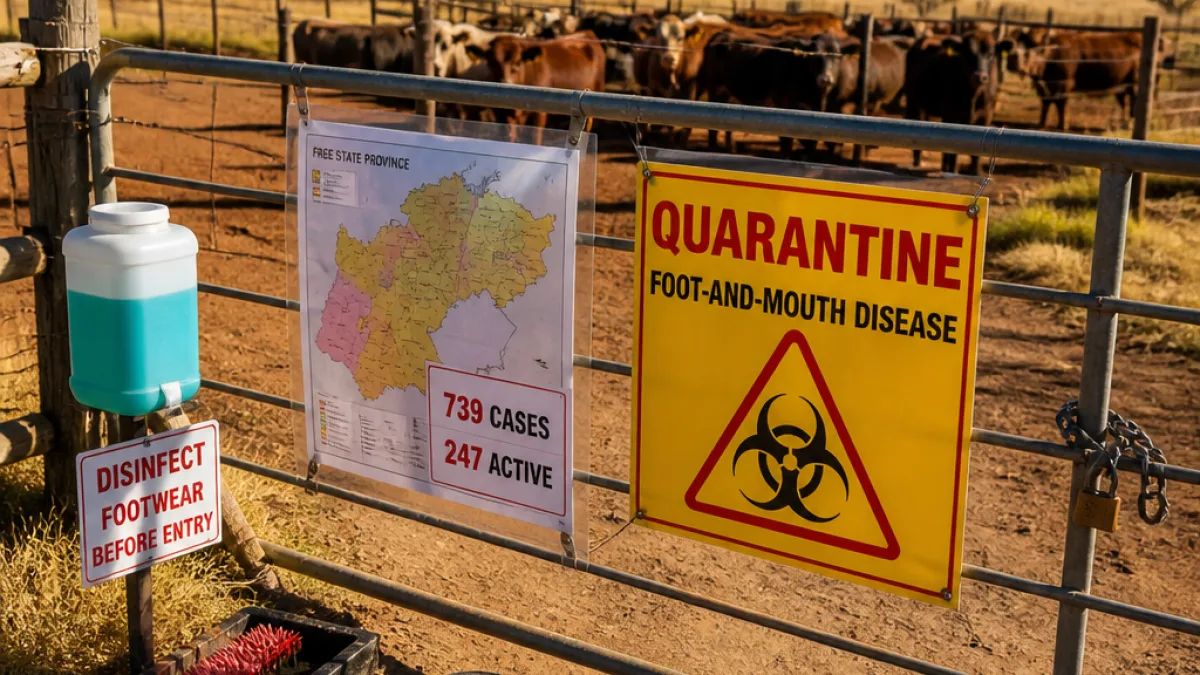
The Free State Department of Agriculture, Rural Development and Environmental Affairs reported that confirmed cases of foot‑and‑mouth disease (FMD) in the province have climbed to 739, with 247 active infections currently under quarantine and 492 properties declared resolved after meeting the conditions to lift restrictions. The department published its latest update on 31 July.
New infections and where they were found
Eleven clinically confirmed cases were added in the most recent update. The extra infections were distributed across several veterinary areas: three in the Welkom State Veterinary Area, four in Fauresmith, two in Bloemfontein and two in Boshof.
Provincial authorities said cases have now been confirmed in 19 local municipalities, and that certain areas remain more heavily affected than others.
| State Veterinary Area / Municipality | Confirmed cases |
|---|---|
| Kroonstad State Veterinary Area (parts of Moqhaka) | 125 |
| Heilbron | 95 |
| Frankfort | 81 |
| Bethlehem | 67 |
| Sasolburg | 64 |
Other affected areas include Welkom (49), Boshof (51), Ladybrand (46), Warden (45) and Qwa‑Qwa (29). Smaller clusters were recorded in Bultfontein (35), Smithfield (16), Fauresmith (17), Bloemfontein (17) and Thaba Nchu (2).
Authorities urge immediate reporting and stronger biosecurity
The department expressed concern about farmers and livestock owners who do not notify authorities when they suspect FMD. It reiterated that reporting a suspected infection is a legal requirement under the national control measures published in Government Gazette No. 54969 on 8 July 2026.
Those national rules require suspected cases to be reported on the same day they are identified so veterinary teams can investigate, impose quarantines and apply control measures to limit further spread. The provincial department warned that poor on‑farm biosecurity heightens the risk of the disease jumping between neighbouring properties and can undermine containment efforts.
- Report any suspected FMD case immediately to the state veterinary office or your local municipal agricultural extension.
- Keep livestock movements restricted until veterinary clearance is given.
- Maintain strict hygiene for people, vehicles and equipment entering and leaving farms.
- Isolate animals that show signs of illness and await veterinary assessment.
While the department said progress was being made in bringing many infected properties under control, it warned that continued non‑compliance would prolong the outbreak and increase the economic impact on farmers, traders and related industries.
Local impact and what to expect next
Quarantines remain in place at the 247 active properties until they meet the prescribed conditions for lifting restrictions. Those conditions typically include negative follow‑up tests, completion of a prescribed period without new clinical cases and confirmation by veterinary officials that there is no ongoing risk of transmission.
The outbreak has implications for local markets and animal movement controls across the province. Farmers with animals in affected zones should expect ongoing inspections and movement restrictions. Those outside declared areas are advised to maintain heightened vigilance and apply recommended biosecurity practices to reduce the chance of introduction.
Provincial veterinary teams continue to monitor affected areas and work with national authorities on surveillance and containment. Farmers seeking guidance or wishing to report a suspected case are advised to contact their nearest state veterinary office without delay.
Reporting and cooperation remain central to ending the outbreak. Failure to notify authorities swiftly or to follow biosecurity advice risks extending restrictions and deepening economic consequences for the agricultural sector in the Free State.














