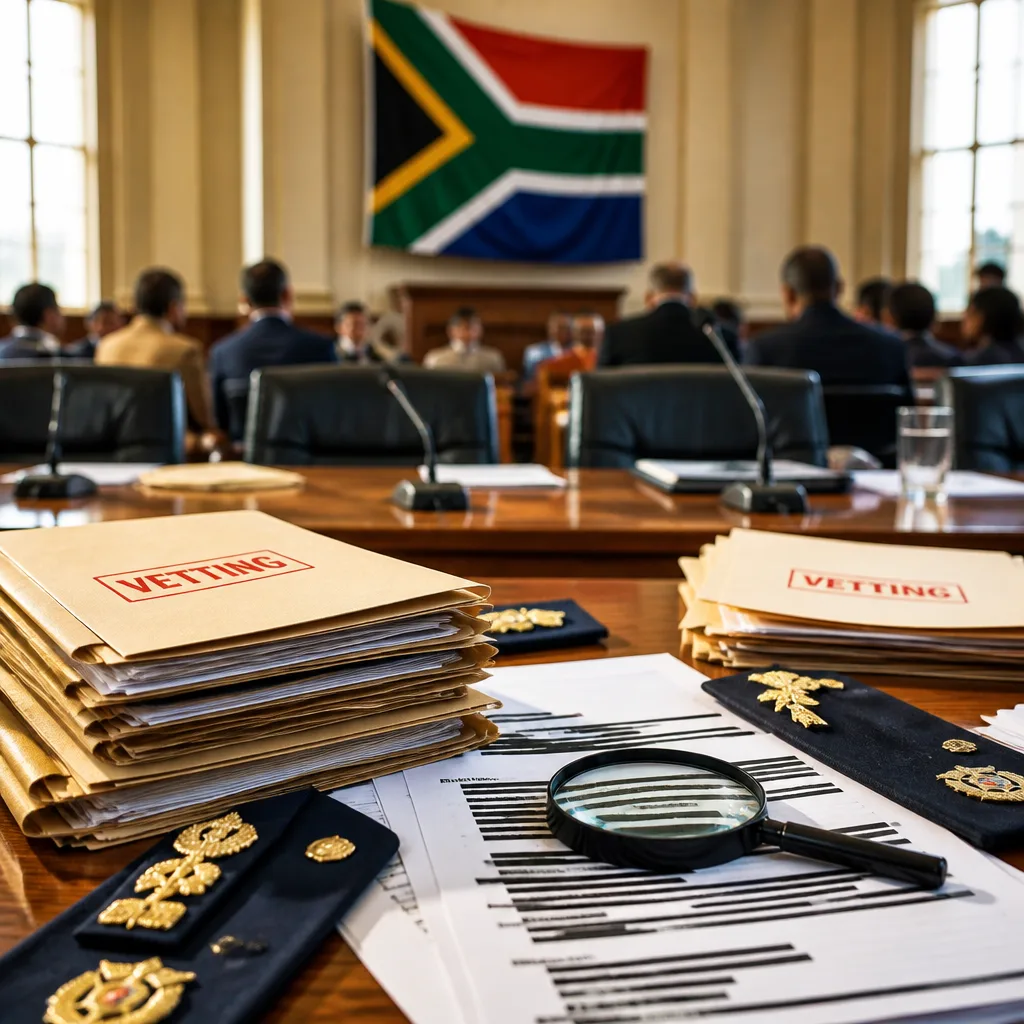
The executive director of the Global Initiative Against Transnational Organised Crime (GI-TOC) has told the Madlanga commission that South Africa requires an urgent, national vetting process for senior police officials to curb organised-crime infiltration of the criminal-justice system.
Reform must start with personnel integrity, expert says
Mark Shaw, appearing as an expert witness for GI-TOC, presented the commission with detailed recommendations on legislative and institutional changes intended to reduce organised criminal influence on law-enforcement and justice institutions. His submission forms part of the evidence the commission will weigh ahead of its final report, due on 16 November.
Shaw told the commission the initial phase of reform should focus on preserving the mandates of key institutions while remedying defects in strategy, personnel integrity, technical capacity, reporting and witness protection. He listed institutions whose stability and leadership, he said, must be addressed as part of a comprehensive reform plan.
“The commission should recommend the prompt and lawful appointment of suitably qualified persons.”
Shaw noted several leadership vacancies and acting appointments across the security cluster. He said that the country lacked an “extraordinary procedure for reassessing all incumbents in an institution where there is evidence that its personnel have been compromised on a large scale”.
Leadership gaps highlighted
According to the GI-TOC submission, the following leadership gaps and acting appointments undermine institutional stability and public confidence:
- SAPS national commissioner — serving in an acting capacity
- National head of the Hawks — serving in an acting capacity
- Director-general of the State Security Agency — serving in an acting capacity
- Head of the Investigating Directorate Against Corruption (Idac) — position vacant
- Inspector-general of intelligence — suspended
A small table below summarises the GI-TOC’s account of current leadership status in key institutions highlighted during Shaw’s testimony.
| Institution | Status |
|---|---|
| South African Police Service (SAPS) | National commissioner acting |
| Hawks | National head acting |
| State Security Agency (SSA) | Director-general acting |
| Investigating Directorate Against Corruption (Idac) | Head vacant |
| Inspector-general of intelligence | Suspended |
Vetting as a first step, not a cure-all
Shaw told the commission that vetting senior officials should be the first phase of reform rather than a standalone cure. He recommended preserving the operational mandates of the SAPS, the Hawks, the National Prosecuting Authority (NPA), Idac, the Independent Police Investigative Directorate (Ipid), the intelligence services and correctional services while reform addresses the structural weaknesses he identified.
His presentation emphasised the need for improvements in technical capacity and in witness-protection measures, as well as clearer reporting lines and stronger strategic coherence across the criminal-justice cluster. Shaw argued that without such measures, personnel changes alone would be insufficient to prevent further organised-crime penetration.
The Madlanga commission, established to investigate allegations of state capture and systemic corruption within law-enforcement and intelligence structures, is currently on a short break and will resume hearings on 15 September. The commission’s final report is expected to provide recommendations on institutional reform and governance, which government and oversight bodies may then act upon.
The GI-TOC submission adds to a growing chorus of voices urging decisive action to shore up the integrity of the security cluster. Any move to implement a national vetting mechanism would raise practical and legal questions about scope, standards, procedural fairness and timelines — matters the commission will need to consider carefully in framing its recommendations.
As the commission prepares its final report, the issues Shaw highlighted — from acting appointments to gaps in accountability frameworks — will be central to debate about how South Africa strengthens its defences against organised crime and restores public confidence in institutions charged with upholding the rule of law.