
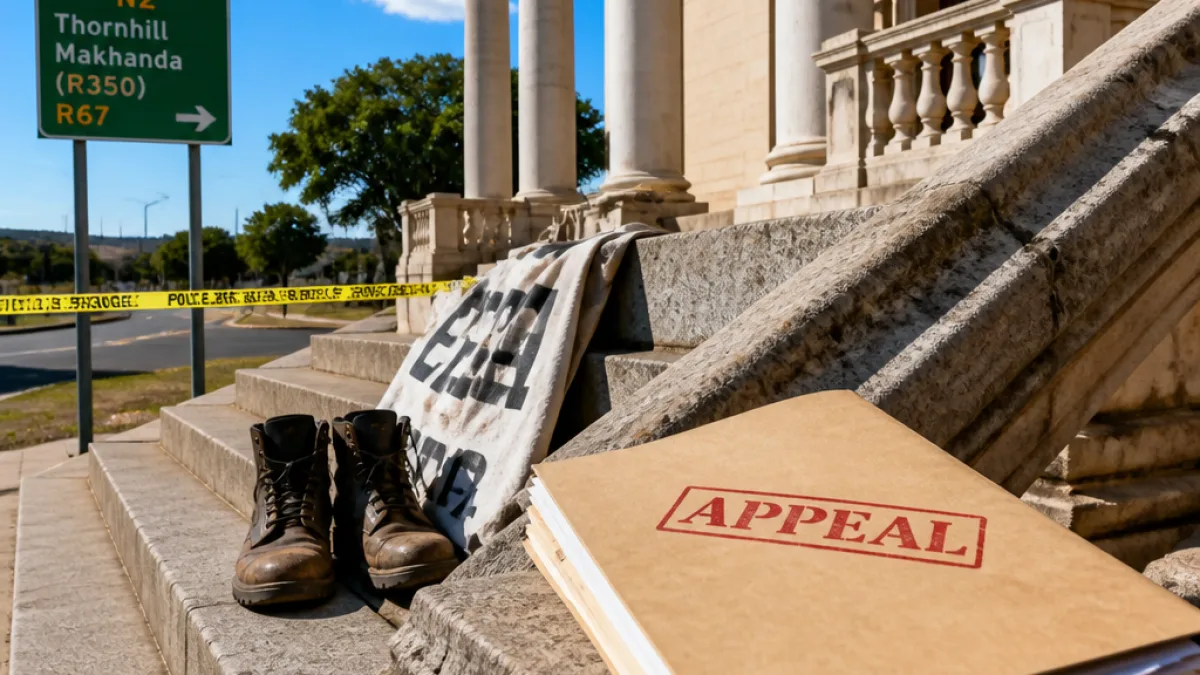
The Eastern Cape High Court in Makhanda has overturned the custodial sentences handed down to two protest leaders who were convicted after a mass service‑delivery demonstration that closed the N2 near Thornhill.
On appeal, the court set aside the effective 15‑year custodial terms and replaced them with periods of correctional supervision, the judgment reported on 18 August said. The original sentences followed convictions linked to the closure of the national road during the protest.
What changed on appeal
The appellate ruling alters the form of punishment. Where the trial court imposed lengthy imprisonment, the High Court found grounds to substitute non‑custodial correctional supervision for both men. The report did not provide the precise duration of the supervision orders, nor did it name the two appellants.
- Original sentence: Effective 15 years in prison (as imposed by the trial court).
- Outcome on appeal: Sentences overturned and replaced with correctional supervision (Eastern Cape High Court, Makhanda).
- Location of incident: N2 near Thornhill; matter concerned the closure of a national road during a mass protest.
| Element | Before appeal | After appeal |
|---|---|---|
| Type of sanction | Imprisonment (effective) | Correctional supervision |
| Custodial length | 15 years (effective) | Not specified in report |
Legal and community implications
The judgment has immediate implications for how courts weigh sentences in cases arising from protest activity. Long custodial sentences for leaders of mass demonstrations attract scrutiny because they intersect with constitutional protections for peaceful assembly and the public interest in maintaining open roads and safety.
In this instance, the High Court’s move to correctional supervision signals judicial willingness to revisit the proportionality of imprisonment in the context of protests, particularly where alternatives to incarceration may better serve rehabilitation and community restoration. The decision will be watched by defence lawyers, prosecutors and civil‑society groups that monitor protest policing across the province.
Impact on policing and road users
Closures of the N2 and other major arteries regularly produce ripple effects for commuters, emergency services and commercial traffic. While the report does not detail the circumstances that led to the protest or the extent of disruption, the sentencing saga highlights two recurring tensions in the Eastern Cape: the intensity of service‑delivery grievances at municipal level, and the criminal‑justice system’s handling of protest leaders.
Road users and residents in affected areas may welcome clarity about the enforcement of law and order, but there is also public interest in ensuring that responses to protests do not unduly criminalise political expression or community mobilisation.
What the ruling does not resolve
The reporting available does not disclose whether there were any conditions attached to the correctional supervision orders, whether the state will seek further appeal, or whether restitution or other remedial orders accompanied the sentencing change. It also does not name the two appellants or outline whether they will be required to report regularly to a parole or corrections official as part of the supervision.
These unanswered questions mean the practical effect of the High Court’s decision — on the ground in Thornhill and on future protest litigation — remains partially opaque pending fuller court documents or statements from the prosecution and defence.
Context in the Eastern Cape
The Eastern Cape has seen sustained pressure around service delivery in towns and rural areas. Protests that block major transport routes, including parts of the N2, have been a recurring feature of the provincial landscape. Courts across the country have grappled with how to balance accountability for illegal conduct during demonstrations with constitutional freedoms and the need for proportional sentencing.
For residents and municipal authorities, the ruling underscores the need for preventative approaches that address underlying service‑delivery grievances before demonstrations escalate into actions that endanger road users and lead to criminal charges.
The full judgment from the Eastern Cape High Court in Makhanda, and any formal statements from the National Prosecuting Authority or the Department of Correctional Services, will be necessary to map the final legal consequence of the appeal.
Reporting note: The available reporting on this matter supplied the outcome of the appeal, the location of the demonstration and the initial effective sentence. Details such as names, precise supervision conditions and whether the state will pursue further appeal were not supplied in the source material.














