
Kenny Morolong, the Deputy Minister in The Presidency, will on Thursday engage the Eastern Cape Provincial Executive Council (PEC) on the revised Government Communication Policy, the Government Communication and Information System (GCIS) said on Wednesday.
What the engagement covers
The session is part of a nationwide rollout designed to strengthen co‑ordination of government communication across national, provincial and local spheres. Delegates from the GCIS will join Morolong, together with representatives from the Media Development and Diversity Agency (MDDA) and Brand South Africa (Brand SA).
The GCIS said the engagement aims to enhance a "coordinated and integrated government communication system" and to promote a "cohesive national narrative" while providing practical support for community media and nation branding.
"We have agreed that communication can no longer be an afterthought. It is an important function that must be enhanced through funding," Morolong said at a similar PEC session in KwaZulu‑Natal earlier this month, according to GCIS reporting.
Key commitments in the revised policy
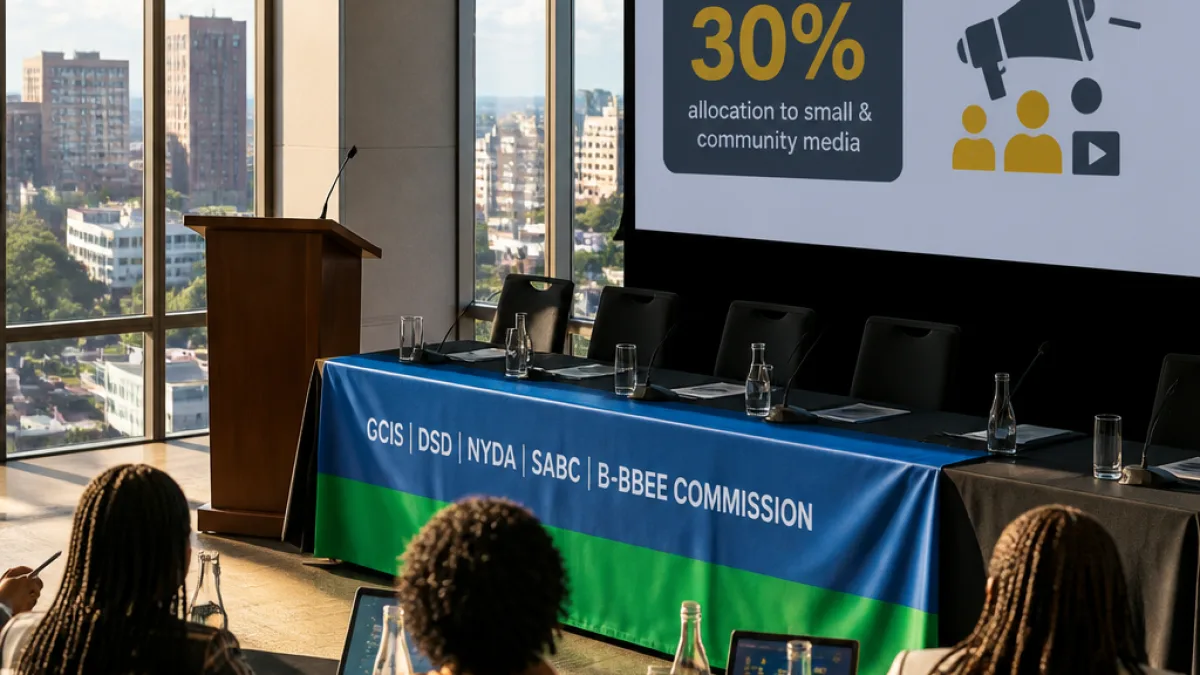
The revised communication policy places a strong focus on supporting small commercial and community media. A headline commitment is that government is expected to set aside 30% of its advertising spend for these media outlets.
| Item | Detail |
|---|---|
| Policy focus | Coordinated communication, nation branding, community media support |
| Advertising allocation | 30% of government advertising spend for small commercial and community media |
| National partners | GCIS, MDDA, Brand SA |
Why this matters for the Eastern Cape
The Eastern Cape has a dispersed population and a large number of rural towns and informal settlements where access to information can be uneven. Changes to how government plans and funds communication have practical implications for how provincial departments and municipalities reach residents, especially where local newspapers, radio stations and community media are an essential source of news and service information.
Increasing the share of advertising for small and community media could provide a financial lifeline for outlets that depend heavily on government advertising revenue. The MDDA’s involvement in the rollout signals an emphasis on media diversity and sustainability, while Brand SA’s presence highlights the national interest in a consistent external image and nation‑branding work.
- Session intent: improve coordination of government messaging across spheres.
- Funding emphasis: ensure communication is properly resourced rather than an afterthought.
- Media support: stronger backing for small commercial and community media through advertising allocation.
Process and next steps
According to GCIS, the Eastern Cape meeting follows similar engagements held in the North West, Free State, Mpumalanga and KwaZulu‑Natal as part of the nationwide rollout. The sessions form part of an advocacy programme intended to strengthen communication planning and support local media infrastructure.
The revised Government Communication Policy is publicly available on the GCIS website for stakeholders to review and for provincial departments to align their communication plans. The policy document details the expectations for coordinated messaging, funding provisions and the mechanisms intended to direct advertising spend toward smaller media outlets.
For provincial officials and media representatives, the immediate questions will be how the 30% allocation will be operationalised, what timelines the national departments will adopt, and how the PEC will integrate the policy’s requirements into the Eastern Cape’s communication and procurement practices.
The consultation also provides an opportunity for community media in the province to raise practical concerns about procurement processes, ratecards and the timeliness of payments — longstanding issues that affect the sustainability of local outlets. The GCIS and MDDA involvement suggests the national government intends to offer implementation guidance, though detailed modalities will become clear only after the PEC meeting.
The Eastern Cape engagement will be closely watched by local editors, broadcasters and municipal communication officers who rely on government advertising and who must now align with a policy that elevates communication funding as a core function of public administration.
The revised Government Communication Policy can be accessed on the GCIS website for those seeking the full text and implementation details.












