
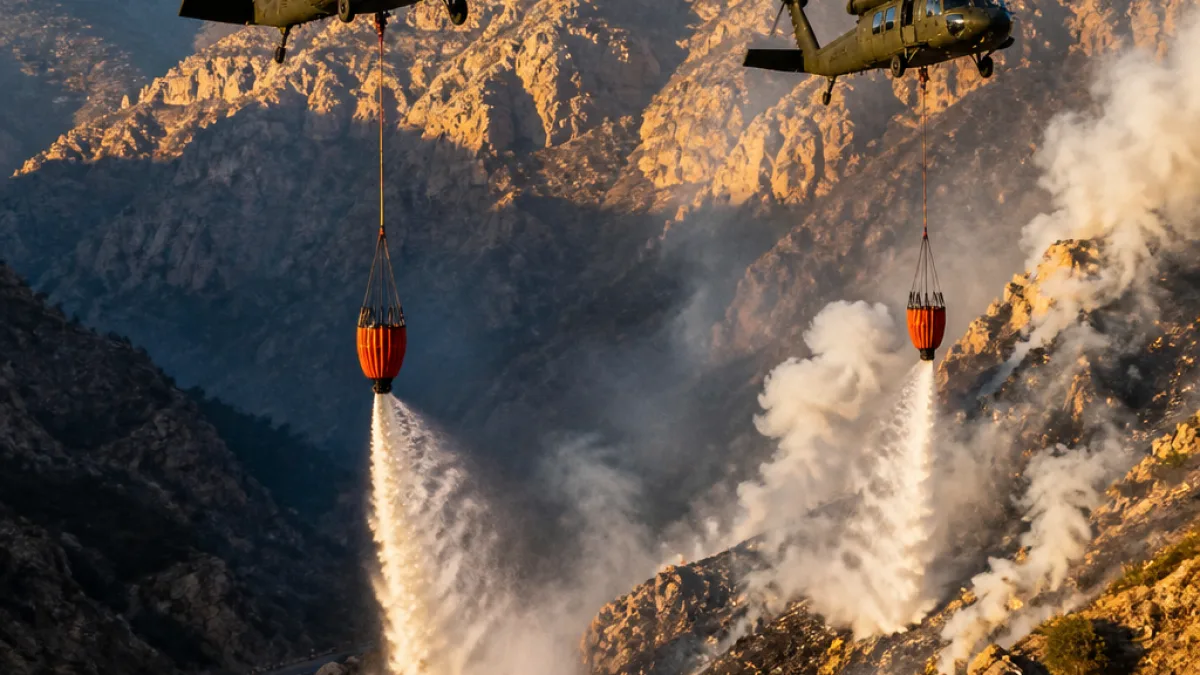
MORGAN COUNTY, Utah — Soldiers from the Utah Army National Guard have been flying sustained aerial water-drop missions over the Rocky Canyon Fire, deploying aviation assets to slow the blaze while local and state fire agencies continue ground operations.
Guard aviation shifts from training to fire response
The aviation contingent, organized under the 2nd Battalion, 211th General Support Aviation Battalion, moved into wildfire support in early August and initially assisted with the Black Canyon Fire in Sanpete County before shifting resources to Morgan County. Guard leaders said the unit is working alongside local authorities following formal requests through the state’s emergency management apparatus and the governor’s office.
On the ground and in the air, crews are focusing on repeated water-bucket drops intended to reduce fire spread and protect structures and communities in the fire’s path. The mission is being flown using two UH-60 Black Hawk helicopters assigned to the battalion.
Long shifts, tight coordination
Pilots and aircrews supporting the operation are working extended schedules. Army Chief Warrant Officer 4 Chris Aylstock, one of the pilots on the mission, described the tempo as demanding and continuous, with crews rotating to maintain operational continuity.
"We fly out there, get gas, get the word to launch, get on the fire, do a full fuel cycle, come back, get gas, shove a sandwich down the throat, go back out and do another fuel cycle,"
Aylstock said crews are typically on about 12-hour shifts, and pilots can spend about seven to eight hours actually flying during those rotations. To preserve institutional knowledge of the operation from day to day, unit leaders stagger pilot overlaps so incoming crews are briefed by those finishing their tours.
"We try to have at least five pilots doing some kind of overlap each day," Aylstock said, explaining the approach helps sustain effectiveness as conditions evolve.
Maintenance, logistics and a whole-unit effort
Guard commanders emphasized that aviation firefighting is not solely about pilots and aircraft. Keeping helicopters ready for repeated missions requires mechanics, logistical staff, refueling operations and mission support personnel working around the clock.
Army Lt. Col. Penny McCarthy, battalion commander for the 2nd Battalion, 211th GSAB, framed the Guard role as a state-capacity support asset that answers when local officials request help.
"We stand ready to support our state when these types of incidents occur,"
McCarthy said the two Black Hawks and their crews are focused on fire suppression activities at Rocky Canyon, and the unit moved rapidly from routine training into active operations once the mission was authorized.
Operational snapshot
| Unit | Aircraft | Typical pilot shift |
|---|---|---|
| 2nd Battalion, 211th GSAB | 2 UH-60 Black Hawks | Approximately 12 hours (7–8 hours airborne) |
- Mission start: Guard wildfire support began Aug. 5 with the Black Canyon Fire.
- Current focus: Rocky Canyon Fire in Morgan County, Utah.
- Primary activity: Repeated water-bucket drops to slow fire spread.
What this means for residents
For communities in and around Morgan County, the Guard’s aviation support supplements local firefighting resources by delivering repeated water drops in difficult terrain and providing sustained aerial suppression. Residents should continue to follow evacuation orders, road closures and guidance from local fire and emergency management officials as smoke and fire conditions change.
Officials did not release an immediate timetable for how long Guard aviation will remain assigned to Rocky Canyon, noting that activation depends on continued requests from local authorities and evolving fire conditions.
The Utah Army National Guard’s response highlights interagency coordination during wildfire season. As state and local partners absorb heavy workloads fighting multiple blazes across Utah, aviation units are a force multiplier for suppression efforts, enabling repeated strikes in areas that can be hard to reach by ground crews.
State and federal officials continue to monitor wildfire activity across Utah as the season progresses.
Spencer Holloway is the state correspondent for WE NEWS.

















