
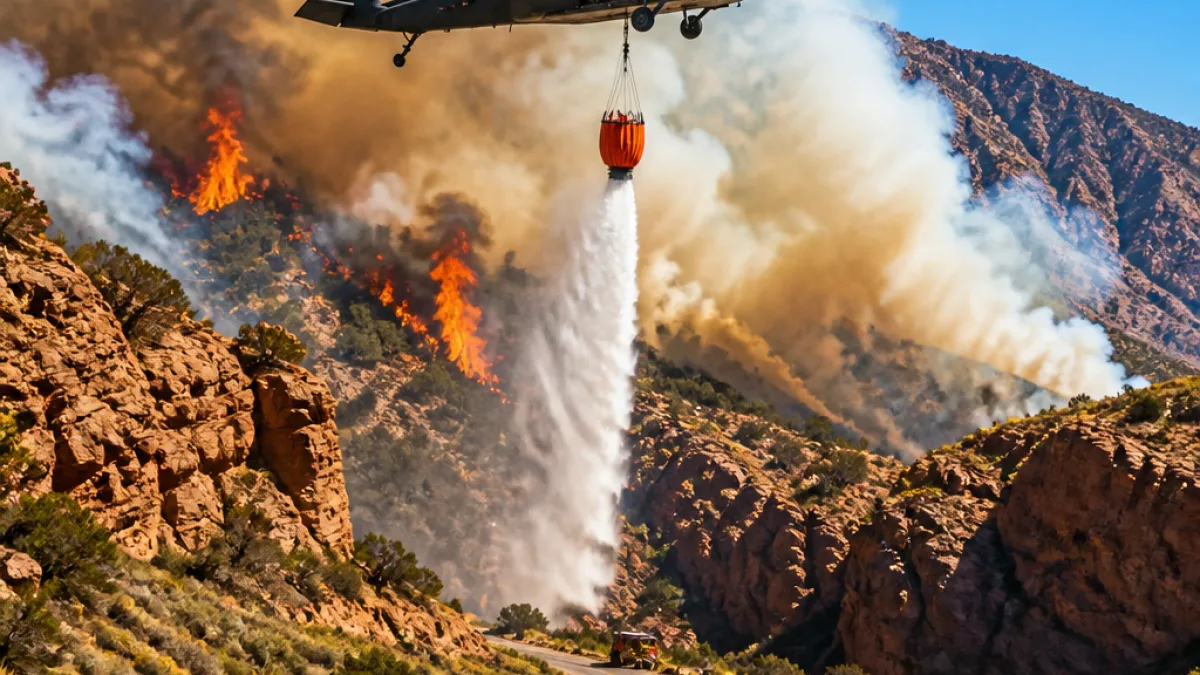
DRAPER, Utah — Utah National Guard Soldiers have mobilized specialized aviation assets to assist local and state firefighting forces as wildfires burn in multiple parts of the state, officials said.
Guard aircrews join ground efforts
Members of the 2-211th General Support Aviation Battalion (GSAB) have been flying UH-60 Black Hawk helicopters over the Rocky Canyon Fire in Morgan County, performing repeated water-bucket drops to slow the blaze’s spread. The battalion began wildfire support Aug. 5 with assistance to the Black Canyon Fire in Sanpete County, and shifted missions between incidents as conditions and requests evolved.
When local authorities request assistance, the Utah National Guard is activated through the state Department of Emergency Management and the governor’s office to supplement firefighting efforts, officials said. Once activated, Soldiers move quickly from training schedules to operational missions supporting suppression, reconnaissance and logistical needs.
Long days, tight rotations for pilots
Pilots and aircrews supporting the Rocky Canyon Fire are working extended shifts to maintain continuous support over the active fire. Chief Warrant Officer 4 Chris Aylstock, a pilot on the mission, described grueling but methodical tempos of operations.
"We fly out there, get gas, get the word to launch, get on the fire, do a full fuel cycle, come back, get gas, shove a sandwich down the throat, go back out and do another fuel cycle,"
Aylstock said crews often fly in approximately 12-hour duty periods, with pilots spending seven to eight hours in the air on some days. To preserve institutional knowledge and continuity across hours of operations, the battalion overlaps pilot rotations so teams arriving for duty are fully briefed on the fire’s status and tactics.
"We try to have at least five pilots doing some kind of overlap each day," Aylstock said, noting the overlap helps transfer experience and situational awareness from one shift to the next.
How activation works
State activation follows a formal request process: local or county agencies request support from the Utah Division of Emergency Management, which coordinates with the governor’s office and the National Guard to direct assets where needed. The Guard’s aviation units bring capabilities that complement ground crews, including rapid water delivery, aerial observation and movement of personnel and equipment.
| Unit | Aircraft | Initial mission date | Fires supported |
|---|---|---|---|
| 2-211th GSAB | UH-60 Black Hawk | Aug. 5 | Black Canyon (Sanpete Co.); Rocky Canyon (Morgan Co.) |
Operational constraints and public impact
Aviation support can be decisive in slowing fire spread, especially where terrain limits ground access. However, missions depend on conditions such as visibility, smoke, and airspace coordination with other aircraft — including state and federal air tankers and helicopters. The Guard’s crews rely on careful planning, fuel cycles and pilot overlap to sustain operations across long days.
For residents near active incidents, the Guard’s presence augments local resources, but it does not eliminate the need for continued public caution. Officials recommend following evacuation orders, staying alert to local emergency notifications and keeping clear airspace for firefighting aircraft by avoiding unnecessary drone flights in fire zones.
What to know and how to stay informed
- Expect increased helicopter activity near the Rocky Canyon and Black Canyon fire areas while missions are active.
- Follow local emergency management channels and county public information officers for evacuation or road-closure notices.
- Do not fly drones in wildfire areas; unauthorized aircraft can endanger responders and delay suppression efforts.
As wildfires continue to challenge Utah communities during the summer, the National Guard’s aviation support provides additional capacity for local and state fire operations. The 2-211th GSAB remains prepared to shift missions as requests and conditions change.
State and local officials did not provide estimates of containment or acreage in initial briefings about these missions.
Spencer Holloway is the state correspondent at WE NEWS covering public safety and state government.

















