
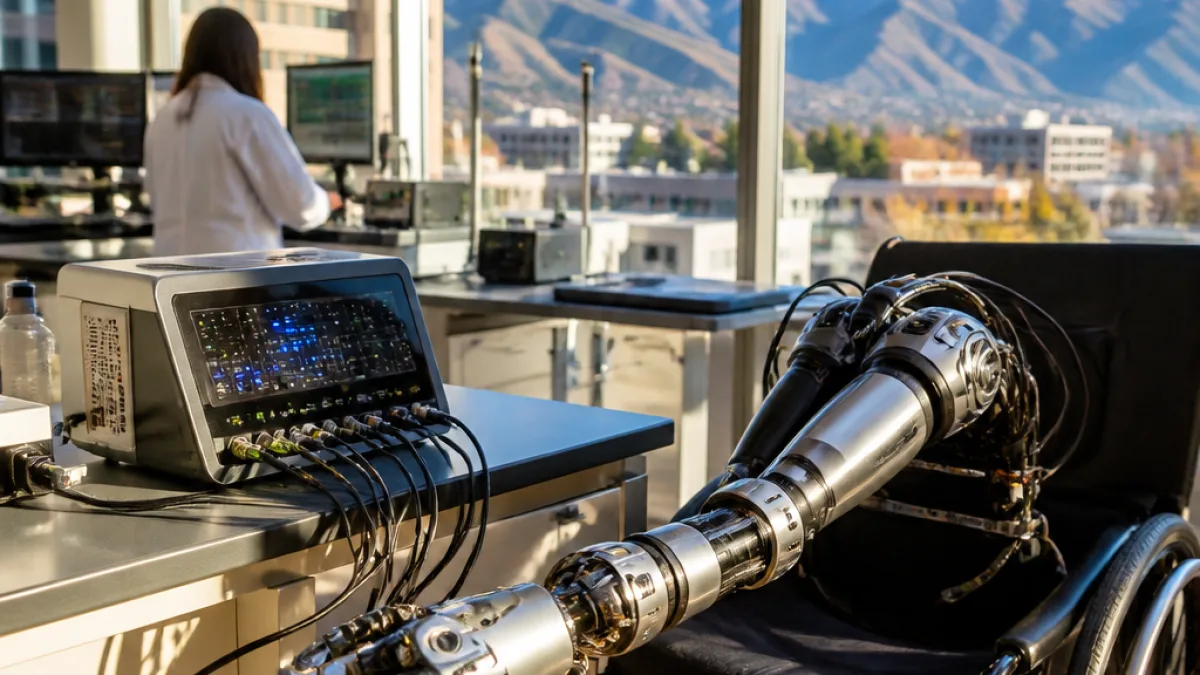
SALT LAKE CITY — A University of Utah–developed bionic arm that users control with their thoughts and that restores a sense of touch has moved out of the lab and into a participant’s home for the first time, researchers said.
First-of-its-kind home trial under way
Seventeen years after a fall from a telephone pole left Alexander “Avi” Davidson with a below‑elbow amputation and paralysis from the waist down, he is the inaugural participant in a clinical trial that will test the neural‑interface prosthesis in daily life. The trial will follow Davidson, who lives in Tampa, Florida, for one year in his home with a possible extension, study organizers said.
The prosthesis is powered by a direct nerve interface known as the BIOS Controller. The interface links the user’s nerves to the robotic limb so the device can be operated by thought and return a sensation that resembles natural touch.
Early results: routine tasks regained
Researchers reported that within days of using the prosthesis at home, Davidson performed everyday tasks many people take for granted, including writing, playing cards, making a sandwich and holding his wife’s hand. Those early demonstrations are being documented by Davidson on his social media accounts as part of the trial.
“The ability to have a return of sensation to my previously dominant hand is a life‑altering experience, as I never imagined feeling any part of that hand in my lifetime, let alone for it to feel so authentic,” Davidson said.
He added that the technology enabled him to perceive pressure and to feel his wife’s hand in return — sensations he described as transformative.
What the trial aims to learn
Investigators said the home trial is designed to provide a rare look at whether nerve‑connected prosthetic technology meaningfully enhances daily life for people with limb loss. The device’s makers emphasize several features that distinguish it from other robotic prostheses Davidson has previously tested:
- Direct nerve control: The BIOS Controller interfaces with the user’s nerves to allow thought‑driven movement.
- Sensory feedback: The prosthesis returns a sense of touch that users report as authentic.
- Fine motor control: Researchers say the device offers a range of movement and precise manipulation compared with other systems.
Davidson, who works as a therapist and photographer and is active in advocacy, said previous prosthetic systems he used did not combine range of motion, fine control and sensory feedback in the way this device does.
Trial details and context
The trial originates from work carried out at the University of Utah’s engineering and medical teams and has been described as inspired by the prosthetic arm seen in popular culture. Study leaders say longitudinal home use will inform whether the technology can improve quality of life beyond controlled clinical settings.
| Item | Detail |
|---|---|
| Participant | Alexander “Avi” Davidson |
| Residence | Tampa, Florida |
| Trial duration | One year (with possible extension) |
| Technology | BIOS Controller — direct nerve interface |
Researchers plan to analyze how the device performs in everyday conditions and how sensory feedback influences tasks that require precise pressure and object handling. The trial also will inform future device development and regulatory pathways by documenting real‑world use, user satisfaction and functional outcomes.
Local and broader implications
The University of Utah’s move to test the prosthesis in a private home represents a shift in how assistive technologies are evaluated. Controlled lab studies can demonstrate feasibility and safety, but extended home use is essential to understand whether advanced prosthetics translate into sustained independence and improved daily functioning.
For Utah researchers and clinicians, the trial could open avenues for expanded clinical testing, partnerships with industry and potential future availability of similar devices for people with limb loss. For patients, the work marks progress toward prosthetics that better mimic natural sensation and control.
As the yearlong trial continues, Davidson’s experiences will provide the research team and the public with first‑hand evidence of how neural‑interface prostheses perform outside clinical settings. Investigators said findings could influence rehabilitation practices and next steps in device refinement.
Contact information and additional trial updates are expected to be shared by the University of Utah and the research team as the study progresses.

















