
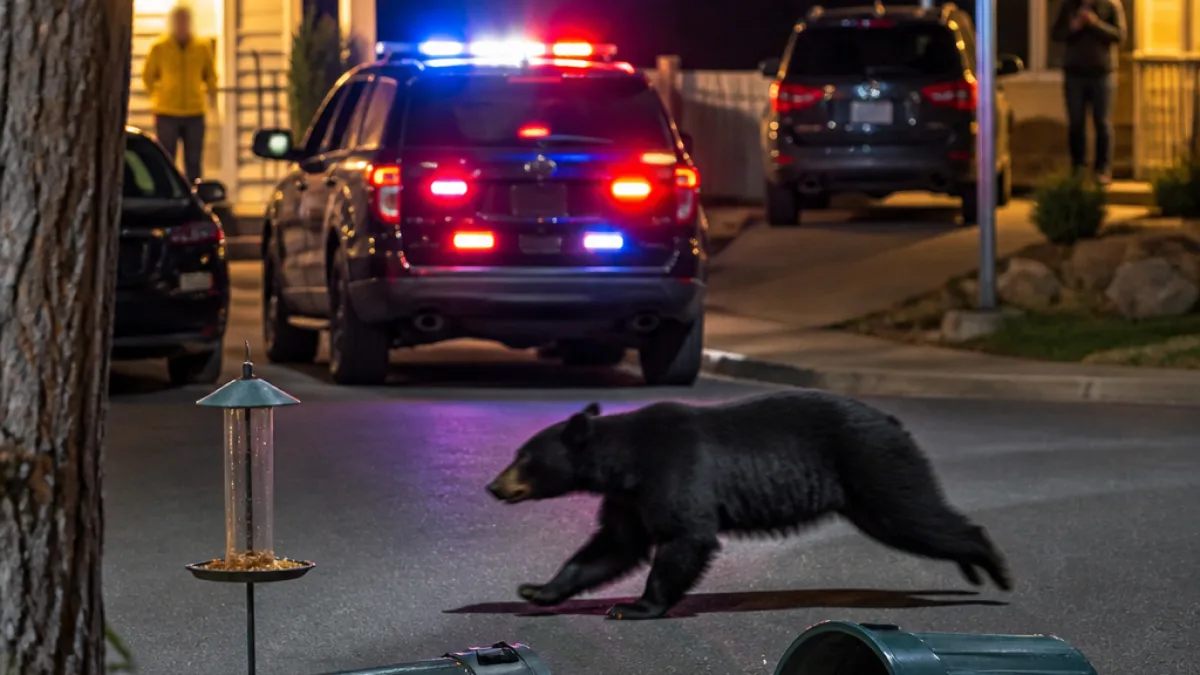
PAYSON, Utah — Residents reported and captured video of a bear sprinting through a Payson neighborhood Thursday night, marking the latest in a series of bear encounters across Utah County over the past several weeks.
What happened in Payson
Photographer Jesse Webber recorded footage of a black bear running across a street in Payson after dark. Officers located the animal later near 1600 North and 1450 East, where it was safely cornered until technicians from the Utah Division of Wildlife Resources could tranquilize and relocate it.
A string of recent sightings
Wildlife crews and law enforcement have responded to multiple bear incidents recently across the region. The uptick includes:
- a young black bear reported near Provo the day before the Payson sighting;
- a mother bear and two cubs found high in a tree in Mapleton on Aug. 4;
- a bear tranquilized and relocated after wandering into Ephraim limits on July 28.
Officials say these encounters are connected to environmental pressures limiting natural food sources for bears.
Why bears are coming into neighborhoods
Wildlife biologists attribute the growing number of close encounters to drought conditions that have reduced the availability of vegetation and other natural foods that compose the bulk of a black bear’s diet. According to wildlife officials, roughly 90% of a black bear’s diet consists of plants and other vegetation — items that have become scarcer this summer.
When natural forage is limited, bears increasingly seek calories in developed areas, turning to garbage, unsecured food, bird seed, pet food, and campsites.
How officials handled the Payson bear
After officers located the animal in Payson, they contained it until Division of Wildlife Resources personnel arrived. The bear was tranquilized and relocated. Officials have not released information about the bear’s age beyond reporters’ descriptions in the field.
| Date | Location | Action taken |
|---|---|---|
| Aug. 13 | Payson (1600 N & 1450 E) | Bear cornered; tranquilized and relocated |
| Aug. 12 | Provo | Young black bear sighted; wildlife crews searched |
| Aug. 4 | Mapleton | Mother and two cubs found in a tree |
| July 28 | Ephraim | Bear tranquilized and relocated |
Advice for residents
Wildlife officials emphasize that residents can reduce conflict by limiting attractants and practicing simple safety steps. Key recommendations include:
- Secure garbage in bear-proof containers and keep bins indoors until the morning of pickup;
- Remove bird feeders or put them out only during daylight hours when bears are less active;
- Bring pet food and bowls inside at night;
- Keep grills clean and store them in a garage or shed when not in use;
- When hiking or recreating in bear country, make noise, travel in groups and carry bear spray where legal.
Officials caution against approaching or attempting to feed bears. If you see a bear in a residential area, they advise calling local law enforcement or the Division of Wildlife Resources so trained personnel can respond.
Broader implications for wildlife management
Biologists say continued dry conditions could prolong increased bear activity near homes and recreation areas. As natural food sources remain limited, biologists expect bears may continue to explore human-dominated spaces for food. That raises both public-safety concerns and the need for community-level prevention measures.
For now, wildlife crews are prioritizing relocation of animals that present an immediate risk while also working with communities to reduce attractants that draw bears into neighborhoods.
Readers with information about recent sightings or video of encounters are encouraged to share details with local officials so authorities can monitor patterns and respond where necessary.
Spencer Holloway is the state correspondent for WE NEWS.

















