Boston — State health officials on Monday confirmed two additional human infections of West Nile virus in Massachusetts, bringing the total number of cases this year to five. The newly identified patients are men in their 70s and 80s, and officials said each was likely exposed in an eastern Massachusetts county.
Where exposures occurred
According to the Massachusetts Department of Public Health, the man in his 80s was likely exposed in Middlesex County. The other newly identified patient, a man in his 70s, is believed to have contracted the virus in Suffolk County. Earlier cases this year included a man in his 90s and a man in his 60s with exposures in Middlesex County, and a man in his 50s linked to Suffolk County.
| Case (2026) | Age group | Probable exposure county |
|---|---|---|
| 1 | 90s | Middlesex |
| 2 | 60s | Middlesex |
| 3 | 50s | Suffolk |
| 4 | 80s | Middlesex |
| 5 | 70s | Suffolk |
Risk levels and surveillance
The agency reported that as of Aug. 31 the West Nile risk is considered high in several communities in and around Boston, including Boston, Brookline, Cambridge, Everett, Newton, Somerville and Watertown. Another 206 municipalities across the state are identified as having a moderate risk.
State monitoring has also detected the virus in mosquitoes: the first positive mosquito samples for 2026 were announced in mid-June, and so far this year West Nile has been found in 232 mosquito samples collected across the state — all counties except Nantucket have reported positive samples.
Who is most vulnerable
Public Health Commissioner Robbie Goldstein emphasized that the risk remains real as summer wanes.
“As we all try to enjoy the last days of summer, we have to recognize the ongoing risk from West Nile virus,”
State and federal guidance notes that many people infected with West Nile virus have no symptoms, while others develop mild, flu-like illness. More severe disease can occur and may lead to hospitalization or death. Older adults and people with weakened immune systems are at higher risk of serious outcomes, the department said.
Prevention steps for residents
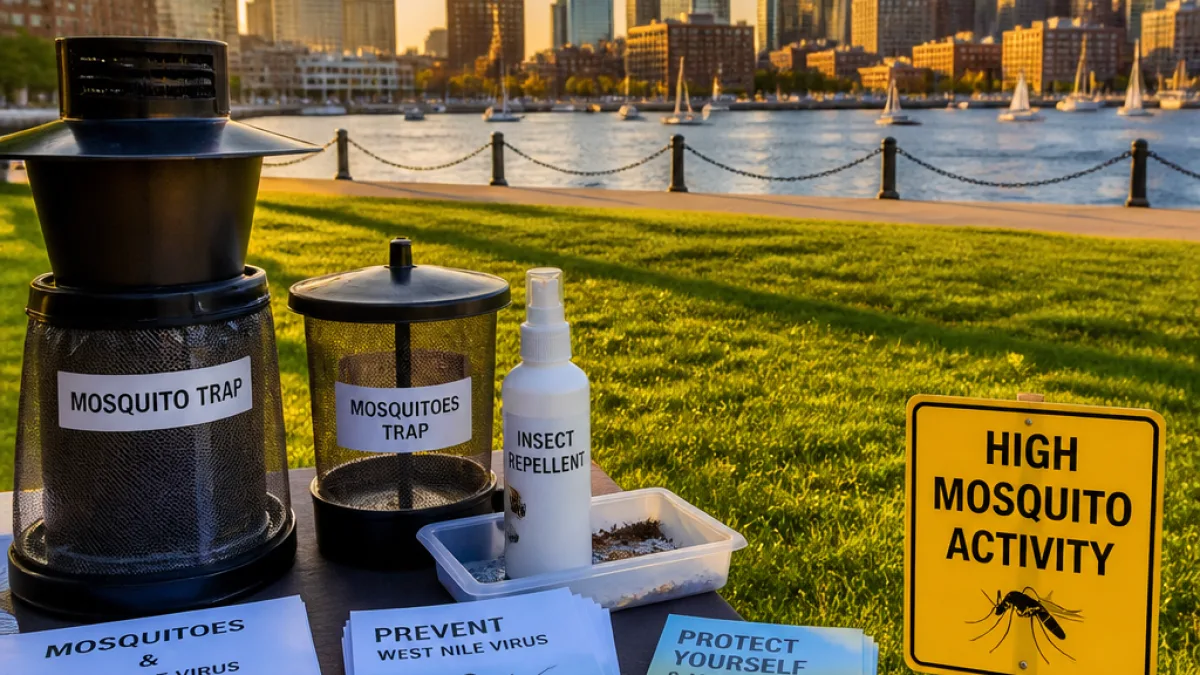
Health officials offered practical precautions to reduce mosquito bites and lower transmission risk. Recommended measures include:
- Use an insect repellent containing an EPA-registered active ingredient such as DEET, picaridin, permethrin (for clothing and gear) or oil of lemon eucalyptus, following label directions.
- Avoid being outdoors during peak mosquito activity, typically dusk to dawn.
- Remove standing water around homes where mosquitoes can breed, including clogged gutters and containers.
- Wear long sleeves and long pants when outdoors in mosquito-prone areas.
Local impact and what to watch for
With positive mosquito samples now widespread and human cases clustered in eastern counties, health officials urged residents in affected communities to be vigilant. People who develop fever, headache, body aches, skin rash or swollen lymph nodes after a mosquito bite should seek medical advice, especially if symptoms are severe or the person is older or immunocompromised.
State surveillance continues through the late summer and into the fall. Health departments at the municipal and state levels will update risk maps and case counts as additional laboratory confirmations are reported.
Reporting and testing of suspected human cases help authorities understand the scope of transmission and target mosquito-control measures. Residents can check the Massachusetts Department of Public Health website for the latest risk maps and guidance.
Andre Okonkwo is the state correspondent for WE NEWS.