The Union Oyster House is celebrating 200 years this summer, and in a city that markets its past as readily as its present, the milestone is a reminder that Boston’s oldest restaurants serve something beyond food: a curated dose of history. The South End landmark — known for dark beams, ship models and a small museum-like atmosphere — remains a touchstone for locals and visitors who want to taste Boston’s long arc.
Dining inside a narrative
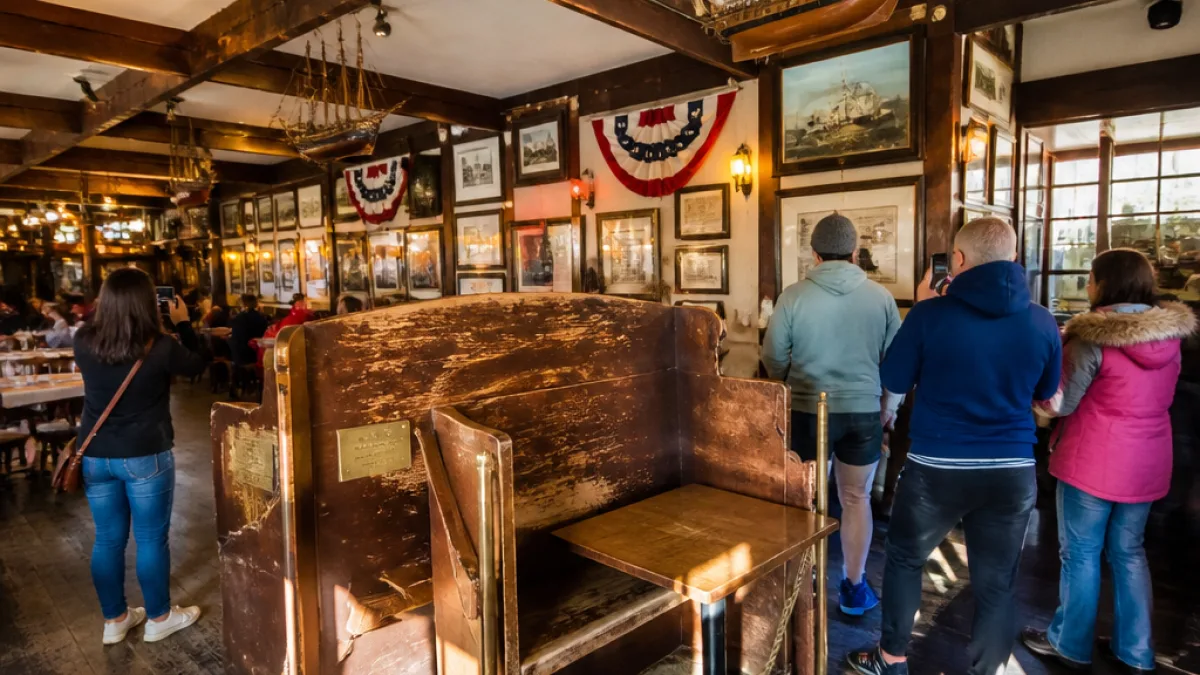
Inside the restaurant, the décor reads like a compact local-history exhibit. Framed plaques, patriotic bunting and maritime ornaments reinforce a story of longevity that has become part of the dining experience. One plaque on display notes an unexpected episode in the room’s past:
“Louis Philippe King of France (1830-1848) taught French to Boston’s fashionable Ladies in this room during His exile from France in 1796.”
Other artifacts invite guests to linger over the past: dioramas, a gift shop selling beanpots and a booth associated with a president. The menu, however, shows how the restaurant balances preservation with modern demand. In addition to traditional offerings such as chowder and schrod, customers can find nontraditional entrées including Bangkok mussels with Thai chiles and fish sauce, and a lobster ravioli — choices that illustrate how historic eateries update menus while leaning on their reputations.
That blending of past and present is common across Boston’s long-lived restaurants. For many of these establishments, age is an asset — a marketing tool that reassures customers about authenticity even as kitchens adapt to evolving tastes. Reporters visiting some of the city’s oldest spots found interiors that lean into narrative and menus that mix the familiar with the contemporary.
What keeps the old places relevant
There are practical reasons these restaurants endure. Historic dining rooms draw tourists seeking a connection to Revolutionary-era lore or presidential trivia, and locals often bring out-of-town guests to show them a piece of Boston they can walk out of and point to on a map. But the staying power also hinges on business decisions: maintaining recognizable fixtures, offering signature dishes, and in many cases updating menus enough to keep regulars coming back without alienating those who arrive expecting a time capsule.
- Heritage as brand: Age and story remain central to marketing and atmosphere.
- Menu evolution: Historic restaurants often add contemporary dishes alongside classic fare.
- Tourism and local loyalty: Both visitors and residents sustain these businesses, each for different reasons.
Not every detail of a restaurant’s past is straightforward. Historians and food writers caution against taking every claim at face value; some stories are curated for effect. Discerning the lines between verifiable history and appealing myth requires research and, at times, skepticism. Still, most agree that the cultural value of these institutions is real — whether they trade primarily on provenance or on the quality of a bowl of chowder.
| Feature | What it signals |
|---|---|
| Plaques and dioramas | Historical framing and storytelling |
| Signature booths (e.g., JFK’s) | Celebrity and civic association |
| Modern dishes on menu | Adaptation to contemporary tastes |
As the Union Oyster House marks two centuries, its mix of relic and restaurant raises questions about what preservation means in a working business. For some patrons, the appeal is unambiguous: to sit where others sat long before and consume a food tradition. For others, the modern touches — from Thai-influenced mussels to creative entrées — show a willingness to survive by evolving.
Boston’s oldest restaurants, it turns out, are less like sealed-off museums and more like living institutions: rooted in history, but continually negotiating how much of that past to display. For the city’s residents and visitors alike, that balance will determine whether these places remain pilgrimage sites or simply well-branded options on an ever-changing dining landscape.