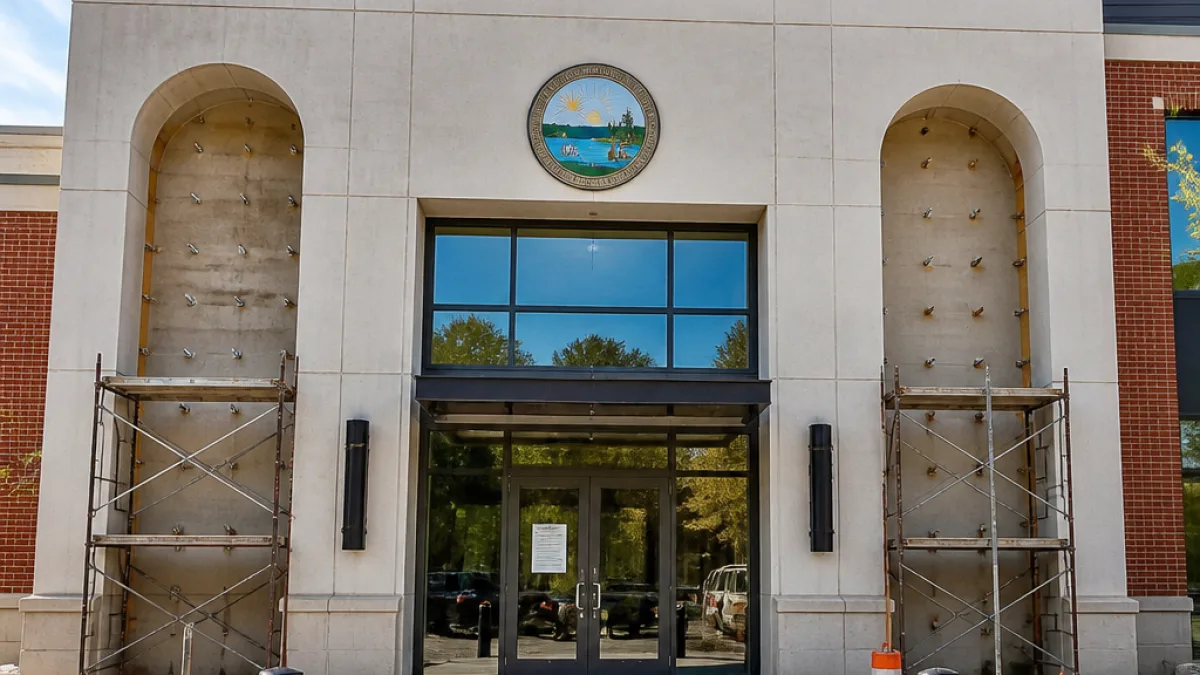
The Massachusetts Supreme Judicial Court unanimously affirmed a lower court ruling that prohibits Quincy Mayor Tom Koch from installing two 10-foot bronze statues of Catholic saints on the exterior of the city's new public safety building, the court said in an opinion released this month.
Court finds likely constitutional violation
The SJC agreed with a Norfolk Superior Court judge that the planned placement of statues of St. Michael the Archangel and St. Florian — patrons of police and firefighters — likely would violate the state constitution’s prohibition against government favoring one religion over another or religion over nonreligion. The unanimous decision affirms the preliminary injunction issued by Judge William Sullivan in September 2025 and leaves intact the bar on installing the figures while the underlying case proceeds.
The plaintiffs, a group of Quincy residents, brought the suit in May 2025 after learning that the statues had been commissioned without public notice. The SJC opinion also concluded the lower court applied the correct legal precedent, citing the 1979 state case Colo v. Treasurer and Receiver General, in evaluating the plaintiffs’ motion for injunctive relief.
Details of the project and controversy
The $175 million, four-story, 120,000-square-foot public safety headquarters opened in March 2026. Two empty niches remain halfway up the building’s impressive facade where the statues would have stood.
Mayor Koch, a practicing Catholic, commissioned the statues in 2023 at a cost of $850,000, according to court documents. The public and elected city council members were not informed of the plan until January 2025, when local reporting from The Patriot Ledger first revealed the commission.
Legal teams and next steps
Attorneys for the plaintiffs include the American Civil Liberties Union, Americans United for Separation of Church and State and the Freedom From Religion Foundation. The city is represented by the Becket Fund, a nonprofit conservative legal group. Lawyers on both sides are working pro bono.
The SJC decision does not resolve the merits of the case; it returns the matter to Norfolk Superior Court for further proceedings. Until that final determination, the injunction remains in place and the statues cannot be installed.
- What was ordered: Installation of the statues is barred pending final resolution.
- Who is involved: Quincy mayor, residents plaintiffs, multiple civil liberties groups and the Becket Fund.
- Legal precedent cited: Colo v. Treasurer and Receiver General (1979).
Local and legal implications
The ruling underscores limits on how municipal officials may use civic architecture to reflect religious imagery. Experts in church-state law say such cases often hinge on whether a reasonable observer would view a government action as an endorsement of religion. The SJC’s unanimous opinion confirms that Massachusetts courts will apply that framework when assessing controversial displays on public property.
For Quincy residents, the decision leaves a visible mark on the new building: the two stone niches remain empty, a reminder of the dispute between a mayoral initiative and constitutional constraints. The case also highlights questions about municipal transparency and whether elected officials must seek public input before commissioning religiously themed art for civic structures.
Timeline
| Date | Event |
|---|---|
| 2023 | Mayor Koch places order for two bronze statues |
| May 2025 | Quincy residents file suit in Norfolk Superior Court |
| Sept. 2025 | Judge William Sullivan issues preliminary injunction |
| Jan. 2025 | Public reporting reveals existence of the commission |
| March 2026 | Public safety headquarters opens with empty niches |
| May 2026 | SJC hears oral arguments |
| Aug. 2026 | Supreme Judicial Court affirms lower court injunction; case returns to Norfolk Superior Court |
The case will continue in Norfolk Superior Court, where a final determination must weigh the competing claims: the mayor’s stated intent to honor public safety personnel and the plaintiffs’ assertion that placing religiously specific figures on a government building violates the state constitution. The SJC ruling narrows the immediate options for city officials, leaving the broader constitutional questions for further litigation.
Andre Okonkwo, State Correspondent, contributed reporting to this article.