
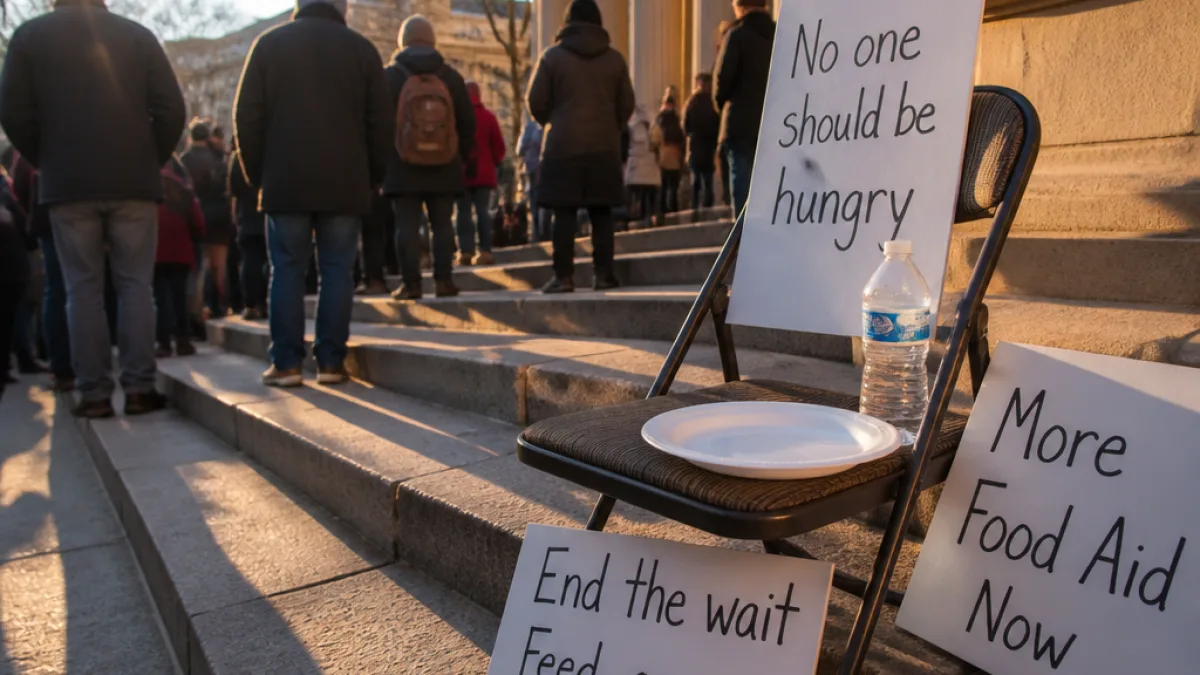
SPRINGFIELD, Mass. — An anti-hunger advocate who leads a Springfield food-policy group said she has gone without solid food for more than two weeks to spotlight a sharp drop in food stamp enrollment driven by sweeping federal changes and to press Governor Maura Healey for a stronger state response.
Fasting as protest
Liz Wills-O'Gilvie, 63, who directs the Springfield Food Policy Council and the food-justice group Gardening the Community, says she has consumed only water, electrolytes and glucose pills for 15 days. Appointed last year by Gov. Healey to the state’s Anti-Hunger Task Force, Wills-O'Gilvie said the fast is intended to draw attention to rising food insecurity after the U.S. Department of Agriculture reported that more than 5.3 million people nationally lost Supplemental Nutrition Assistance Program benefits following policy changes enacted in 2025.
"I know what (hunger) looks and feels like," Wills-O'Gilvie said.
Wills-O'Gilvie, who told Reuters she lives with lupus and hypoglycemia, said the fast has left her unable to drive. She told state legislators and said she spoke last week with Healey, who she said told her the governor was working on the issue. Wills-O'Gilvie added she intends to forgo food indefinitely until changes are made.
State administration under strain
Massachusetts’ Department of Transitional Assistance, which administers SNAP, has experienced a notable decline in enrollment. According to agency data cited in the reporting, enrollment in the state is down by nearly 182,000 people, including almost 65,000 children. The DTA also reported an uptick in daily call volume and difficulty connecting callers with caseworkers: a roughly 9% rise in daily calls, with about 47% unable to connect, compared with about 37% previously.
The DTA and Healey’s office did not provide comment to Reuters for the story.
How advocates describe the impact
Advocates warn that the combination of tighter federal SNAP rules and higher grocery prices has increased strain on low-income households. Wills-O'Gilvie and other anti-hunger activists say the state’s assistance system is overwhelmed and that people are losing benefits because they cannot reach caseworkers or navigate updated application procedures.
- Human cost: Thousands of families face tighter food budgets and interrupted benefits.
- Administrative pressure: DTA call centers are handling more calls and many callers are unable to connect.
- Policy gap: Advocates are pressing the governor and legislators for additional state-level support to offset federal changes.
Numbers at a glance
| Measure | Figure |
|---|---|
| National SNAP benefit losses (USDA) | 5.3 million |
| Mass. enrollment decline | ~182,000 people |
| Children losing benefits in Mass. | ~65,000 |
| Increase in DTA daily calls | 9% |
| Share callers unable to connect | 47% (up from ~37%) |
What this means locally
Springfield and other Massachusetts communities that rely on SNAP say they are now seeing the policy changes reverberate through food banks, school meal programs and local outreach groups. Wills-O'Gilvie’s fast is intended to push for immediate state intervention, whether through supplemental funding, staffing increases at the DTA or policy adjustments to reduce administrative barriers to benefits.
State lawmakers and anti-hunger organizations have previously urged Massachusetts to consider short-term measures to prevent family food instability while longer-term federal debates continue. The details of any new state action remain unresolved.
Next steps
Wills-O'Gilvie said she has met with legislators in her home and continues to press the governor’s office for change. Her protest highlights broader debates over responsibilities between federal and state governments when program rules change and underscores the operational challenges state agencies face when implementing major policy shifts.
Reporting for this story relied on a Reuters account. The Massachusetts Department of Transitional Assistance and Gov. Healey’s office did not respond to requests for comment in that reporting.
— Andre Okonkwo, State Correspondent

















