
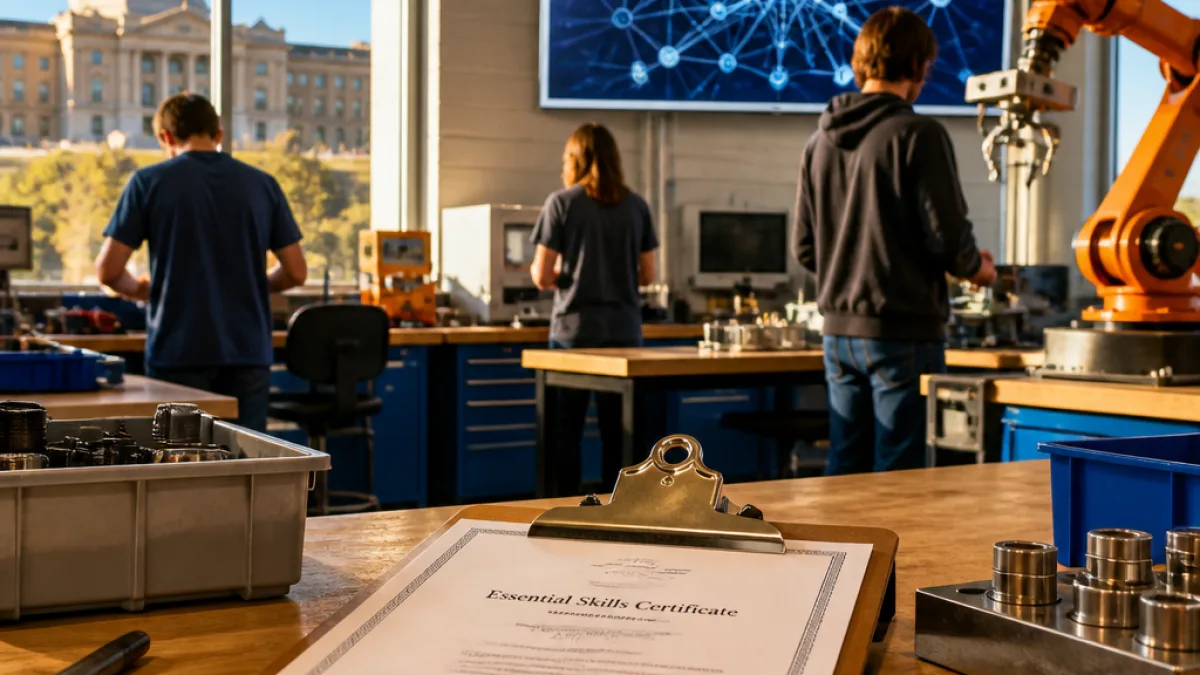
South Dakota faces a choice about how to train its next generation of workers as artificial intelligence changes the nature of routine entry-level tasks, state workforce officials and experts say. The Workforce Development Council’s August 25 agenda included proposals for an Essential Skills Certificate, a list of Hot Careers and updated career-and-technical education standards — a timely moment to consider how apprenticeship and training models should adapt when AI performs much of the work junior employees once learned on the job.
New research raises urgency
A recent employment analysis from the Stanford Digital Economy Lab, using ADP payroll records through June 2026, found a widening gap in hiring for young workers in occupations most exposed to AI. Workers ages 22 to 25 employed in highly AI-exposed roles numbered about 19 percent below where they would be if hiring had kept pace with peers in less-exposed occupations. The same comparison using July 2025 data showed a 15 percent gap.
The researchers concluded the adjustment has come mainly through reduced hiring rather than increased separations, and that this pattern is concentrated among early-career workers; more experienced employees do not show the same shortfall.
| Data vintage | Gap in employment for ages 22–25 |
|---|---|
| July 2025 | 15% |
| June 2026 | 19% |
Apprenticeship as a policy lever
State officials and workforce advocates say South Dakota’s registered apprenticeship system offers a ready framework to respond: it combines paid employment with structured instruction and allows employers to build training around the specific skills their positions require. Leaders suggest the model could be extended beyond traditional trades into offices, professional services, health administration, finance, agriculture and manufacturing support — sectors where AI is increasingly used for predictable, routine work.
Rather than eliminating entry-level tasks, employers could redesign them so that automation performs routine preparation while human trainees develop higher-order skills. Suggested adjustments include:
- Letting AI produce first drafts, basic research, schedules and standardized summaries;
- Moving junior employees earlier into verification, exception spotting and judgment-based tasks;
- Measuring coaching as a production activity so experienced staff spend part of saved time on structured mentorship.
For example, when AI composes a draft report or pulls a standard data set, new hires could be responsible for validating sources, identifying anomalies and asking clarifying questions of clients — functions that require critical thinking and communication rather than rote repetition.
Redesigning on-ramps to careers
Workforce and education leaders in South Dakota already are discussing credentialing and curricular changes that would support this shift. An Essential Skills Certificate and revised career-and-technical education standards were on the Workforce Development Council’s agenda, signaling a move toward formal recognition of the competencies employers will need.
That recognition matters because the Stanford analysis indicates the disruption is shaping who gets hired, not who keeps working. If entry-level positions disappear, students and new labor-market entrants risk losing the practical training that historically built skills and career momentum. Apprenticeship structures can preserve paid learning opportunities, align them with employer needs and embed AI literacy and judgment evaluation into training.
Implementation considerations
Adapting apprenticeships for knowledge-intensive roles will require deliberate changes in how employers assign work and how training is assessed. Practical steps could include:
- Creating task maps that separate routine, automatable activities from those that build judgment;
- Reallocating hours saved by AI to supervised review and coaching;
- Developing standards for assessing a trainee’s ability to verify AI outputs and manage exceptions.
State policymakers, employers and educators will need to collaborate on accreditation, funding and employer incentives so apprenticeship programs can be expanded into white-collar and administrative fields without shifting costs entirely to businesses or students.
What’s at stake
The stakes are economic and social. If hiring for young workers continues to lag in AI-exposed jobs, South Dakota risks shrinking early-career opportunities that historically have fed the state’s workforce pipeline. By contrast, updating apprenticeships and credentialing could preserve paid on-the-job learning, accelerate the development of judgment and communication skills, and help employers reap AI productivity gains without hollowing out career entry points.
As the Workforce Development Council moves forward with its agenda, the choices made now will shape how the state equips young people for a labor market in which machines handle routine work and humans retain responsibility for oversight, problem solving and client-facing judgment.















