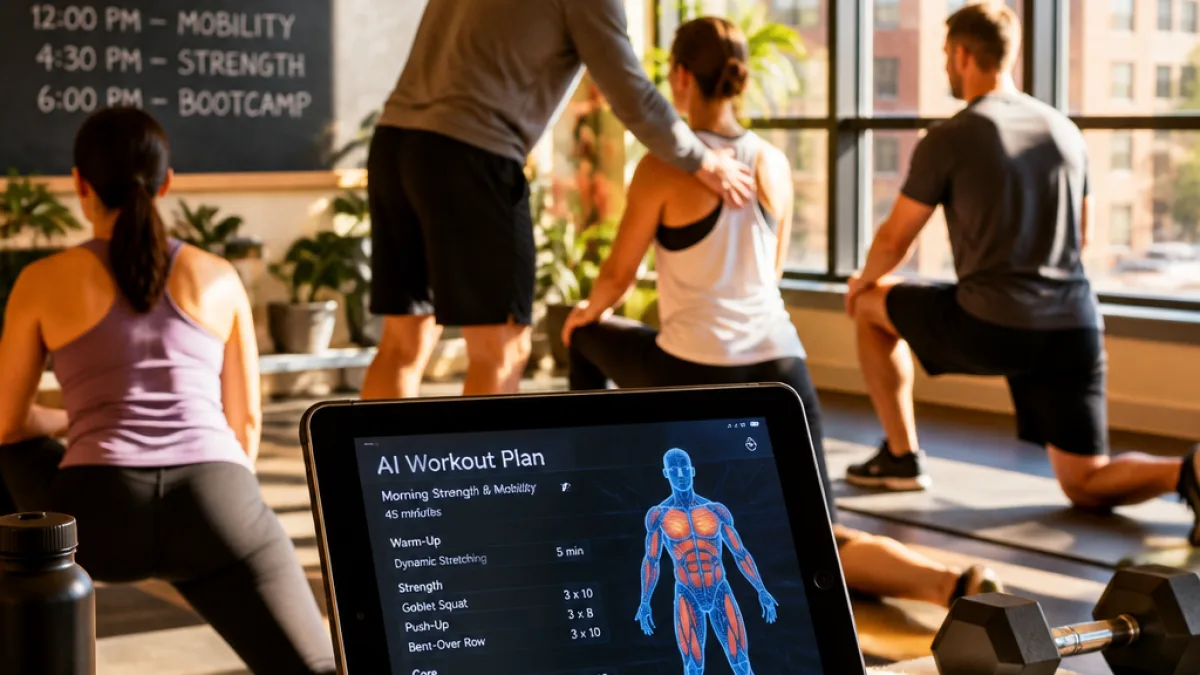
SIOUX FALLS, S.D. — Artificial intelligence tools can produce a workout routine in seconds, but local fitness professionals say technology still falls short where it matters most: accountability, real-time feedback and the human connection that keeps people coming back.
Community and presence matter
William Sturgeon, owner of Mind Body Wellness in Sioux Falls, said AI can be useful for generating generic plans, but it cannot replicate the environment that encourages people to follow through. In his early-morning classes, accountability begins with the simple act of showing up.
“When you’re in an environment where you’re supported, it makes life easier, because I’ll be honest, doing fitness sucks; it’s hard,” Sturgeon said.
That support shows up in ways beyond motivation. Sturgeon emphasized the trainer’s role in modifying sessions based on a client’s immediate needs — whether they slept poorly, are experiencing high stress or have joint limitations. He said those moment-to-moment adjustments are critical to safe, effective training and are difficult for AI to reproduce.
Where AI fits — and where it doesn’t
AI advocates point to speed, customization at scale and data tracking. Tools can build a program quickly, measure performance metrics and deliver reminders. But local experts caution that precision in a controlled dataset is not the same as precise coaching for a lived body.
- Accountability: Human-led classes and appointments create a social commitment that many clients rely on.
- Real-time feedback: Trainers observe form and fatigue, making on-the-spot corrections to prevent injury.
- Connection: Group and one-on-one settings provide emotional and social support that AI cannot offer.
Peter Folliard, vice president of innovation at Augustana University, who uses AI in his day-to-day work, said his gym experience underlined the value of human interaction.
“AI can’t replace people and connection,” Folliard said. “It’s not going to connect you like these people will keep you connected, and grounded, and fed in a really deep way. I rely on the workout for my body; I rely on the team for my soul.”
Practical implications for Sioux Falls residents
For residents weighing apps and AI-generated plans against trainer-led sessions, the choice often comes down to goals and needs. Those seeking convenience or a starting structure may find AI tools helpful. But people with chronic joint issues, recent injuries, or who need motivation and social support are likely to get more consistent results from in-person coaching, local trainers say.
| Feature | AI-generated programs | In-person trainers (Sioux Falls) |
|---|---|---|
| Speed | High — plans in seconds | Moderate — tailored planning takes time |
| Real-time adjustments | Limited — based on user input | Strong — trainer observes and adapts |
| Social connection | Low | High — classes and teams |
Sturgeon described a simple protocol he uses: the first question to a returning client is whether anything has changed since the previous session, a quick assessment that can alter the day’s plan. That kind of conversational triage is difficult to model with current AI systems, he said.
Blended approaches are emerging
Neither Sturgeon nor Folliard dismissed AI entirely. Both acknowledged that technology has a role — for program ideas, tracking progress and augmenting human-led services. The local trend in Sioux Falls appears to be toward hybrid approaches that use AI for data and structure while keeping coaches responsible for adaptation, safety and community.
For Sioux Falls residents, the message from local experts is clear: technology can help with logistics and initial programming, but those seeking sustained behavior change, injury prevention and deeper social connection should consider trainer-led options or blended services that combine the best of both worlds.