
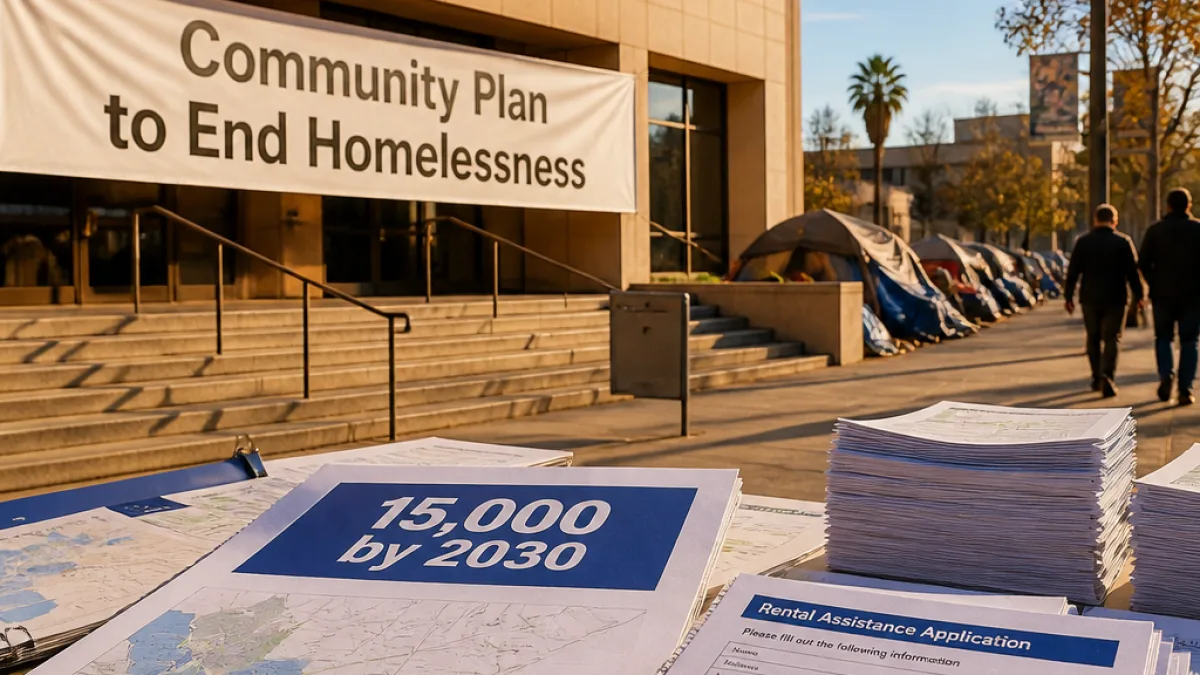
The Santa Clara County Board of Supervisors on Tuesday unanimously approved a new Community Plan to End Homelessness that lays out county priorities through 2030, but officials warned the effort faces significant financial and legal headwinds.
Ambitious targets amid rising need
The plan builds on progress from the previous five years, during which the county says it helped nearly 21,000 people into housing. Over the next five years, county leaders are targeting assistance to secure permanent homes for an additional 15,000 people and to provide eviction-avoidance rental support to 3,000 households annually.
- Goal: house 15,000 more people by 2030
- Prevention: rental assistance for 3,000 households each year
- Focus areas: prevention, housing retention, outreach/services for people living on the street, and investments in people with lived experience
Supervisors requested periodic updates on implementation and asked the county to report on how different parts of the county will address homelessness. The plan emphasizes four core strategies: homelessness prevention, housing retention, increasing services for people living on the street and investing in those with lived experience.
“We have so many proof points that the model works, it is simply not at scale,” District 4 Supervisor Susan Ellenberg said at the meeting. “Being able to continue along the same path is very critical … and extraordinarily more challenging right now.”
Mounting challenges: funding, court rulings and shifting federal priorities
Even as the county sets forward goals, officials acknowledge barriers. The county is contending with what officials described as a record homeless population of approximately 10,700 people. At the same time, county leaders say federal funding priorities have shifted under the Trump administration toward temporary housing tied to conditions such as work or sobriety, making long-term affordable housing investment more difficult to secure.
County staff are also engaged in a legal fight to preserve federal Continuum of Care grants for affordable housing rather than letting those dollars be redirected toward temporary, conditional housing programs. Complicating enforcement and outreach are broader legal changes: the 2024 U.S. Supreme Court ruling in Grants Pass v. Johnson has been cited as enabling measures that criminalize some aspects of homelessness — a factor county leaders say has led to increased sweeps, restrictions on RV parking and more citations and arrests in jurisdictions such as San Jose.
| Metric | Figure |
|---|---|
| People housed in prior 5 years | ~21,000 |
| Target additional people housed by 2030 | 15,000 |
| Annual rental assistance target | 3,000 households |
| Approximate current homeless population | 10,700 |
Local impact and next steps
For Santa Clara residents, the county plan could mean expanded rental assistance programs, more outreach teams and a continued emphasis on permanent supportive housing as the primary tool for reducing long-term homelessness. The county’s insistence on tracking implementation and requiring regional updates may also affect how city governments across the county allocate resources and coordinate with county programs.
County officials have framed the plan as a continuation of an approach they say has produced demonstrable results, while acknowledging it will be harder to scale given tighter federal funds and legal pressures that shift how cities manage encampments and street outreach. The Board’s unanimous approval moves the plan into an implementation phase in which funding allocation, intergovernmental coordination and legal outcomes will determine whether the county can reach its stated targets.
As implementation proceeds, county residents can expect regular updates to the Board on progress and challenges. Officials have pledged ongoing reporting on how each part of the county will meet the plan’s goals and on the performance of the strategies the plan endorses.
















