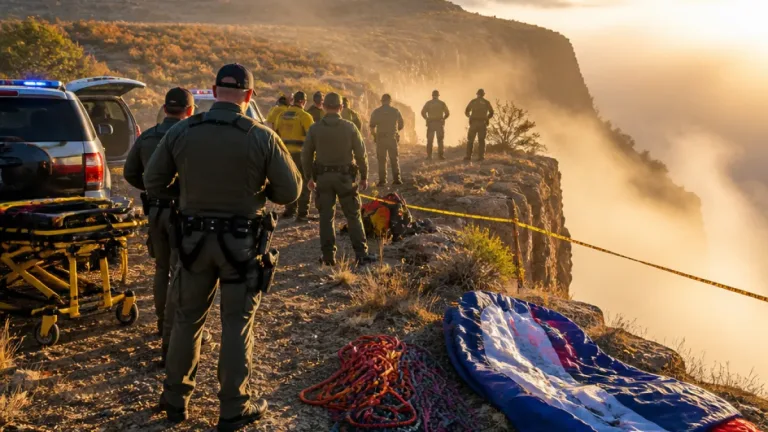

Gov. Larry Rhoden has authorized state firefighting resources to assist local governments in suppressing wildfires as South Dakota contends with widespread drought and a string of recent blazes. The executive order, signed Tuesday, broadens the operational footprint of South Dakota Wildland Fire beyond the Black Hills Forest Fire Protection District.
What the order changes
Previously, the state's wildland firefighting agency focused responses inside the Black Hills Forest Fire Protection District — a region that begins at the Wyoming-South Dakota border and extends east through parts of the Black Hills, excluding areas inside city limits. Rhoden’s order expands the agency’s authority to provide approved assistance outside that district, enabling quicker deployment of state resources to support volunteer and local fire departments across a larger portion of the state.
Volunteer fire departments, which handle the majority of wildfire responses across South Dakota’s rural landscape and rely heavily on local funding and donations, have faced increased demand this season as parched conditions make fires more likely and more difficult to contain.
"As a volunteer firefighter, I understand that every second counts when attacking a fire. And as a lifelong rancher, I recognize the difficulty feeding livestock during this ongoing drought," Rhoden said in a news release. "Supplementing local resources with approved state assistance will improve response time, saving lives and property."
Where drought and fires are worst
According to the U.S. Drought Monitor, most of South Dakota falls in categories ranging from abnormally dry to severe drought, with pockets of extreme drought in parts of the southwest. Fire activity this year has included several significant incidents in western counties.
| Incident | County | Approximate acres burned |
|---|---|---|
| Qury Fire | Custer County | 9,000+ |
| False Bottom Fire | Near St. Onge | 242 |
| Bear Butte Fire | Meade County | 400 |
Relief steps for agriculture and logistics
In addition to expanding firefighting authority, Rhoden extended a July order that relaxes hauling restrictions for hay producers. The measure permits hay transport up to two hours before sunrise and two hours after sunset, a move designed to help ranchers move feed during a season when grazing land and stored supplies are under strain.
Rhoden activated the state Drought Task Force in May. The multi-agency group evaluates potential impacts on agriculture, fire management and water resources and coordinates state-level responses including mutual aid and logistical support.
Local capacity and response time
Volunteer departments are the first line of defense in most rural areas, but limited personnel, equipment and funding can hinder response, especially when multiple incidents occur simultaneously. By authorizing state assets to operate beyond the previous boundary, the executive order aims to reduce travel time for additional crews and equipment, bringing reinforcement to rural communities faster when a blaze threatens lives, homes or livestock.
- Expanded authority: South Dakota Wildland Fire can now assist outside the Black Hills protection district.
- Hay transport eased: Producers may move hay earlier and later to ensure livestock feed.
- State coordination: Drought Task Force continues to monitor agricultural and water impacts.
What residents should know
Residents in at-risk areas should follow local emergency alerts and heed evacuation or sheltering guidance from county emergency management. Those living near fire-prone grasslands or rangeland should create defensible space around structures, keep ignition sources controlled, and maintain a plan for livestock or companion animals that may need evacuation or alternative feed.
State officials did not provide an estimate in the release for how quickly additional crews could arrive under the expanded authority nor a breakdown of new resources being deployed. Local emergency managers remain the primary contact for on-the-ground incident information.
The combination of persistent dryness and recent large fires highlights continuing wildfire risk across the state. The executive order is intended to strengthen support for volunteer departments at a time when every minute matters during suppression efforts.
Reporting from the Statehouse and on the range will continue as agencies provide further detail on deployments and as the Drought Task Force assesses needs for the coming weeks.