
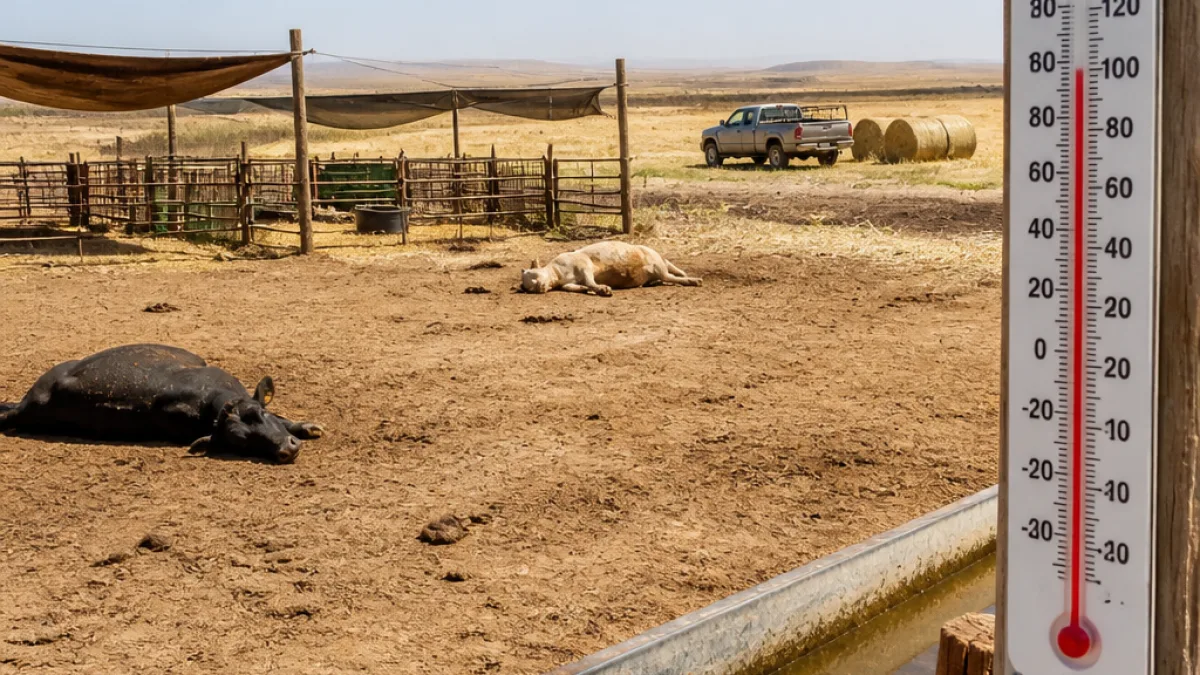
The fallout from a historic July heat wave continues to reverberate across South Dakota as ranchers tally livestock losses and sorting through the financial and emotional aftermath. Producers say standard heat-mitigation steps were not enough against a combination of extreme daytime temperatures, high humidity and insufficient overnight relief.
Historic heat, unusual conditions
Data from the National Weather Service’s Rapid City office underscored how extreme the event was locally: downtown Rapid City reached 110 degrees Fahrenheit on July 25, while the Rapid City airport recorded 112 degrees that day. At the national level, the National Oceanic and Atmospheric Administration reported July as the warmest month on record for the contiguous United States, with an average temperature of nearly 77 degrees.
Feedlot management specialists and producers described not just high daytime heat but a dangerous mix of elevated humidity, stagnant air and modest overnight cooling — conditions that reduce cattle’s ability to shed heat and recover between hot periods.
Ranchers tried to prepare
Producers say they took proactive measures in anticipation of the heat wave: increasing water access, adding light-colored bedding to reduce ground heat absorption and keeping surfaces wet to limit heat radiation. George Kenzy, who operates a family feedlot, said those precautions were in place but could not prevent heavy losses.
“And it seemed like Mother Nature just had the upper hand on this one,” Kenzy said.
Warren Rusche, a feedlot management specialist with South Dakota State University Extension, emphasized the unusual scale of death losses. While heat stress is a known and recurring challenge in the state, he said the recent event produced larger mortality across wider areas than producers typically experience.
“Heat stress is one of those issues we have to be ready for all the time in South Dakota,” Rusche said. “What’s different is we haven’t seen widespread death losses like we saw in quite a few years.”
Estimates and local impacts
There is no official statewide death toll yet; Rusche estimated at least 2,000 cattle deaths across South Dakota but cautioned that number is likely conservative. South Dakota ranks seventh nationally with about 3.6 million cattle, according to U.S. Department of Agriculture figures.
Brule County — which includes the communities of Chamberlain and Kimball — reported the largest local losses Rusche cited: between 1,500 and 2,000 cattle, which he said equates to roughly $6 million in direct financial losses for that county alone. Producers statewide are still documenting individual losses; officials expect a more complete accounting to take weeks.
Practical steps producers employed
- Increasing the number and accessibility of watering stations.
- Using light-colored bedding and ground coverings to reduce heat absorption.
- Keeping yard surfaces wetted to limit radiated heat.
Despite these efforts, experts note that when extreme heat combines with high humidity and little wind, cattle are far more susceptible to heat stress, particularly when nighttime temperatures do not drop enough to allow animals to cool.
Broader consequences and what comes next
While the immediate concern is the well-being of affected producers and disposal of deceased animals, the losses may also have ripple effects on local economies and supply chains. Large-scale death losses can affect feedlot turnover, sale weights, and producer cash flow. However, Rusche and other experts said it is too soon to predict any statewide market impacts.
State and extension officials are working with producers to document losses and provide guidance on carcass disposal and biosecurity. Full assessments of total deaths and economic impact will depend on producer reporting and ongoing field verification.
| Measure | Value (reported) |
|---|---|
| Rapid City downtown high (July 25) | 110°F |
| Rapid City airport high (July 25) | 112°F |
| Average temp, contiguous U.S. (July) | ~77°F |
| South Dakota cattle inventory | 3.6 million |
| Estimated minimum statewide cattle deaths | 2,000 (likely low) |
| Brule County estimated losses | 1,500–2,000 (approx. $6 million) |
Producers and agricultural officials say documenting losses accurately is a priority so ranch families can pursue assistance programs for animal loss and disposal where eligible. Extension specialists plan to continue outreach on preventing and responding to heat stress, but many agree that the recent event exposed vulnerabilities even among operations that follow recommended practices.
As communities process the losses and begin recovery, ranchers face not only a financial burden but also the emotional toll that comes with large-scale livestock deaths. Officials say they will update totals and resources as more producer reports are completed.
— Hannah Steele, State Correspondent


















