
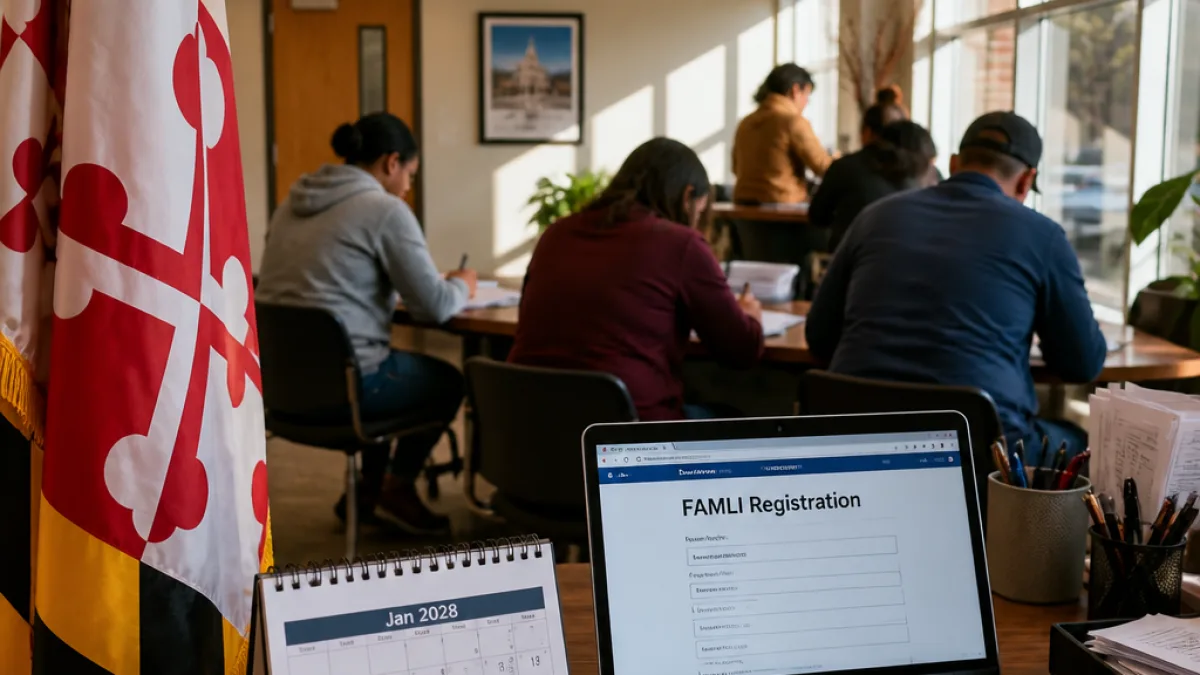
Maryland is moving forward with a long-delayed paid leave program that will require employers to register for benefits beginning this January, state officials announced. The Family and Medical Leave Insurance program — created by the Time to Care Act passed in 2022 — will offer up to $1,000 per week for as many as 12 weeks of job-protected leave when benefits begin in January 2028.
Who must register and when
All employers with at least one Maryland-based employee are required to register for the program prior to the start of contributions next January, the state said. Businesses may either opt into the state-run plan or contract with a private insurer that provides comparable paid leave benefits.
- Registration requirement: Employers with any Maryland-based employee must register ahead of contributions starting in January.
- Participation options: Employers can enroll in the state FAMLI plan or secure private insurance that meets program standards.
- Exemption for small employers: Employers with fewer than 15 employees are exempt from the employer portion of contributions.
Benefit details and timeline
Once the program goes live for benefits in January 2028, eligible workers will be able to take paid, job-protected leave to:
- Welcome a new child;
- Tend to their own serious health condition;
- Care for a family member’s serious health condition; or
- Manage qualifying family needs related to deployment.
The state estimates employee-side contributions will average out to roughly $1 per day, a cost that Maryland Secretary of Labor Portia Wu described as a manageable tradeoff for the protections provided.
| Item | Detail |
|---|---|
| Maximum weekly benefit | $1,000 |
| Maximum weeks of paid leave | 12 weeks |
| Benefit start date | January 2028 |
| Employer registration begins | Registration open ahead of contributions starting January |
Officials describe expected impacts
Secretary Wu emphasized both workforce stability and regional competitiveness in explaining why the program is needed.
"[FAMLI] increases retention. It helps to keep people attached to the workforce and helps smaller businesses who might not otherwise be able to support such a benefit keep their skilled talent working with them," Wu said.
She also framed the employee contribution as modest relative to the benefit, saying workers often lose pay and risk their jobs when they must take leave under current conditions.
"The fact is, workers are not able to work when these incidents happen often, and what they're doing now is totally losing their pay and risking their jobs," Wu said. "And so this program will make sure that does not happen and provide that financial security that Maryland families and workers really need and deserve."
Maryland joins a growing regional trend
Maryland will be the 14th state to offer a paid leave program. Officials cited examples such as New York, New Jersey and Delaware, saying the policy has become a regional expectation in the Mid-Atlantic and is important for keeping Maryland competitive for workers and employers.
What employers should do now
Employers should review the registration requirements and decide whether to enroll in the state plan or pursue approved private coverage. Smaller businesses with fewer than 15 employees should take note of the employer contribution exemption but still complete any required registration steps before contributions begin.
State labor officials are expected to provide guidance and resources for both employers and employees as registration proceeds and contribution and benefit rules are finalized ahead of the 2028 benefits launch.
The program caps and exemptions reflect policy decisions made when the Time to Care Act was approved by the General Assembly in 2022 and implemented after a series of delays.
As the registration window opens, employers and workers will continue to watch how the state rolls out details on contribution rates, claims processes and rules for private-plan approval.