An Anne Arundel County judge on Wednesday barred Maryland election officials from placing a proposed constitutional amendment about congressional redistricting on the November ballot, concluding parts of the measure were deliberately misleading to voters.
Court finds ballot language deceptive
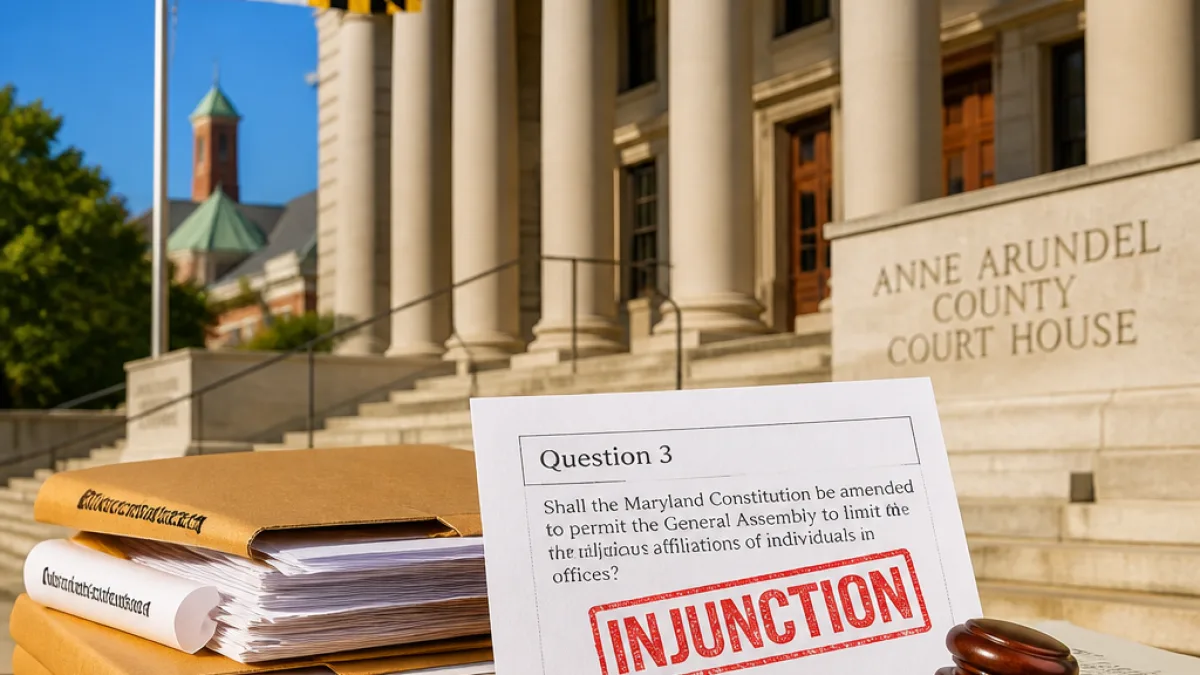
Judge Robert Thompson issued an injunction against including what would have been listed as Question 3 on the Nov. 3 general election ballot. The action follows a lawsuit challenging the wording of House Bill 2100, which Gov. Wes Moore signed into law on Aug. 5.
“The court has no choice but to enjoin the board of elections from including ballot Question 3 on the general election ballot for November 3, 2026,”
The ruling said specific passages of the proposed question were crafted in a way that could mislead voters about the amendment’s effect, a determination that the court said required removing the measure from the ballot as currently written.
What H.B. 2100 would have done
The bill sought to place a constitutional amendment before voters that would alter redistricting criteria for U.S. congressional districts. Among its provisions, the measure would have required that each congressional district be aligned with "natural boundaries and the boundaries of political subdivisions," language supporters argued would clarify standards for mapmakers.
Critics — including several conservative lawmakers and advocacy groups — said the legislation was an attempt to sidestep a prior court ruling from 2022 that had invalidated a Democratic-drawn plan. That earlier decision remains a key backdrop to the current legal fight.
Reaction from challengers and supporters
The Maryland Freedom Caucus, a conservative group that joined one of the two lawsuits against the measure, publicly praised the judge’s decision. State Del. Matt Morgan, a Republican, framed the ruling as a rebuke of the legislature’s process.
“Today the court made clear that three-fifths of the vote doesn’t buy you an exemption from the rules you wrote yourself. Maryland doesn’t answer to kings, and it doesn’t answer to a legislature that thinks it’s one,”
The injunction is temporary while the state pursues an immediate appeal to the Supreme Court of Maryland, according to court filings. The outcome of that appeal will determine whether voters will see the proposed amendment on the ballot this fall.
Broader stakes in a close congressional landscape
The dispute comes as control of the U.S. House of Representatives remains competitive. Democrats presently hold seven of Maryland’s eight congressional seats, and national parties are watching redistricting disputes closely because map changes can influence which party wins additional seats.
Lawmakers, legal advocates and voters are now left to consider both the legal timeline and the practical effects of the injunction. If the state’s highest court lifts the injunction, election officials would need to finalize ballot content on an accelerated schedule ahead of November.
Key points
- Judge Robert Thompson enjoined inclusion of the proposed constitutional amendment on the Nov. 3 ballot.
- H.B. 2100, signed Aug. 5 by Gov. Wes Moore, would have revised redistricting criteria for congressional districts.
- The decision is under immediate appeal to the Supreme Court of Maryland.
| Item | Detail |
|---|---|
| Bill | H.B. 2100 (signed Aug. 5) |
| Ballot question | Question 3 (enjoined) |
| Judge | Robert Thompson |
| Next legal step | Immediate appeal to the Supreme Court of Maryland |
As the legal process unfolds, Maryland voters and political observers will be watching for the state Supreme Court’s timetable. The court’s decision will determine whether the statutory language survives judicial scrutiny or whether lawmakers will need to revise the amendment and potentially seek a later path to present redistricting changes to voters.
The dispute underscores how redistricting — a technical, often arcane policy area — can have direct consequences for competitive national politics and local representation. Whatever the courts decide, the outcome will shape how Maryland draws its congressional boundaries for years to come.