
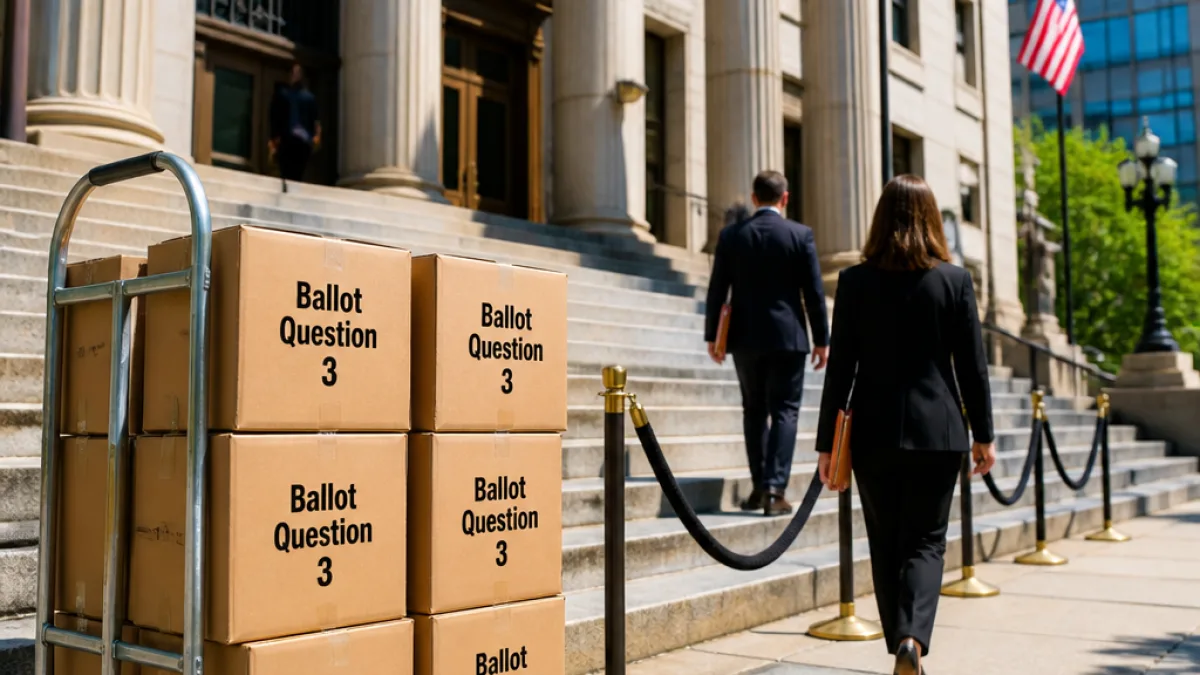
BALTIMORE — A Dorchester County judge on Friday sided with Republican lawmakers and blocked Maryland’s proposed congressional redistricting amendment from appearing on the November ballot, handing opponents their second lower-court victory over Ballot Question 3.
Judge S. James Sarbanes issued a 12-page opinion that found for the plaintiffs on all three claims brought in the lawsuit: that the ballot language failed to give voters adequate notice of the amendment’s effect; that the General Assembly violated election laws during the process; and that the proposed constitutional change improperly combined multiple subjects into a single ballot question.
Ruling, appeals, and pressing timelines
The ruling is currently stayed as the case is expected to move quickly to the Maryland Supreme Court. That court already has arguments scheduled Sept. 3 for a separate, overlapping challenge filed in Anne Arundel County — the same day the State Board of Elections plans to begin printing ballots for the November general election.
The scheduling creates a narrow window for state officials and the courts to resolve whether Ballot Question 3 will appear on ballots and, if so, whether its language must be revised to provide clearer notice to voters.
What the judge said
In his opinion, Sarbanes said the ballot description was misleading and did not supply enough information for voters to make an informed decision about the amendment’s practical effect.
“The practical effect of HB 2100 is to remove all Maryland Constitutional standards and protections from congressional districting plans,” Sarbanes wrote.
He also rejected the state’s argument that voters could understand the amendment by reading separate portions of the ballot language together, writing that the question should not be so confusing for the electorate.
Claims and context
The lawsuit challenged wording voters would see for Ballot Question 3, which arose from a two-day special session in early August when the General Assembly passed legislation implementing the proposed constitutional amendment. The amendment’s language states that certain Maryland constitutional redistricting standards continue to apply to state legislative districts but not to congressional districts.
Plaintiffs argued the ballot language misleadingly describes the change as a “clarification” of existing law — an assertion the judge found insufficient to inform voters of the amendment’s effect.
Reaction from plaintiffs
Republican Sen. Chris West, one of the plaintiffs, welcomed the decision and framed it as a victory for voters and the rule of law. In an interview with FOX45 News, he emphasized the significance of two independent judges reaching similar conclusions in different counties.
“The decision today by Judge Sarbanes was a complete win for Maryland voters as well as for the rule of law in this state,” Sen. Chris West told FOX45 News.
What comes next
Because the decision is subject to appeal and overlapping cases are already slated before the Maryland Supreme Court, the fate of Ballot Question 3 likely will be decided over the next several days. If the high court determines the issue must be resolved before ballots are printed, election officials may need to delay or alter printing schedules. If the Supreme Court allows the amendment on the ballot, counties will proceed with printing as planned.
Legal observers and election officials will be watching the Sept. 3 appearances closely, given the potential for immediate operational impacts on the State Board of Elections and county election boards.
Why this matters to voters
The case goes to the heart of how Maryland draws congressional districts and what constitutional standards will govern that process. Voters could see a change on the ballot that, if approved, would explicitly limit the reach of certain state constitutional standards to legislative districts while leaving congressional districting governed by different criteria.
- Timing: Arguments related to overlapping challenges are scheduled Sept. 3 — the same day ballot printing is to begin.
- Legal findings: Judge Sarbanes found the ballot language misleading and the amendment improperly combined subjects.
- Next step: The Maryland Supreme Court is expected to resolve the dispute.
The rapid progression of the litigation underscores how legal and procedural issues can affect election administration and voter information in the weeks before a general election. The state’s highest court will have to balance the need for a clear ballot against tight printing and certification deadlines set by election officials.
| Item | Detail |
|---|---|
| Court issuing opinion | Dorchester County Circuit Court (Judge S. James Sarbanes) |
| Claims found valid | Misleading ballot language; violations of election law; improper multiple-subject ballot question |
| Next scheduled court action | Maryland Supreme Court arguments (overlapping case): Sept. 3 |
| Election administration milestone | State Board of Elections scheduled to start printing ballots: Sept. 3 |
As the legal process moves forward, Maryland voters and officials will await the state Supreme Court’s ruling to determine whether Ballot Question 3 will remain off the November ballot, be presented in revised language, or proceed as originally drafted.
Priya Chandrasekaran is a state correspondent for WE NEWS based in Maryland.