
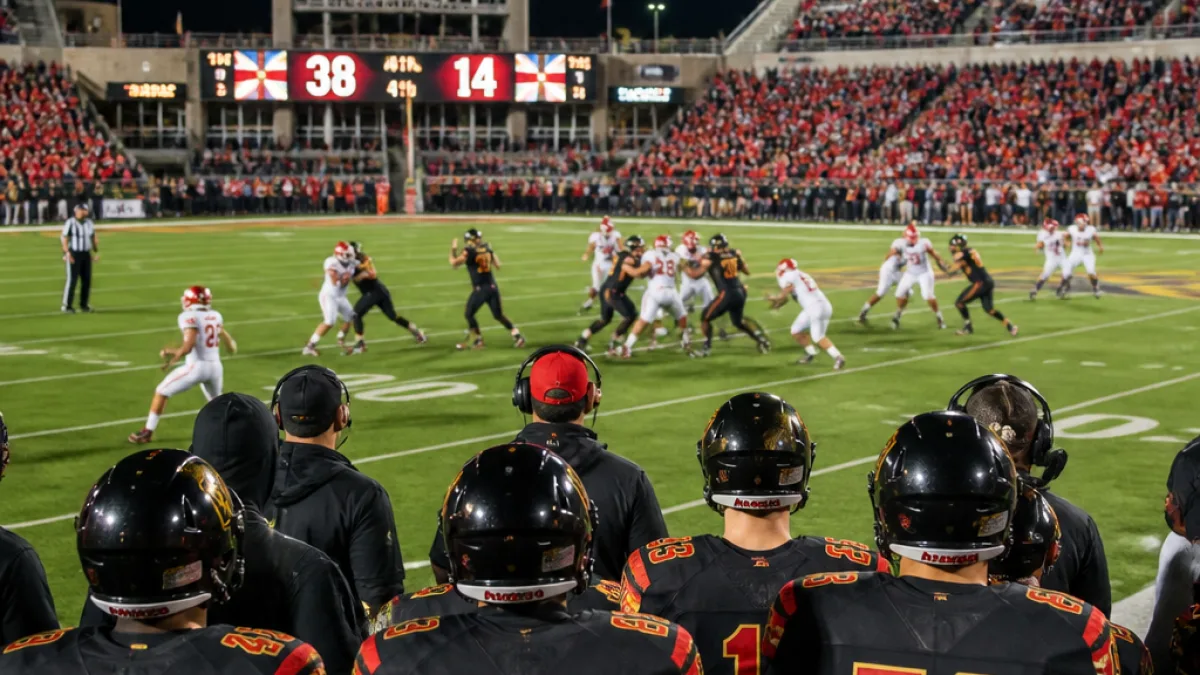
Maryland recovered from an early deficit and built control of Saturday’s game, defeating UConn by a final of 38-14. The Terps’ passing attack and a defensive front that pressured the line of scrimmage shaped a contest that was never close after the first quarter.
Quarterback efficiency fuels Maryland
Maryland quarterback Malik Washington completed a remarkable 83% of his attempts, finishing 347 yards passing on 41 throws. The efficient aerial game helped Maryland string together sustained drives and convert several into touchdowns after an early 7-0 UConn lead.
Game plan: attack the secondary
The Terps leaned into a strategy of challenging UConn’s secondary, especially early and in the third quarter. They called passing plays on 14 of 18 plays in the first quarter and on 11 of 18 in the third. While many completions were short, Maryland’s receivers generated a large share of the offense after the catch.
“Those kids on the defensive front played their tails off; played hard throughout the whole time,”
The comment came after the game from UConn coach Jason Candle, who credited his defensive front while noting weaknesses in the Husky secondary that Maryland exploited with throws and RPOs.
UConn’s offense showed flashes but stalled
UConn had moments of competence, including an early lead, but the offense failed to maintain consistency. In the second quarter, the Huskies managed only 30 yards across two possessions, allowing Maryland to push ahead by two scores on long drives.
The Huskies completed short passes effectively at times—many of Washington’s completions were for short yardage—but struggled to produce chunk plays through the air beyond yards after catch and occasional interference calls that aided Maryland drives.
Big plays after the catch
Maryland’s passing numbers were amplified by yards gained after receptions: of Washington’s passing totals, receivers accumulated a substantial portion as after-the-catch yardage. One illustrative play saw Na’eem Abdul-Rahim Gladding take a short pass 60 yards for a touchdown, converting a routine target into a game-changing score.
- Maryland score: 38
- UConn score: 14
- Washington: 41 attempts, 83% completion, 347 yards
- Two Maryland receivers topped 100 yards receiving
Defensive mismatches and schematic consequences
UConn’s defensive front earned praise for effort and playmaking, but the relative inexperience in the secondary created matchup problems. Maryland repeatedly chose passing looks when the Husky personnel suggested vulnerability to quick throws and RPOs. As Candle observed, the front could not be expected to absorb repeated pressure without additional help from other phases of the defense.
Former UConn player John Lista noted the challenge of defending Maryland’s combination of size and speed: “They had some shifty players; their o-line was getting downfield. So you have big bodies like that going downfield, and you’re trying to chase after small, shifty, elusive guys; it’s tough.”
Key statistics
| Category | Maryland | UConn |
|---|---|---|
| Final score | 38 | 14 |
| Passing leader (comp %) | Malik Washington (83%) | — |
| Passing yards (leader) | 347 | — |
What it means going forward
The victory gives Maryland momentum on the offensive side of the ball and highlights areas UConn must address, particularly in its secondary coverage and in sustaining drives. For Maryland, the ability to convert short completions into significant gains and to attack perceived weaknesses in coverage will be encouraging signs as the season progresses.
UConn showed resilience and flashes early but will head back to the drawing board after a defeat that exposed matchup vulnerabilities. Maryland’s balance of efficient quarterback play and after-the-catch production proved decisive in turning an early deficit into a convincing home result.