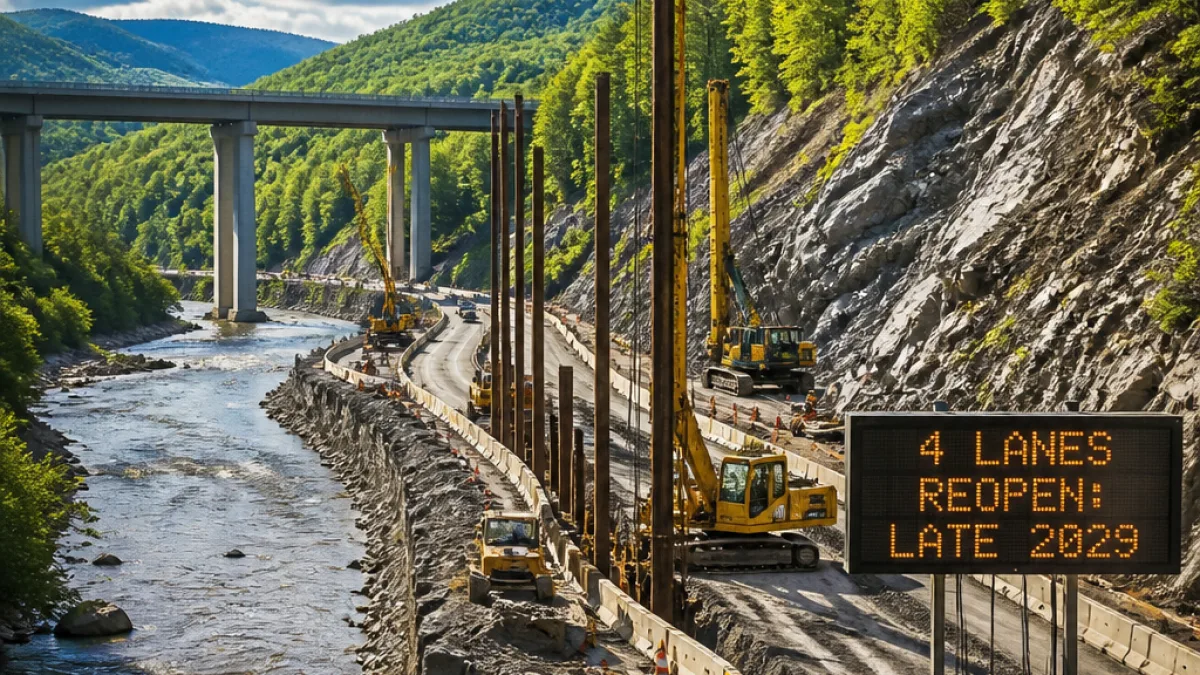
The North Carolina Department of Transportation now estimates the reconstruction of Interstate 40 through the Pigeon River Gorge will cost about $2.8 billion, up from an original projection of $2 billion, and that work to restore four lanes is not expected to be completed until late 2029, officials announced Sept. 2.
Unexpected geologic conditions drive costs and delays
NCDOT said new testing along the roughly five-mile stretch of highway damaged by Hurricane Helene found deeper bedrock in some locations than previously identified. That discovery requires the use of longer steel piles for bridge and slope support — a change that has contributed to both the higher price tag and a longer construction schedule.
The Pigeon River Gorge is a critical connector for eastern and western traffic across the mountains. The corridor has long been vulnerable to river-driven erosion and slope failures; this reconstruction is being carried out with an eye toward increased storm resilience, NCDOT officials said.
Scope and design emphasize long-term resilience
NCDOT has described the project as not merely repairing what was lost but building back stronger. Design work focuses on reinforced structures intended to withstand powerful river forces and reduce the risk of future catastrophic failures along the transportation corridor.
Officials say the work will help protect the interstate from future flood damage and slope movement, but the more robust approaches — including deeper foundations and heavier structural components — are among the factors pushing the project cost upward.
- New cost estimate: $2.8 billion (previously $2 billion)
- Work area: Approximately five miles through the Pigeon River Gorge, Haywood County
- Target for four lanes restored: Late 2029
- Cause of revisions: Deeper bedrock necessitating longer steel piles; storm-resistant redesign
| Item | Original | Updated |
|---|---|---|
| Estimated cost | $2.0 billion | $2.8 billion |
| Four-lane restoration target | — | Late 2029 |
| Primary reason for change | Initial design assumptions | Deeper bedrock; longer piles |
Local and regional impacts
Interstate 40 is a vital corridor for freight, tourism and local commuters across western North Carolina. Extended construction timelines and heavier work zones could mean prolonged travel impacts for residents, commercial drivers and visitors heading through the mountains.
Although NCDOT expects to restore four lanes by late 2029, the timetable suggests drivers will face continued detours, reduced speeds and alternating lane closures for years. The agency has framed the trade-off as temporary disruption for a more resilient infrastructure that will better withstand extreme weather events.
What comes next
NCDOT will continue phased construction and monitoring as crews install longer piles and place reinforced structural elements. The agency’s messaging has emphasized building to higher standards to avoid repeating the damage caused by Hurricane Helene.
For travelers, NCDOT and local law enforcement typically post updates about active closures, lane shifts and recommended alternate routes as work progresses. Motorists should check NCDOT travel advisories and real-time traffic information before planning trips through the western corridor.
The revised estimate and timeline underscore the broader challenges agencies face when rebuilding infrastructure after severe storms: initial assessments can miss subsurface conditions that materially affect both the technical approach and the eventual price tag. NCDOT’s updated figures offer an early window into how those challenges play out in the rugged terrain of the Pigeon River Gorge.
As reconstruction proceeds, officials say the goal is to produce a safer, stronger stretch of I-40 that reduces the risk of future closures and improves long-term mobility for the region.