
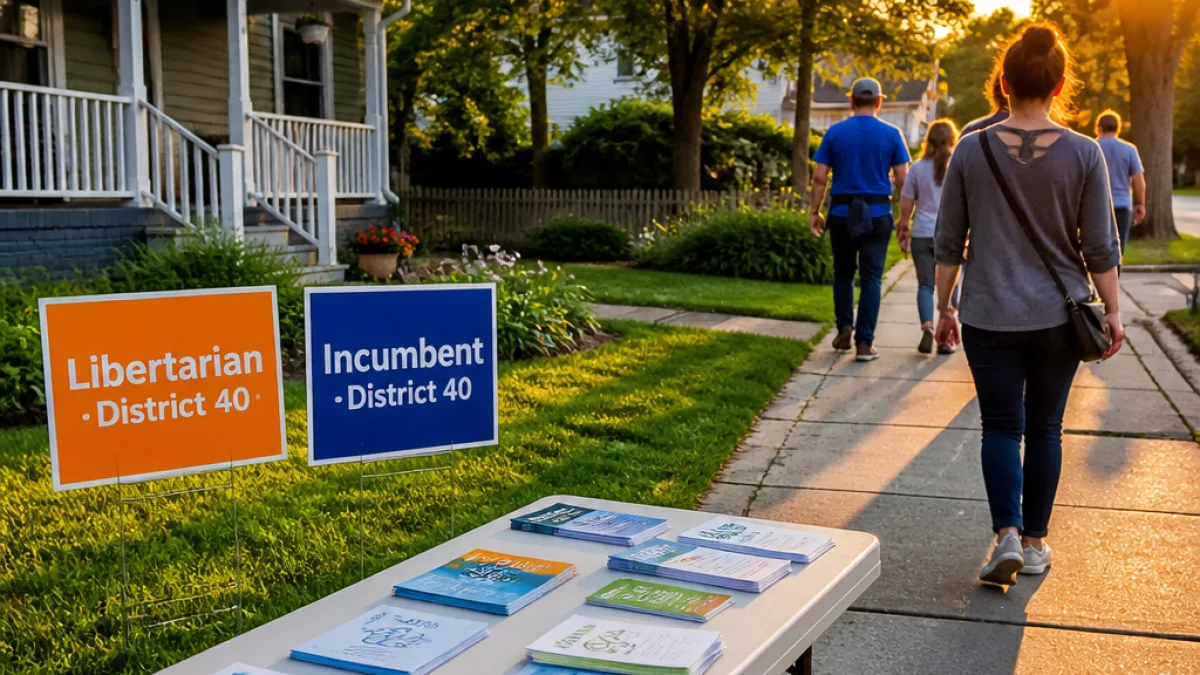
The Nov. 3, 2026, election for North Carolina House of Representatives District 40 will pit incumbent Phil Rubin against Libertarian challenger Lucas Everett Jones, who, at 22, represents a youthful, third-party bid to unseat the current officeholder.
Candidate background and priorities
Jones, whose campaign website is listed as electlucaseverettjones.org, described his current occupation as a cart runner and said he has two years of professional experience and attended Wake Technical Community College. He told The News & Observer that his public experience has largely consisted of volunteering with the Libertarian Party prior to his run.
"As only one of many in the state House, I would have only so much control."
The challenger framed his potential influence in Raleigh and the state assembly as limited by the realities of serving as one member among many, but he identified several areas where he would press for change if elected.
Policy positions highlighted
Jones emphasized deregulatory priorities, describing several reforms he would support or pursue:
- Certificate of need reform: He said the Wake County Libertarian Party has made this a major advocacy topic and he would seek the "maximum possible reduction of restrictions," up to total repeal.
- Property taxes: Though he is not a property owner, Jones said he supports lowering property taxes on principle and signaled agreement with recent calls to limit local property tax increases should a constitutional amendment pass.
- Public subsidies for sports facilities: He opposed state assistance for a Major League Baseball stadium, saying the state should not fund such a project.
- Hemp and marijuana regulation: Jones stated a philosophical preference for no regulation but would back rules that produce greater freedom than current law.
- Data centers and private industry: He argued private companies "should be able to do what they want," and placed responsibility on infrastructure systems themselves should they fail to meet demand.
Local implications and questions for Raleigh voters
A Libertarian challenge in a Raleigh-area seat injects a different policy vocabulary into the campaign, centered on deregulation and tax relief. For District 40 voters, the issues Jones raised — health-care facility entry rules governed by certificate of need laws, property tax levels, and how the state balances private development with public infrastructure — have direct local resonance.
Certificate of need reforms could affect where health-care providers locate and expand in Wake County. Debates over property tax limits touch municipal budgets and funding for services that Raleigh residents rely on. The question of public financing for major sports facilities ties into broader discussions about economic development incentives and priorities for state spending.
Jones’ comments on data centers — an increasingly visible presence across North Carolina — and water infrastructure underscore practical concerns about growth and resource planning. While he advocates minimal regulation for companies, his answers also suggest that infrastructure shortfalls would need to be resolved at the system level rather than by constraining corporate activity.
What voters will hear next
The News & Observer questionnaire included both candidates in the race; Rubin is the incumbent in the district. As the election approaches, District 40 voters should expect continued contrast between Rubin’s record and Jones’ platform focused on liberty-oriented reforms. Voters in Raleigh and Wake County will decide whether a third-party approach to these issues resonates enough to change the district’s representation.
| Candidate | Party | Age (Nov. 3, 2026) | Key positions |
|---|---|---|---|
| Lucas Everett Jones | Libertarian | 22 | Certificate of need repeal, lower property taxes, no state stadium funding, minimal regulation of hemp/marijuana |
| Phil Rubin | Democrat (incumbent) | — | Incumbent (questionnaire responses available from The News & Observer) |
As the campaign continues, Raleigh residents in District 40 should follow candidates’ statements and voting records to assess how each would approach the district’s needs in the General Assembly. The Nov. 3 vote will determine whether incumbent leadership holds or if a Libertarian voice joins the state House from this Raleigh-area district.
















