County approves larger design budget to pursue long-term savings
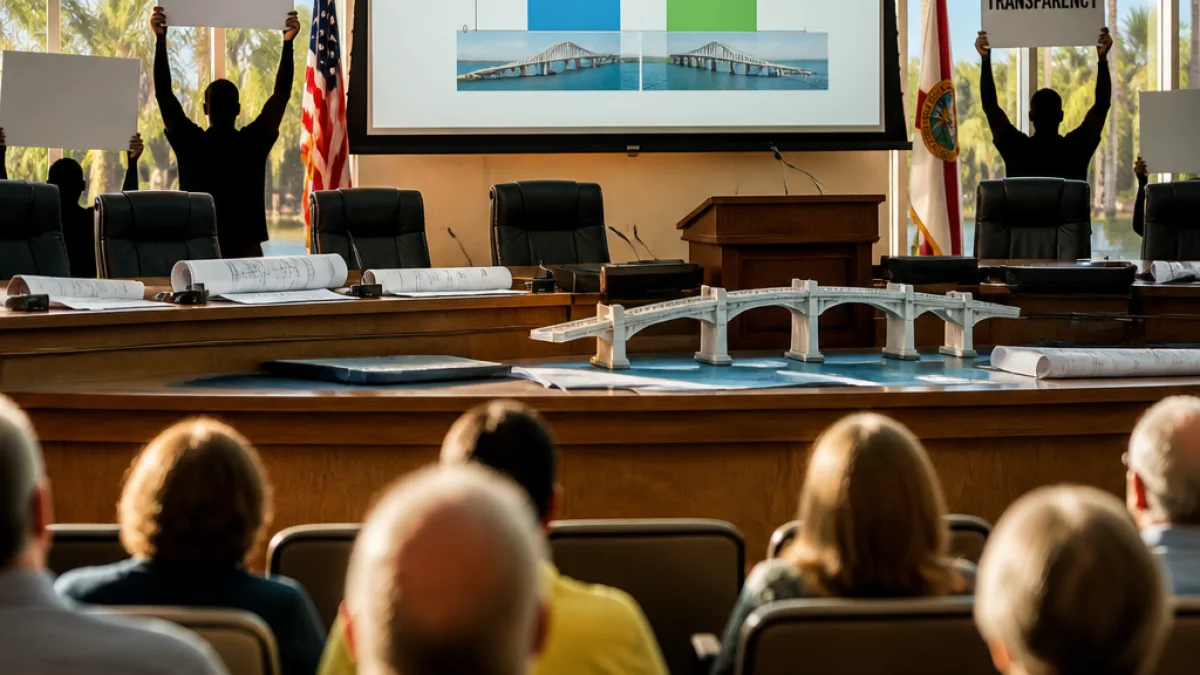
Lee County commissioners voted to add $4.6 million to the design budget for the new Cape Coral bridge, increasing total design expenditures to more than $25 million. Officials say the additional design spending is intended to generate savings during construction and reduce the amount the county would need to borrow.
Commissioner Brian Hamman framed the move as a cost-avoidance strategy. "We budgeted for the project to be $450 million at this point. But we'd like to get that budget down to only $400 million," he said. Hamman said the extra money is expected to produce at least $45 million in savings, which would otherwise have to be financed and repaid through tolls.
What the additional design work will examine
Lee County and the Florida Department of Transportation have asked engineers to revisit aspects of the bridge design to identify strategic adjustments. Officials highlighted several areas under review, including emergency lanes, walking and biking paths, and the classification of multi-use paths so they can be attached to the bridge rather than built as separate spans.
- Emergency lanes: re-evaluate necessity and configuration.
- Pedestrian/bike access: consider reclassifying multi-use paths to sidewalks to allow attachment to the main structure.
- Cost trade-offs: invest more in design to reduce borrowing and toll burdens during operations.
The county expects redesigned details to help lower the overall project cost, a goal that has gained urgency as commissioners and residents weigh the magnitude of the planned investment.
Local reaction: calls for transparency amid traffic frustrations
The budget increase prompted mixed reactions among Cape Coral residents. Some welcomed efforts to control long-term costs, while others asked for more transparency about how the added funds will be spent.
"I'm all about transparency. So, if they want to spend this money, I'd really love to see everything it's going towards,"
said Cape Coral resident Kristen Willert. Another resident, Gabrielle Jacobson, acknowledged potential benefits: "I mean, I guess for like, more lanes. I guess the money could be worth it," she said.
For many residents, short-term traffic pain is real. Willert described daily backups on the existing Cape Coral bridge that affect commutes and punctuality for important appointments.
Timeline and financial context
Final design plans are expected to be completed by May of next year, with construction slated to begin in early 2028. County leaders originally budgeted roughly $450 million for the entire project; by increasing design spending now, they hope to bring that figure closer to a targeted $400 million.
| Item | Amount |
|---|---|
| Original design budget (before increase) | approximately $20 million |
| Additional approved design increase | $4.6 million |
| Total design budget (after increase) | more than $25 million |
| Original project budget | $450 million |
| Targeted reduced project budget | $400 million |
| Estimated savings from added design work | $45 million |
Hamman said saving that level of money would lower borrowing needs and, consequently, reduce the toll burden that could fall on drivers if the county had to finance a larger portion of the project.
Questions ahead for county and FDOT
As design revisions proceed, residents and local officials will be watching for several outcomes: clear documentation of how the extra funds are allocated, firm estimates of construction savings, and assurances that any design changes will preserve safety and multimodal access. The FDOT-led review will also need to balance pedestrian and bicycle access with cost-saving measures, an area that has drawn public interest during planning.
With construction not scheduled to start until 2028, county leaders have time to refine plans. But the choices made now — about lanes, path classifications and where to invest design dollars — will influence traffic patterns, tolling and multimodal options for Cape Coral commuters for decades.