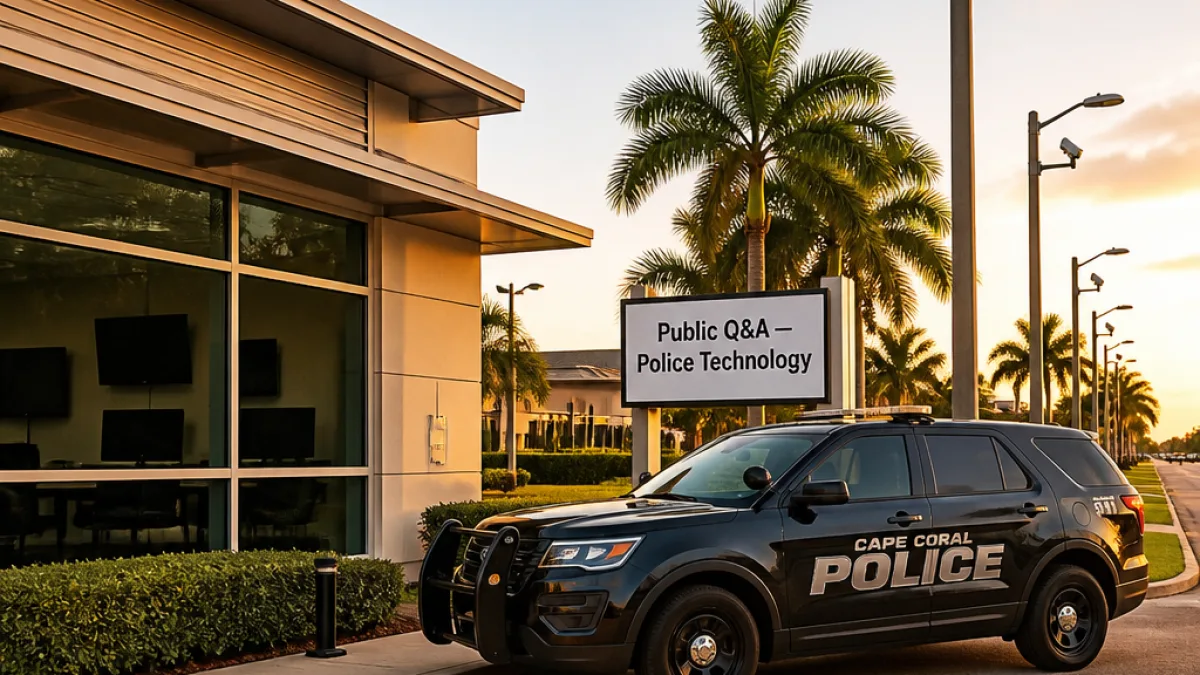
The Cape Coral Police Department announced the shutdown of all automated license plate reader cameras across the city as officials and residents debate the proper role of the technology in law enforcement.
Chief explains scope and immediate effects
At a public question-and-answer session Wednesday, Chief Anthony Sizemore described how the department has used automated license plate readers, or LPRs, for roughly a decade and what the cameras’ removal means for ongoing and future investigations. He told attendees the cameras have been a tool to aid officers and detectives but said he recognized legitimate public concerns about privacy and data handling.
"To say that there would be no impact would be naive," Sizemore said, acknowledging the department will need to adjust investigative practices now that the technology is offline. According to his remarks, the shutdown followed an announcement made Tuesday when the city disabled all LPR equipment.
What the department says the system delivered
In a written statement provided to the public, the chief outlined the investigative uses the department attributes to the technology over the last decade. The statement credited LPRs with helping solve a range of cases, including homicides and vehicle thefts, assisting in locating missing people and developing leads that otherwise may not have existed.
"For more than a decade, the Cape Coral Police Department has responsibly utilized Automated License Plate Reader (ALPR) technology as one of many tools available to our officers and investigators."
The department also said the technology aided in identifying suspects who are now serving life sentences and stressed that LPRs are a supplement to traditional police work rather than a replacement.
Officials point to oversight questions
Sizemore said there have been no reported instances of misuse of LPR data by Cape Coral officers during the period the system was operational. Still, he acknowledged ongoing public questions about how data is collected, how long it is retained, who has access, and how it is shared.
He expressed confidence that lawmakers will move quickly to develop guidelines and policies governing LPR use so the department can consider reinstating the technology under clearer rules.
- Duration of use: Department has used LPRs for about 10 years.
- Operational status: All LPRs were turned off as of the Tuesday announcement.
- Department claim: LPRs contributed to solving homicides, locating stolen vehicles and missing people.
Local context and likely consequences
For Cape Coral residents, the removal of LPRs could mean longer investigatory timelines in certain cases that previously benefited from automated plate-matching capabilities. The department’s reliance on the technology for some homicide inquiries and vehicle recoveries suggests a practical gap that officers will try to fill with other investigative methods.
At the same time, the decision aligns with a broader national conversation about surveillance technologies and individual privacy. Cities and states across the country have wrestled with policy frameworks for LPRs, addressing concerns such as how long captured plate data may be stored, whether it can be shared with other agencies, and what oversight mechanisms are required.
City residents and civil liberties advocates may press local policymakers for clear rules that balance investigative benefits against privacy protections. The chief urged a legislative solution, saying he expects lawmakers can provide guidance quickly so the department may reassess the technology’s use under formal safeguards.
| Item | Fact |
|---|---|
| Chief | Anthony Sizemore |
| Length of LPR use | About a decade |
| Operational status | All LPRs shut down as of Tuesday announcement |
City officials will face decisions about whether to pursue temporary fixes, request new funding for alternative tools, or await state or local policy direction before restoring automated plate-reading capabilities. Meanwhile, the Cape Coral Police Department said it will continue investigations using traditional methods while awaiting clearer rules from lawmakers.
The shutdown marks a notable shift in local policing tools and opens a period of public discussion about transparency, accountability and how technology should fit into public safety strategies in Cape Coral.