
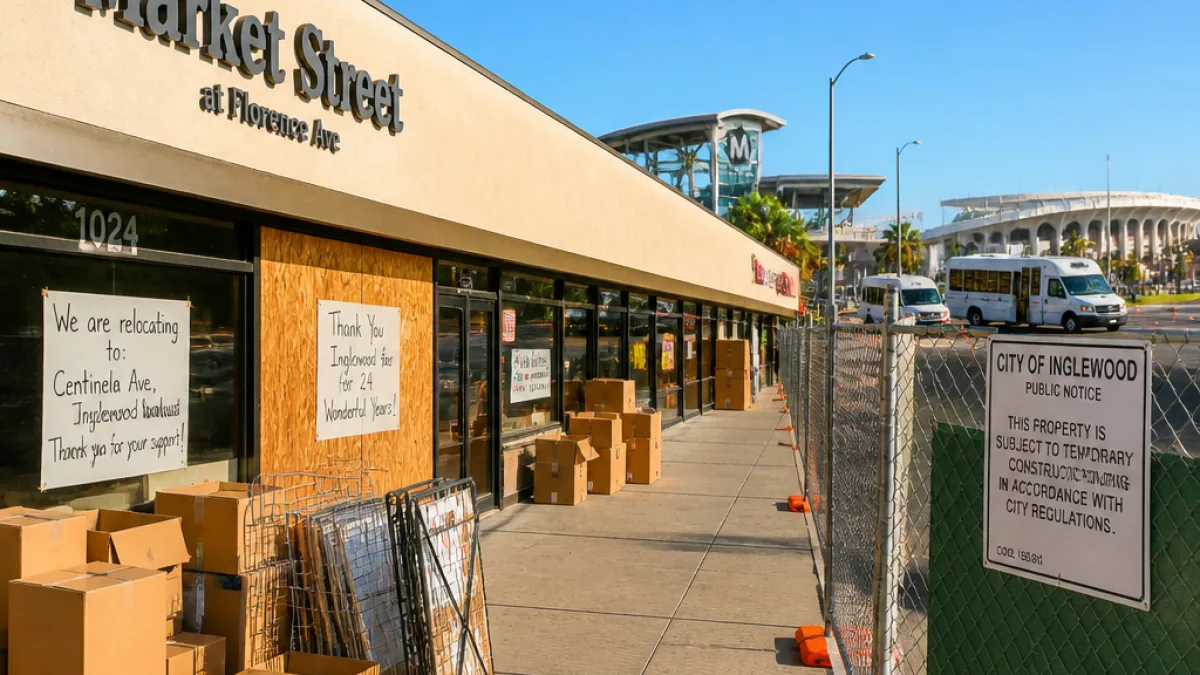
Inglewood officials have moved to acquire a shopping center at Market Street and Florence Avenue that is home to more than 20 small businesses, advancing a long‑planned transit project that city leaders say will improve access to the Metro K Line and the Stadium District.
Project and property: purpose and controversy
The project, known as the Inglewood Transit Connector, would replace the existing shopping center with a bus plaza and parking structure to serve the stadium district and the nearby Metro K Line station. City officials contend the hub will streamline shuttle service to SoFi Stadium and other venues, while opponents and business owners say the plan abruptly upends established livelihoods.
Mayor James Butts has described the development as part of the city’s broader effort to revive Market Street, which he said suffered for years because of limited parking. The mayor told reporters the city has budgeted $125 million for property acquisition and assistance for affected businesses and has set aside $250,000 to help merchants with relocation and facade renovations.
Local owners react
Owners who have operated on the Market Street corridor for years expressed frustration and uncertainty about the timeline and what relocation will mean for their customer base. Lavern Upton, who has styled hair at Inglewood Beauty Salon for 15 years, told reporters she was not ready to move and that the takeover would “upend” her livelihood. Other merchants described similar concerns about displacement, lack of clarity on where to relocate and whether compensation and assistance will be sufficient.
“They’re upending my livelihood,” said Lavern Upton, who operates a longtime salon in the shopping center.
The shopping center also houses a variety of other small enterprises, including restaurants and a jeweler, and has been part of Market Street’s commercial fabric that city planners have sought to revitalize following the construction of SoFi Stadium in 2015.
Timeline and legal steps
The city intends to acquire the property through eminent domain. Court filings from project personnel indicate the city is working against a compressed schedule tied to regional events: an engineer associated with the project wrote that the city needs to take possession of the land by Oct. 1 and begin construction by Oct. 21 to complete the work in time for the 2028 Olympics.
City officials have offered a slightly different public timeline in separate statements, saying merchants have until October to relocate and that construction would begin roughly six months after that. The discrepancy in timelines has left some business owners uncertain about when they must vacate and how to plan their next steps.
- Number of businesses affected: more than 20
- Project goal: shuttle bus plaza and parking structure to connect Metro K Line to stadium district
- City budget: $125 million for property acquisition; $250,000 earmarked for business relocation and facade work
| Item | Detail |
|---|---|
| Location | Market Street & Florence Avenue, Inglewood |
| Primary transit link | Metro K Line to Stadium District |
| Affected businesses | More than 20 (restaurants, salon, jeweler, others) |
City redevelopment context
City leaders frame the transit connector as part of a broader push to invigorate downtown Inglewood and improve pedestrian and parking conditions near the stadium corridor. The city has also announced other investments along Market Street, including streetscape improvements and grant programs for business renovations, to accompany the transit work.
Yet for business owners who have served community customers for years, the promise of revitalization does not remove the immediate challenge of relocation: identifying new leases, transferring clients and absorbing costs in the months before the project begins. Some merchants said they expect to be out by this fall; others are still seeking precise dates and assurances.
The use of eminent domain and the accelerated schedule tied to the 2028 Olympics make the next weeks and months critical for shop owners, who must weigh legal options, negotiate with the city and prepare for a move. City officials say they will provide financial and logistical assistance, but details on the scope of that aid and how it will be distributed remain central concerns for affected proprietors.
As Inglewood continues to balance major public infrastructure projects with the preservation of neighborhood businesses, residents and owners alike will be watching how the city manages compensation, relocation timelines and the broader reshaping of a once‑bustling commercial corridor.















