
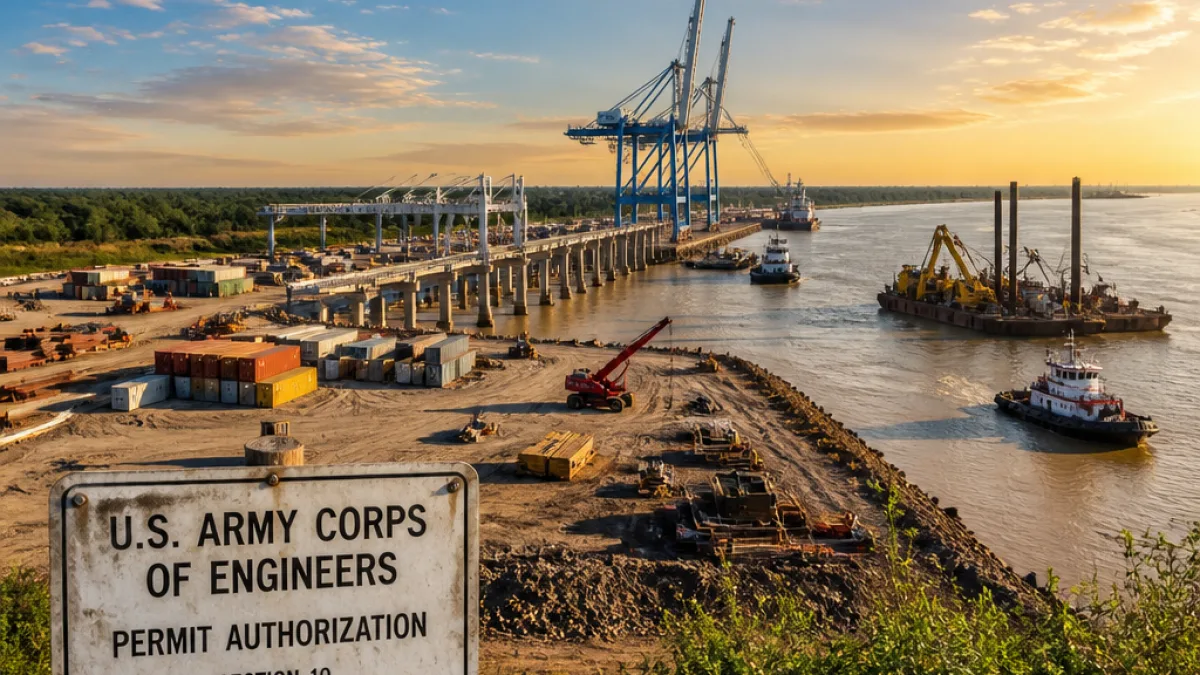
NEW ORLEANS — Federal regulators have issued the permit allowing construction to begin on the Louisiana International Terminal, a deepwater container facility planned for St. Bernard Parish that backers say will reshape freight movement on the lower Mississippi River.
What regulators approved
The U.S. Army Corps of Engineers granted the federal authorization on Monday, clearing the major environmental and engineering reviews that preceded project approval. The Port of New Orleans, which is partnering with international terminal operator Terminal Investment Limited (MSC’s terminal arm) and Ports America, announced the decision and said it paves the way to start on a project valued at roughly $1.8 billion.
Port of New Orleans officials contend the new terminal — sited near Violet in St. Bernard Parish — will be capable of accommodating the most modern, ultra-large container ships by providing a 50-foot channel depth and berth dimensions that exceed what upriver facilities can accept beneath existing bridges.
“This is not simply a regional port expansion — it is nationally significant infrastructure that will expand American export capacity and position Louisiana to lead the next generation of maritime commerce,” Port of New Orleans President and CEO Beth Branch said in a statement announcing the permit.
Economic and supply-chain implications
State leaders hailed the decision. Gov. Jeff Landry called the permit a “defining moment” for Louisiana and said the terminal will enhance export opportunities and create jobs for Louisiana families.
Proponents say the facility would improve logistics for container and barge traffic serving a broad inland network tied to the Mississippi River, including rail connections and tributaries. The port estimates the terminal’s services would benefit businesses across 32 states with direct or indirect access to the river system.
Timeline, partners and capacity
The public-private partnership advancing the development includes Port NOLA, Terminal Investment Limited and Ports America. Officials are targeting a phased opening in 2028, contingent on construction schedules, supply-chain conditions and remaining permits or local approvals.
| Item | Detail |
|---|---|
| Estimated cost | $1.8 billion |
| Target opening | 2028 |
| Channel depth | 50 feet |
| States served (estimate) | 32 |
Local impacts and concerns
Supporters highlight potential economic gains: new jobs during construction and operations, greater capacity for exports, and strengthened positioning of Louisiana as a national trade gateway. The partnership model combines public investments with private terminal expertise to attract global shipping lines.
But major infrastructure projects on the lower Mississippi typically attract scrutiny from environmental groups, local communities and navigation stakeholders concerned about coastal and wetland impacts, dredging effects, traffic patterns and long-term ecosystem health. The Corps’ approval followed years of environmental review and technical analysis intended to identify and mitigate such impacts.
What comes next
With the Corps permit in hand, project partners are expected to move toward final construction contracts, local permitting and site preparation. Officials say they are prepared to begin work, while also continuing engagement with regional stakeholders and federal agencies to coordinate dredging, access and operational plans.
How quickly the terminal translates into more freight moving through southeast Louisiana will depend on construction timelines and the willingness of shipping lines and inland carriers to make use of the new deepwater access. If completed as planned, the terminal could provide an alternative berth for ships that cannot pass beneath upriver bridges, a logistical constraint that currently limits the size of vessels reaching some existing ports.
- Permit: Issued by U.S. Army Corps of Engineers
- Cost: $1.8 billion public-private investment
- Target: Facility operations aimed for 2028
The Port of New Orleans and its private partners say they will continue community outreach and provide updates as construction milestones are reached. The decision marks a significant step for Louisiana’s maritime infrastructure and positions the state to potentially capture a larger share of global container trade.
















