
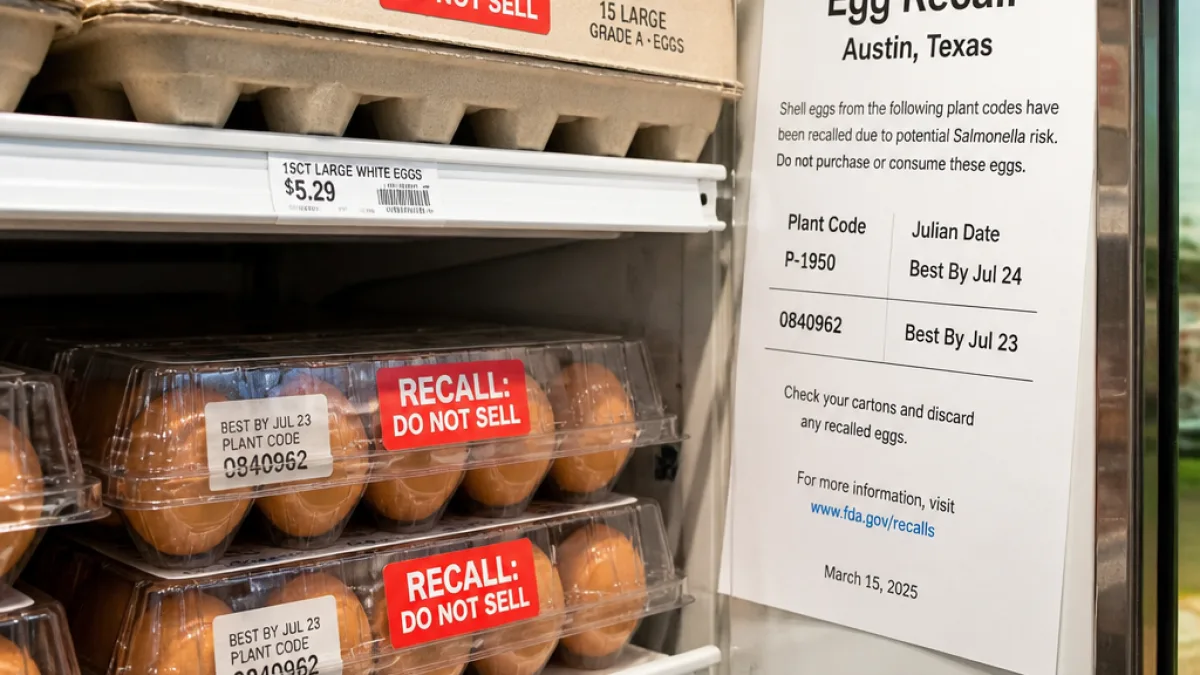
AUSTIN, Texas — Federal health authorities have escalated a recall of eggs produced at Texas farms to the Food and Drug Administration’s most serious category after investigators tied the product to a multistate Salmonella Enteritidis outbreak that has sickened dozens.
FDA upgrades recall after matching tests and traceback
The recall, originally announced July 22 by Midwest Poultry Services, now covers 1,589,577 dozen eggs sold under multiple retail brands and distributed across several states. The FDA designated the action as a Class I recall, reserved for situations in which exposure to a product could cause severe health consequences or death.
"Class I, its most serious recall category, used when exposure to a product could cause serious health consequences or death."
The Centers for Disease Control and Prevention and the FDA said laboratory testing, epidemiological evidence and product traceback all pointed to eggs produced by Midwest Poultry Services as a likely source of the illnesses. Samples collected at the company’s Texas farms tested positive for salmonella, and whole genome sequencing found matches to the outbreak strain.
Scope of illnesses and distribution
Federal officials reported the outbreak has led to 98 reported infections across 17 states, with 26 hospitalizations. No deaths have been reported.
The recalled eggs were sold between June 6 and July 3 and carry sell-by or best-by dates from July 20 through Aug. 17. They were distributed to food-service and retail customers in Texas, Oklahoma and Louisiana, and some cartons were sold at Brookshire Grocery stores in Arkansas, New Mexico and Mississippi. Affected products include white shell and brown cage-free eggs marketed under several brands, including Kroger, Simple Truth, Brookshire's, Country Morning and Cal-Maine Sunups.
How to identify affected cartons
Consumers and businesses should not use, sell or serve eggs that match the recalled identifiers. The FDA and CDC advise discarding or returning affected cartons.
- Check the carton for plant code P-1950 or 0840962.
- Verify the brand and the sell-by/best-by dates between July 20 and Aug. 17.
- If you are unsure whether your eggs are part of the recall, contact the retailer where you purchased them for guidance.
Health risks and symptoms
Salmonella Enteritidis typically causes gastrointestinal illness. Symptoms commonly include diarrhea, fever and abdominal cramps that can begin 6 hours to 6 days after exposure. Most healthy people recover without treatment, but young children, older adults and people with weakened immune systems can develop severe or invasive infections requiring hospitalization.
Officials recommend that anyone who believes they may be ill from consuming recalled eggs contact a health care provider and mention possible Salmonella exposure to help guide testing and care.
What this means for Texas consumers and businesses
The recall directly affects food-service operations, grocery stores and households that purchased the recalled cartons. Restaurants, catering businesses and institutional kitchens that received shipments during the distribution window should check inventory immediately and remove any affected product from use.
Retailers that sold the eggs are expected to follow FDA and CDC guidance for returning or disposing of recalled products and notifying customers when possible. Consumers should avoid attempting to salvage cooked dishes that may have been prepared with the affected eggs, as heating does not guarantee elimination of all risk in previously contaminated dishes.
Key figures
| Item | Number |
|---|---|
| Dozen eggs recalled | 1,589,577 |
| States reporting illnesses | 17 |
| Reported illnesses | 98 |
| Hospitalizations | 26 |
State and federal officials continue to investigate the outbreak and advise consumers to check their cupboards and refrigerators for the plant codes and dates listed above. Retailers with questions about the recall are asked to consult FDA resources and their supplier contacts for next steps.
Reporting for this article included information from the FDA and the CDC, which led the federal investigation tying the recalled eggs to the outbreak.

















