
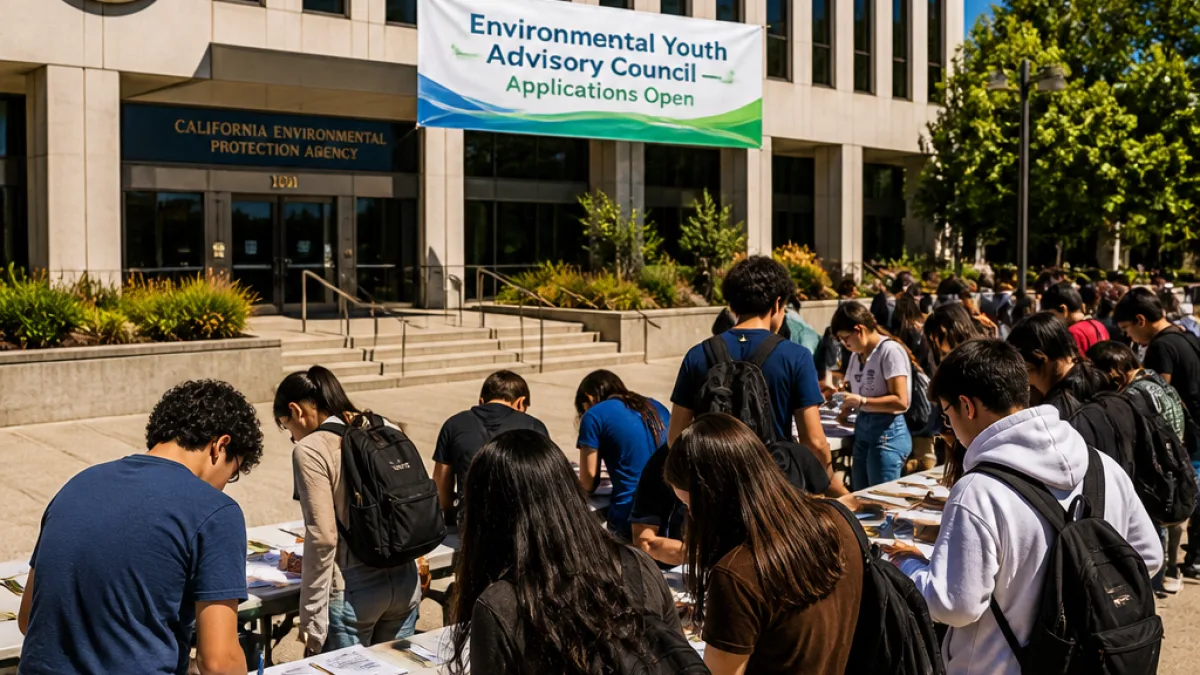
SACRAMENTO — The California Environmental Protection Agency this week began accepting applications for the state's first Environmental Youth Advisory Council, a new forum for young Californians to advise state environmental policy and programs.
Governor Gavin Newsom announced the council on Aug. 13, 2026, framing the initiative as a response to the dismantling of a federal youth advisory body and as an effort to ensure that younger generations have a formal role shaping the policies that will affect their future.
What the council is and who can apply
The Youth Council will bring together residents aged 14 to 20 from across California. State officials say the group is intended to provide a statewide leadership opportunity and a channel for young people to contribute ideas on climate, pollution and other environmental issues.
| Feature | Detail |
|---|---|
| Ages eligible | 14–20 |
| Administered by | California Environmental Protection Agency (CalEPA) |
| Scope | Statewide advisory role on environmental priorities |
State leaders link the council to federal rollback
The announcement contrasted California's new council with recent actions by the U.S. Environmental Protection Agency. State officials noted that the federal National Environmental Youth Advisory Council was quietly disbanded, leaving a gap in structured youth input at the national level.
"Young people everywhere will inherit the environmental legacy we build today," said Yana Garcia, California secretary for the Environmental Protection Agency. "That’s why, at CalEPA, we believe young people should get a say in the decisions we make, and that their diverse perspectives should be heard and honored."
Governor Newsom's statement described the federal move as a step backward and framed the state's action as a deliberate effort to "move forward," giving youth "a seat at the table." The administration emphasized the council's role in allowing young people to engage directly in climate action and community service tied to environmental priorities.
Local impacts and background
California youth already experience the state's climate and pollution challenges firsthand. State messaging accompanying the announcement highlighted the exposure many young Californians have had to wildfires, extreme heat waves, flooding and poor air quality—issues the council is expected to address through advisory input.
State officials say the council will seek participants from both rural and urban communities and from diverse backgrounds to ensure a range of perspectives. Beyond advising on policy, the council is described as a capacity-building opportunity that could help members develop leadership skills, advocacy experience and familiarity with state environmental programs.
- Eligibility: California residents aged 14–20.
- Purpose: Provide youth perspectives to CalEPA on climate and environmental policy.
- Outreach: Officials emphasized recruiting from varied communities, including rural and urban areas.
Practical notes for prospective applicants
The announcement invites interested young Californians to apply; the public release indicates the program is intended to be inclusive of diverse experiences and backgrounds. State officials have not yet provided details on selection criteria, the number of seats on the council or the application deadline in the announcement summary provided.
Prospective applicants and educators who wish to encourage student participation should monitor CalEPA communications and the governor's office for application materials and any subsequent guidance about appointment terms, meeting logistics and the council's formal responsibilities.
As California moves to codify a place for youth voices in environmental decision-making at the state level, the new council represents a concrete vehicle for that engagement. How the council is structured, who participates and the extent to which its recommendations influence policy will become clearer as CalEPA rolls out application procedures and begins selecting members.
This initiative arrives as a test of state-level responses to federal policy shifts, with California positioning itself as an alternative forum for young people seeking to shape environmental priorities that will affect their communities and futures.
















