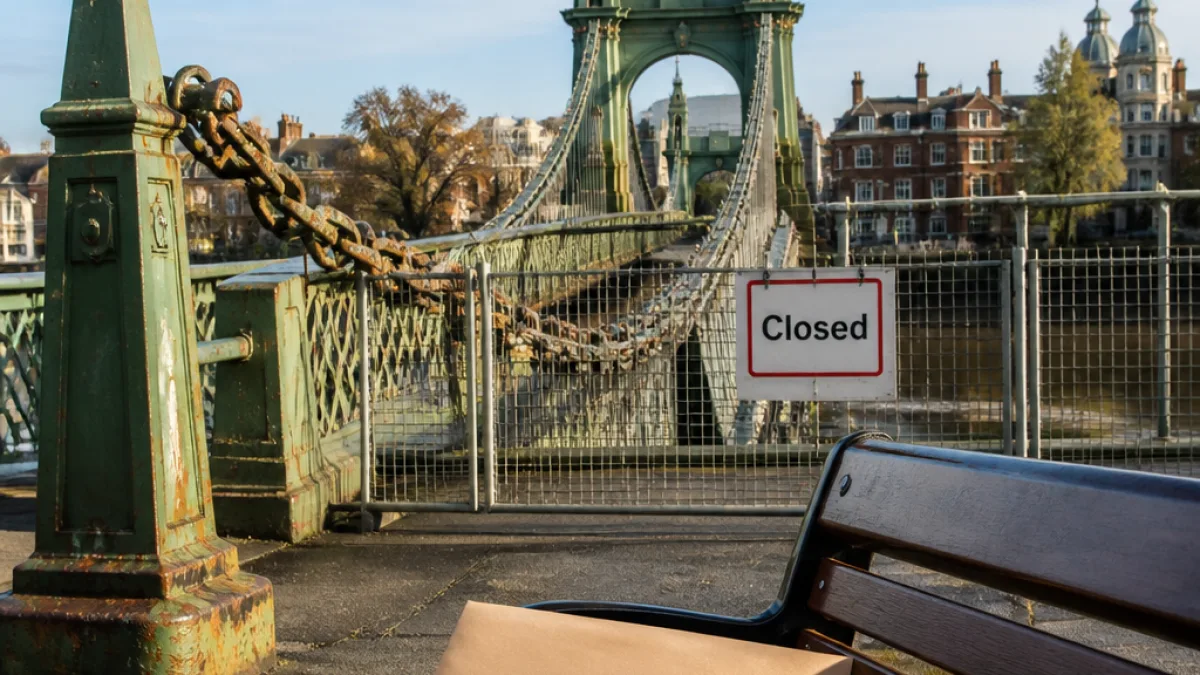
The row over the future of Hammersmith Bridge escalated this week after Wandsworth Council declined to back a funding application from the bridge’s owner, Hammersmith and Fulham Council. The decision leaves uncertain the prospects of keeping the Grade II* listed crossing open to pedestrians, cyclists and river traffic while longer‑term repairs are planned.
Neighbouring council says bid 'falls short'
Hammersmith and Fulham had asked neighbouring authorities to support a bid to the Government’s £1 billion Structures Fund — applying specifically for £128 million to deliver essential repairs. The borough had originally hoped for up to £300 million to fully restore the crossing, but council officers said the Department for Transport had urged them to submit a proposal for a “phased repair” intended to keep the bridge accessible to pedestrians, cyclists and river users.
In a letter to Hammersmith and Fulham councillor Nicole Trehy, Wandsworth’s new leader, Councillor Robert Morritt, made clear his authority would not endorse the application. He said the package submitted by Hammersmith and Fulham was inadequate for the expectations of people and businesses in the area.
"It fell well short of what the vast majority of residents and businesses in the immediate area and across London would like to see,"
Hammersmith and Fulham labelled the refusal a “matter of deep regret” and accused Wandsworth of playing political games rather than collaborating to secure the bridge’s future.
Why full restoration is currently ruled out
Council officers in Hammersmith and Fulham have previously said that there is no realistic financial route to a complete restoration of the bridge at present. Officials argue that full repair work would in effect require construction of a new bridge — a project that would exceed the timescales and eligibility rules set by the Structures Fund, which requires schemes to be finished by 31 March 2030.
Instead, the DfT’s apparent steer towards a phased approach is intended to deliver limited but tangible benefits: reopening for pedestrians, cyclists and river traffic while leaving more extensive reconstruction to be considered later if and when funding becomes available.
Local reaction and practical consequences
Residents and businesses who rely on the crossing have long campaigned for a durable solution. For some, a phased repair that restores foot and cycle access may be welcome if it restores connectivity quickly. For others, particularly traders and motorists who want a fuller reopening, the phased plan falls short.
- Hammersmith and Fulham sought up to £300m for full restoration.
- The borough applied for £128m from the Government’s Structures Fund for essential phased repairs.
- The Department for Transport signalled a preference for a phased scheme that can be completed before 31 March 2030.
| Item | Amount/Position |
|---|---|
| Hammersmith and Fulham hoped for | £300m (full restoration) |
| Application to Structures Fund | £128m (phased repairs) |
| DfT completion deadline for eligible schemes | 31 March 2030 |
What happens next?
By refusing to back the application, Wandsworth has added a political obstacle to Hammersmith and Fulham’s attempt to secure Government cash. Hammersmith and Fulham say they remain willing to work constructively with neighbouring authorities to find a solution, but without broad stakeholder backing the borough’s capacity to present a compelling case to ministers may be weakened.
For residents the immediate question is whether any phased scheme will be enough to ease disruption on local walking and cycling routes and restore river access — or whether the community must continue to endure a prolonged limbo while councils and Whitehall haggle over the scale of repair and the allocation of public funds.
Local campaigners and traders will be watching closely for the next moves from Hammersmith and Fulham Council and the Department for Transport. If the borough presses ahead with the phased application without cross‑borough support, ministers will have to weigh the merits of a smaller, quicker intervention against long‑term calls for a complete rebuild.
This dispute underscores the broader challenge facing London’s ageing infrastructure: when high repair costs meet constrained public budgets, neighbours and political actors are forced into difficult choices about what can be achieved within funding and timetable limits.