
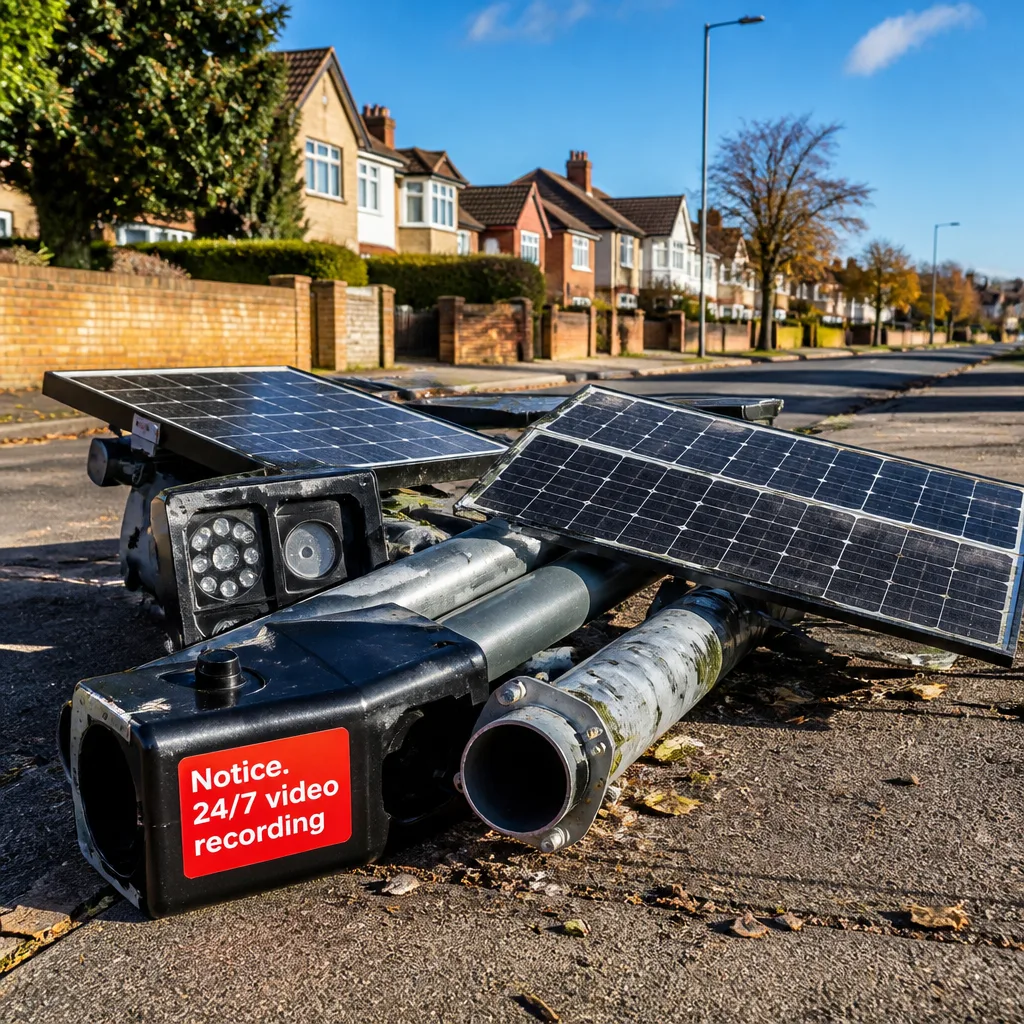
In late July, four sleek black surveillance cameras were cut down in Houston’s Old Braeswood neighbourhood, their metal poles severed and the devices left on the ground beside their solar panels. On some of the fallen units was a small red sign reading
"Notice. 24/7 video recording"— a reminder that the cameras were there to record every car that passed.
The devices were made by Flock Safety, a company that has become one of the United States’ most prominent suppliers of Automatic Licence Plate Readers (ALPRs). Founded in 2017, the firm says it works with more than 7,000 communities and estimates roughly 100,000 cameras are deployed nationwide. The Houston attacks are part of a wider pattern: similar vandalism has been reported in Minnesota, California and Georgia.
What the cameras do — and why people object
Flock’s cameras take images of the rear of every vehicle that drives past. Those images are processed by algorithms and retained for a limited time, according to company statements. Supporters argue the systems help law enforcement solve crimes more quickly, raising clearance rates for vehicle-related offences and offering communities a visible deterrent.
But critics say ALPR networks are blunt instruments that treat entire populations as potential suspects. Concerns centre on scale, transparency and the risk of mission creep: once a location is mapped by continual vehicle reads, it can be used for more intrusive investigations. There are also questions about governance — who has access to the data, how long it is kept, and the safeguards against misuse.
- Visible backlash: physical sabotage of cameras has occurred in multiple states, signalling community resistance.
- Opacity: Flock does not publish detailed usage data, making independent oversight difficult.
- Potential for misuse: records obtained by the BBC suggest the technology in some deployments is combined with controversial facial-recognition systems.
Transparency and trust
Surveillance makes people safer only if there is public confidence in the institutions that operate it. The appearance of small black poles around a neighbourhood can act as a reminder of state power, especially at a time when trust in public institutions is at a low ebb. Where deployment decisions are taken without broad public consultation, pushback is unsurprising.
Flock and its municipal partners face a difficult communications task. The company provides crime-solving statistics and cites cases where its data helped law enforcement identify suspects. But large, distributed sensor networks live or die on public consent and transparent governance. Without clearer public reporting on who uses the data and for what purposes, the cameras are likely to remain a flashpoint.
Legal and ethical fault lines
In the US, regulation of ALPRs varies by state and locality. Some jurisdictions limit data sharing with federal agencies or set retention limits. Others have fewer constraints, enabling broader use by police and prosecutors. Where the BBC’s records indicate integration with facial-recognition tools, the concerns move from licence-plate tracking to biometric surveillance — an area that has prompted bans and moratoria in several cities.
The practical consequence is that communities are now balancing two competing outcomes: more data for police investigations, or less intrusive public spaces. That trade-off will be settled not by technology vendors, but by elected officials, courts and citizens. The vandalism in Houston is an emphatic reminder that when public consent is missing, technology deployment can provoke confrontation rather than calm.
For technology editors and policymakers in the UK and beyond, the US experience offers a cautionary tale. High-tech surveillance can offer operational benefits, but without clear limits, independent audit and open reporting, it risks eroding the civic trust that policing ultimately depends on.









