
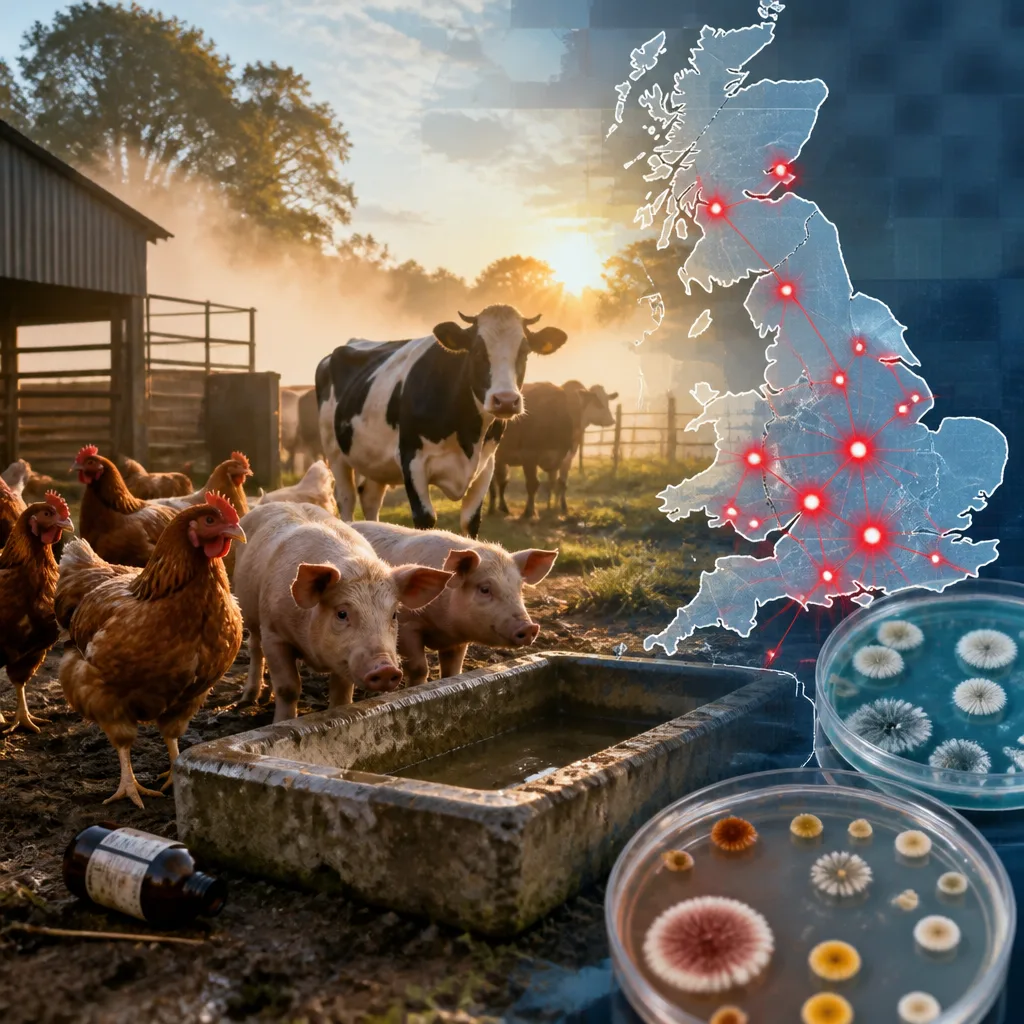
An editorial synthesising ten recent studies in Frontiers in Cellular and Infection Microbiology warns that infections in farm, wild and companion animals are increasingly relevant to human health — through expanding host ranges, rising antimicrobial resistance and complex coinfections that complicate diagnosis and treatment.
Evidence from veterinary infections
The editorial, written by researchers from the Canadian Food Inspection Agency’s National Centre for Foreign Animal Disease and Rowan University, brings together work on bacterial and viral threats at the animal–human interface. The studies examine mechanisms by which pathogens survive in animal hosts, examples of previously overlooked species causing human disease, and the role of coinfections and microbial metabolism in disease severity.
Among the findings highlighted:
- Research into avian pathogenic Escherichia coli suggested bacterial competition for nutrients and iron — rather than a single virulence gene — can determine survival inside chicken embryos, pointing to metabolism as a potential intervention target.
- A genome sequence from a bloodstream infection in China implicated Macrococcus caseolyticus — long viewed as a low‑risk relative of staphylococci — with genes associated both with antimicrobial resistance and disease potential. The authors described it as the earliest documented human death linked to this species.
- Distinct strains of Clostridium perfringens were associated with fatal gut disease in young Bactrian camels, information that could inform vaccine development for an economically important species in arid regions.
Implications for human health and policy
The assembled work reinforces a central public‑health message: animal and human health are tightly interconnected. The studies underline three policy challenges relevant to the UK and internationally:
- Surveillance gaps: species not previously considered pathogenic to people can harbour resistance and virulence genes; routine human and veterinary surveillance may miss these changes.
- Antimicrobial resistance (AMR): the detection of resistance genes in animal isolates emphasises the need to coordinate stewardship across human medicine, veterinary practice and agriculture.
- Complex coinfections and diagnostics: multiple pathogens in the same host can obscure causes of disease and hinder treatment decisions.
Experts have long argued for a One Health approach that integrates veterinary, environmental and human health data. The new collection adds weight to that argument by providing concrete examples where animal pathogens either directly caused human disease or carried genetic traits that elevate risk.
What the evidence does — and does not — show
It is important to distinguish documented instances and plausible risk from proof of widespread threat. The studies describe individual cases and experimental findings rather than national‑scale epidemiology. As the editorial's authors note, these results signal where attention is required, not that imminent large‑scale outbreaks will occur.
For example, the identification of a human fatality involving Macrococcus caseolyticus demonstrates that previously neglected species can acquire concerning gene profiles, but it does not quantify how common such events are. Likewise, findings on bacterial nutrient competition point to possible targets for intervention, yet translating such basic science into field‑tested vaccines or therapies will take further research.
| Area | Key concern |
|---|---|
| Pathogen host range | Previously overlooked species infecting humans |
| AMR genes | Animal isolates carrying resistance determinants |
| Diagnosis | Coinfections complicating clinical management |
Consequences for NHS, agriculture and public messaging
For the NHS and public‑health agencies, the studies underline the ongoing need for integrated surveillance that connects veterinary labs and human clinical microbiology. Rapid detection of unusual pathogens or resistance patterns in animals could support earlier public‑health responses and inform antibiotic policies.
For farmers and veterinarians, the findings reinforce the value of responsible antibiotic use and biosecurity measures to reduce transmission between animals and people. For policy makers, they reiterate that funding One Health surveillance and research is an investment in preventing future zoonotic and AMR crises.
These studies do not prove a direct causal chain from specific animal infections to a wider human epidemic, but they highlight actionable signals. Policymakers should treat the evidence as a call to strengthen cross‑sector surveillance, support research on interventions and communicate clearly about risks — emphasising that correlation requires careful investigation before claims of causation can be made.
Further multidisciplinary work will be needed to quantify how often animal pathogens jump into humans, which genetic changes matter most, and which interventions are cost‑effective in reducing risk.














