
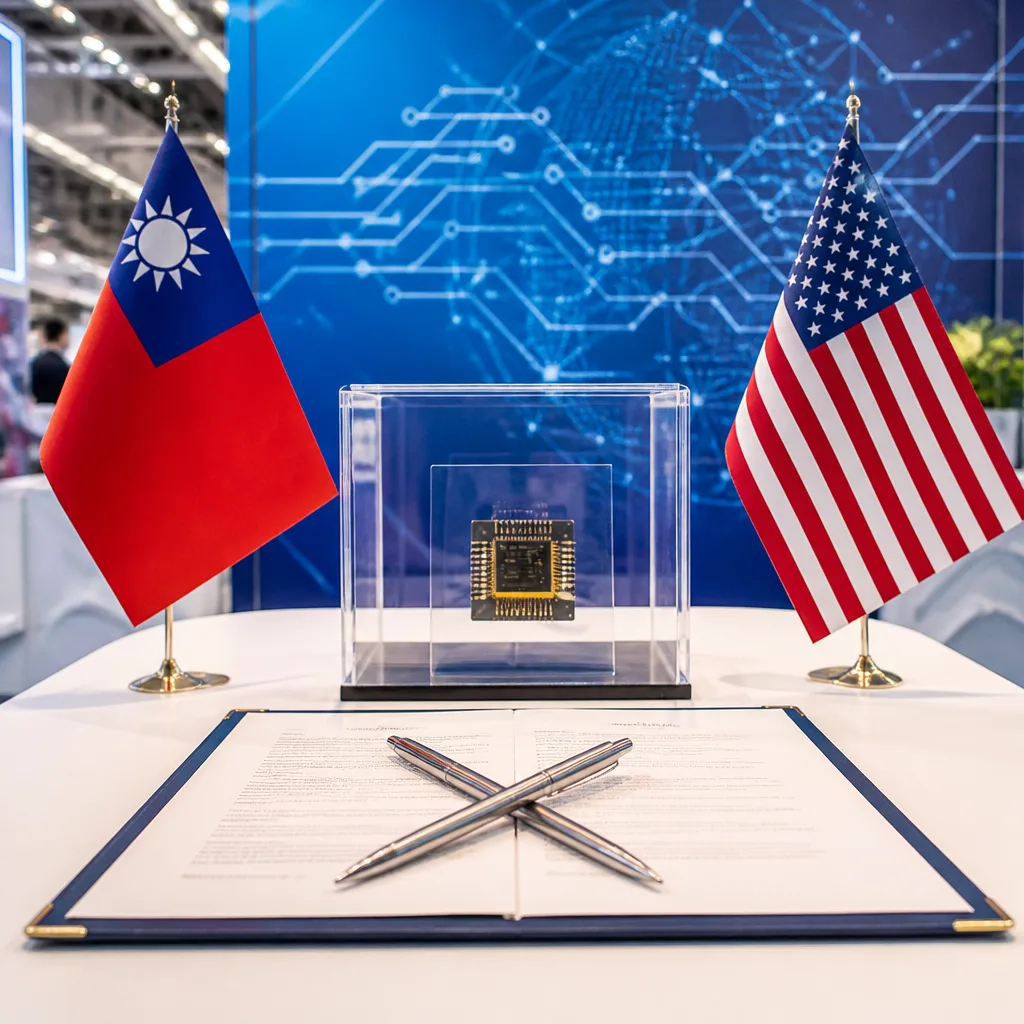
SEEQC, a US‑based developer of chip‑scale quantum computing technology, has signed a Memorandum of Understanding (MOU) with Taiwan’s Quantum Industry Technology Promotion Office to broaden co‑operation across quantum technology and the emerging global quantum supply chain.
The agreement, announced on 2 September via Business Wire, was signed by SEEQC’s Chief Technology Officer, Dr Shu‑Jen Han, during SEMICON Taiwan 2026. It creates a framework for engagement between the company and Taiwan’s research and industrial community on a range of activities spanning development, manufacturing and commercialisation.
What the MOU covers
The MOU sets out potential areas for collaboration without committing either side to specific projects or financing. According to SEEQC’s press release, the parties will explore co‑operation in:
- technology and product development,
- manufacturing,
- testing and validation,
- commercialisation, and
- supply‑chain development.
It also notes the MOU could facilitate introductions between SEEQC and Taiwanese companies, academic institutions and technology providers to support technical exchange and joint development.
"Taiwan has an extraordinary concentration of semiconductor, electronics and manufacturing expertise that can play an important role in the development of a scalable global quantum industry," said Shu‑Jen Han, Chief Technology Officer of SEEQC.
Why Taiwan matters to quantum firms
Taiwan hosts a dense cluster of semiconductor and electronics capabilities, from chip fabrication to advanced packaging and component supply. SEEQC’s announcement says the MOU builds on existing relationships it has in Taiwan around room‑temperature electronics, superconducting chip manufacturing and CMOS interface development, and aims to marry that industrial base with the company’s US‑developed quantum technology.
For quantum hardware companies, access to mature semiconductor manufacturing and test facilities is a practical necessity if they want to scale. The MOU is therefore as much about supply‑chain resilience and testing regimes as it is about intellectual collaboration.
What it does — and does not — commit
The press release describes the MOU as a framework to explore collaboration, not as a detailed contract that funds projects or guarantees production. There are no timelines, financial terms or specific joint projects disclosed in the announcement. The signatory was SEEQC’s CTO and the context was SEMICON Taiwan 2026, a trade event that brings together foundries, equipment suppliers and technology firms.
That form — a non‑binding MOU announced at an industry fair — is a common early step in international technology co‑operation. It signals intent and opens channels for technical teams and business development work, but leaves substantive commitments to subsequent agreements.
| Element | Role in MOU |
|---|---|
| Technology development | Exploration of joint R&D and product roadmaps |
| Manufacturing & testing | Access to Taiwanese manufacturing expertise and validation capabilities |
| Commercialisation | Potential commercial collaboration and market access |
| Supply‑chain development | Facilitating partnerships across suppliers and research institutes |
For national technology watchers, the announcement is notable because it shows a US quantum company explicitly seeking tighter integration with an Asian semiconductor hub. That reflects a wider industry pattern: quantum hardware developers are increasingly reliant on classical semiconductor manufacturing chains to produce control electronics, cryogenic interconnects and superconducting devices at scale.
The MOU also highlights the role trade shows and national industrial promotion bodies play in forging cross‑border deals. Whether this framework translates into concrete manufacturing agreements, joint test facilities or supply‑chain contracts will depend on the follow‑up work outlined in the MOU and any subsequent commercial negotiations.
For now, the SEEQC announcement is a signalling move: it indicates the company is pursuing a strategy of combining its US technology with Taiwan’s industrial strengths, and it underscores the multinational nature of the efforts to build a scalable quantum industry.









