
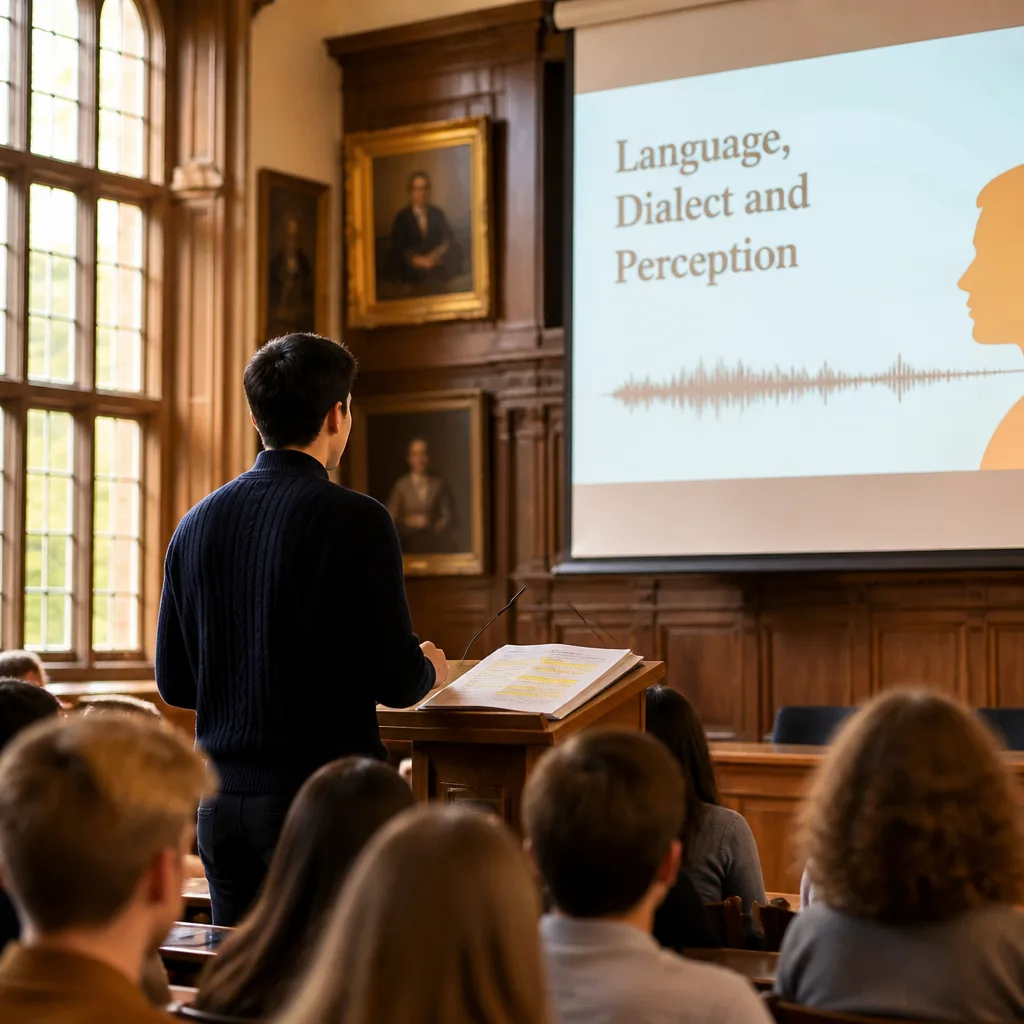
A Brigham Young University senior was the lone undergraduate selected to present at the Oxford Education Research Symposium after adapting a classroom essay into an extended research project examining how dialect and linguistic prejudice shape perceptions of race and intelligence.
Research drawn from classroom work and study abroad
The student’s essay — originally written for a module on Mark Twain — became her English capstone and was developed into a paper titled “White Ears Fix Black Lives in Place: Dialect as Power, Identity and a Barrier in James, Pudd’nhead Wilson and The Lynching of Jube Benson.” Her research focuses on African American Vernacular English (AAVE) and the ways Black speakers can be stigmatised and generalised as less intelligent because of how they speak.
“Race is something that we generally see as a visual construct, but there’s also something audible about it, right? Linguistic prejudice is very much an issue in today’s world,” she told organisers, emphasising that accents and dialects continue to shape identity and social judgement.
“These texts speak directly to our world today. People are still judged by how they speak, through accents, dialects and linguistic bias, showing that sound continues to shape identity in powerful ways.”
From London study programme to international presentations
The presenter said the opportunity to take her work to Oxford stemmed in part from a summer study abroad in London the previous year. That seven-week programme, hosted at the BYU London Centre, explored sacred spaces in literature and history and was led by two co-directors who described a competitive selection process.
One co-director said many strong applicants were turned away and that the cohort represented the “cream of the crop,” with the student among those singled out. The study abroad placement provided both the impetus and the context that helped the undergraduate broaden and refine her research.
She is also taking part in a multi-university collaboration known as the Quill Project, which examines constitutional meanings across institutions. Organisers confirmed she will present another piece of research in November in Washington, D.C.
Classroom to conference — implications for teacher education
The trajectory from a class assignment to an international research forum illustrates how undergraduate teaching, capstone projects and overseas study can combine to produce scholarship that engages with contemporary social problems.
- Source work: initial paper written for a Mark Twain course.
- Capstone: essay expanded into an English senior capstone project.
- Symposium: selected as the only undergraduate presenter at Oxford.
- Ongoing work: participation in the Quill Project and upcoming presentation in Washington, D.C.
The case underscores how literary study can intersect with social science questions — here, linking canonical texts to contemporary debates about linguistic prejudice, identity and structural racism. It also reflects on the value of study-abroad experiences in giving students exposure to scholarly networks and presentation opportunities.
| Activity | Detail |
|---|---|
| Original assignment | Mark Twain class essay |
| Capstone | English senior project adapting the essay |
| Symposium | Oxford Education Research Symposium — sole undergraduate presenter |
| Future presentation | November event in Washington, D.C. |
For teachers and university departments, the student’s experience offers a concrete instance of how curricular assignments can be scaffolded into research outputs and public dissemination. It also prompts reflection on how literature courses can be used to explore contemporary issues of race and communication, helping pupils and students to recognise the social consequences of linguistic bias.
The student’s research adds to ongoing conversations in education about how language, identity and prejudice are taught and discussed in classrooms and academic fora.











