
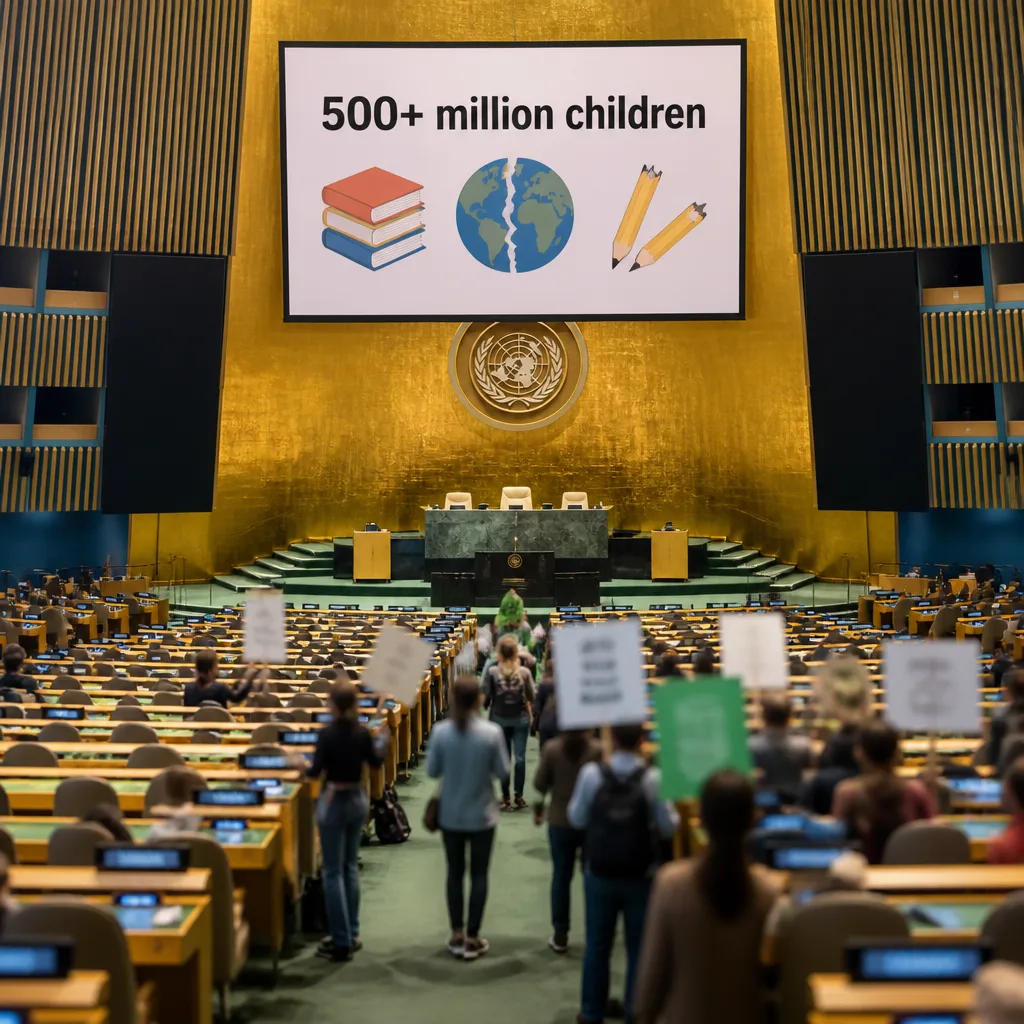
At gatherings around this week’s United Nations leaders’ meeting, campaigners and officials warned that more than 500 million children worldwide are in urgent need of education support, as conflict and climate shocks strip away access and quality.
Numbers paint stark picture
Speakers drew attention to two overlapping groups of children in particular: those who are not enrolled in school and those who are in classrooms but are not mastering basic literacy and numeracy by the age of 11.
| Category | Children affected |
|---|---|
| Not in school | 273 million |
| In school but not learning basic skills by age 11 | 270 million |
Those figures were cited by Gordon Brown, the former British prime minister who now serves as the UN special envoy for global education, and were used to underline the scale of the challenge facing efforts to deliver universal, quality education by 2030.
Voices from crisis zones
Humanitarian and education advocates used visits to conflict-affected areas to bring the statistics to life. One account from a war-affected classroom in Sudan described a teacher managing a class of about 120 children in extreme heat, with no water or electricity, and many more children left outside because the school could not accommodate them.
“She pleaded with me to make sure that her siblings and her cousins and her orphan friends are also able to attend school,”
That testimony was recounted by the director of Education Can't Wait, who said pupils asked visitors to press for the building of more schools — a plea echoed in discussions at the UN.
Causes and commitments
Speakers at the UN summit pointed to conflict and climate change as major obstacles that push children out of education or undermine learning. Brown warned that the world is falling short of promises made under the 2015 sustainable development goals to ensure quality education for every child.
He reminded countries of their commitments, saying it was important both to nudge governments to allocate the portion of national budgets pledged for education and to press donor nations to uphold their international assistance pledges. Brown warned that the current trajectory leaves the world some distance from delivering on the 2030 target for education.
Funding and practical steps
Delegates and campaign groups used the sideline events at the UN to appeal for expanded funding for education in emergencies and for investment in school capacity in fragile settings. The testimonies and statistics were deployed to argue that meeting international promises will require both increased finance and practical measures — from building more classrooms to supporting teachers operating under devastating conditions.
- Advocates called for more funding to expand school capacity in conflict and climate-affected regions.
- Officials urged richer nations to honour international aid commitments and for governments to dedicate more of their budgets to education.
- Campaigners emphasised the need for both access and learning outcomes to be prioritised together.
The debate at the UN highlighted a familiar tension in education policy: enrolling children is only the first step if learning is not secured. The combined totals cited by Brown — 273 million out of school and around 270 million in school but not attaining basic skills — were used to support calls for a renewed global push to deliver both access and quality.
As world leaders meet to discuss security, climate and development, education campaigners hope the urgency conveyed by classrooms in Sudan and elsewhere will translate into concrete financial pledges and policy changes. Without them, the warnings issued at the UN suggest that hundreds of millions of children's futures will remain at risk, with long-term consequences for societies and economies worldwide.











