
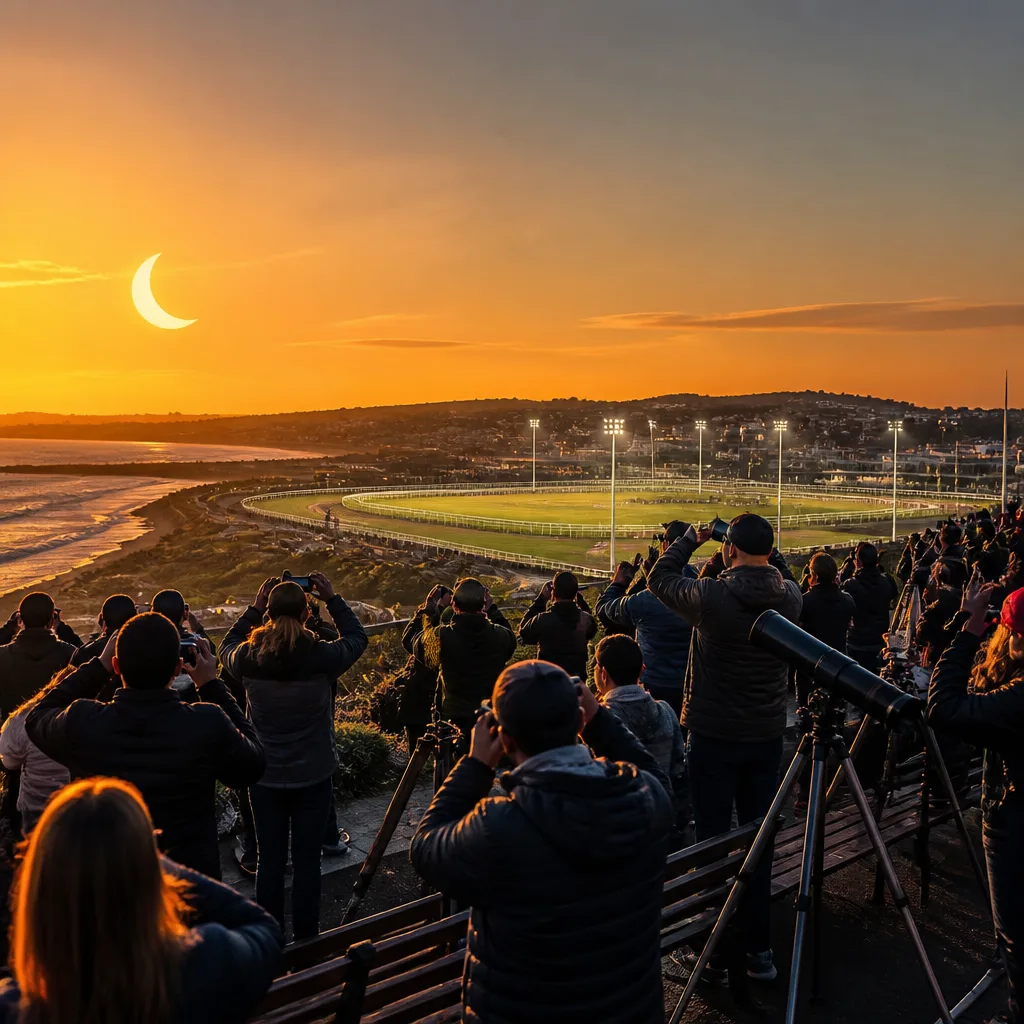
Millions across the UK will see a partial solar eclipse tonight as the Moon passes between the Earth and the Sun, while parts of mainland Europe will witness complete totality. The event has already prompted changes to sporting timetables and prompted astronomy clubs to stage coastal viewing gatherings.
Disruption to racing and cricket schedules
Racing fixtures and summer cricket matches have been adjusted to take account of the reduced daylight that will occur during the eclipse. The British Horseracing Authority has moved the first race at Ffos Las in South Wales from an original 17:40 BST start to 15:35 BST. Kempton racecourse, which had evening races scheduled for 19:00 and 19:30, said those meetings would not be affected because they are run under floodlights.
At cricket venues staging several Hundred matches, organisers have said floodlights will be switched on throughout play to maintain consistent conditions for players and spectators.
- Ffos Las — first race rescheduled from 17:40 BST to 15:35 BST.
- Kempton — evening races unchanged; already under floodlights.
- Hundred cricket matches — floodlights to remain on throughout games.
Public viewing and safety
In Cornwall, stargazers from the Kernow Astronomers group are hosting a coastal public view of the eclipse. Members of the club are preparing telescopes and guidance for attendees about how to observe the event safely. Astronomers emphasise that a solar eclipse progresses slowly from the perspective of an observer on the ground.
"The description I would use is that it progresses about the same speed as the minute hand goes around, so it's not something that is instantaneous, especially here,"
The quoted remark was made by Frank Johns, a member of Kernow Astronomers, speaking to BBC Radio 5 Live. Observers are being reminded not to look directly at the Sun without approved eye protection at any point when the photosphere remains visible; improperly viewed eclipses risk serious eye damage.
Types of eclipse and what to expect
Scientists distinguish between different eclipse phenomena depending on the alignment and apparent sizes of the Sun and Moon:
- Partial eclipse — the Moon covers only part of the Sun; the UK will see this tonight.
- Total eclipse — the Moon completely obscures the Sun, briefly turning day into near-night; parts of Europe will experience this.
- Annular eclipse — the Moon is too distant to cover the Sun entirely, leaving a bright ring or "ring of fire" around the Moon.
Where totality occurs, observers can momentarily remove specialised eye protection during the brief period when the Sun is wholly covered, but such guidance applies only in the narrow path of totality on the European continent, not across the UK.
| Location | UK Impact |
|---|---|
| Ffos Las | Racing moved to 15:35 BST |
| Kempton | No change; races under floodlights |
| Cornwall (Kernow Astronomers) | Public coastal viewing event |
Context and consequences
While the UK will not experience totality, the event is still significant for public safety and for the scheduling of evening outdoor events. The last time a major eclipse affected the UK was in 1999, when matches and other activities were disrupted; officials and event organisers are drawing on that experience to minimise disruption and to protect attendees.
Organisers across sport and public events have taken a precautionary approach — advancing or confirming earlier start times and ensuring floodlighting where available — to maintain safety and playing conditions. Astronomy societies are using the opportunity to engage the public in science, while emphasizing the importance of safe viewing equipment.
Authorities and clubs are expected to issue further local guidance for spectators and participants as the event unfolds this evening.















